

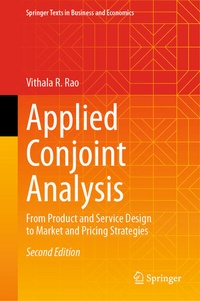
Applied Conjoint Analysis
Description

This book provides different applications and methods of conjoint analysis in marketing. It gives an introduction into the basic ideas of conjoint analysis and describes the steps involved in designing a ratings-based conjoint study. This new revised second edition offers newer methods for estimating utility functions for products with multiple attributes such as Best-Worst Scaling, incorporating non-compensatory aspects, and auction methods. It features new chapters on advanced methods of analysis (e.g., machine-learning based and others) and conjoint analysis with other types of data such as eye tracking, visual design evaluations, search data and GPT, among others. While the focus of the book is on methods in marketing, these methods are also applicable for other business and social sciences.
This book is useful to academics, researchers, and scholars applied marketing science. This book is also suitable as a textbook for quantitative marketing coursework.
More details
Other editions
Additional editions
Person
Vithala R. Rao is the Deane Malott Professor Emeritus of Management and Professor Emeritus of Marketing and Quantitative Methods at the Samuel Curtis Johnson Graduate School of Management, SC Johnson College of Business, Cornell University (Ithica, NY, USA). He has published over 150 papers on several topics including conjoint analysis and multidimensional scaling, pricing, bundle design, brand equity, market structure, corporate acquisition, and linking brand strategies to financial performance. He has also published several books including Applied Conjoint Analysis (Springer, 2014) and Advanced Introduction to Pricing Strategy and Analytics (Edward Elgar Publishing, 2023). Dr. Rao serves as a Senior Editor on the editorial board of Customer Needs and Solutions and was awarded the 2017 Churchill Award by the American Marketing Association's Marketing Research Specialist Interest Group for his lifetime contributions in marketing research.
Content
Chapter 1 Introduction.- Chapter 2 Relevant Consumer Behavior Paradigms.- Chapter 3 Theory Design of Ratings-Based Conjoint Studies.- Chapter 4 Analysis and Utilization of Ratings-Based Conjoint Data.- Chapter 5 Choice Based Conjoint Studies: Design and Analysis.- Chapter 6 Methods for a Large Number of Attributes.- Chapter 7 Advance Methods of Analysis (Machine-Learning and other).- Chapter 8 Non-compensatory Models for Conjoint Analysis.- Chapter 9Applications for Products and Service Design and Market Segmentation.- Chapter 10 Applications for Product Positioning and Market Segmentation.- Chapter 11 Applications for Pricing Decisions.- Chapter 12 Applications to a Miscellany of Marketing Problems.- Chapter 13 Conjoint Analysis with Other Types of Data.- Chapter 14 Recent Developments and Future Outlook.- Chapter15An Interdisciplinary Review of Research in Conjoint Analysis:Recent Developments and Directions for Future Research.- Chapter16 Sawtooth Software's Influence on the Conjoint Analysis Industry.
