

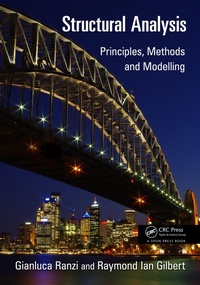
Structural Analysis
Principles, Methods and Modelling
1st Edition
Published on 8. October 2018
576 pages
978-1-4822-2354-5 (ISBN)
Description

Provides Step-by-Step Instruction
Structural Analysis: Principles, Methods and Modelling
outlines the fundamentals involved in analyzing engineering structures, and effectively presents the derivations used for analytical and numerical formulations. This text explains practical and relevant concepts, and lays down the foundation for a solid mathematical background that incorporates MATLAB (R) (no prior knowledge of MATLAB is necessary), and includes numerous worked examples.
Effectively Analyze Engineering Structures
Divided into four parts, the text focuses on the analysis of statically determinate structures. It evaluates basic concepts and procedures, examines the classical methods for the analysis of statically indeterminate structures, and explores the stiffness method of analysis that reinforces most computer applications and commercially available structural analysis software. In addition, it covers advanced topics that include the finite element method, structural stability, and problems involving material nonlinearity.
MATLAB (R) files for selected worked examples are available from the book's website. Resources available from CRC Press for lecturers adopting the book include:
A solutions manual for all the problems posed in the book
Nearly 2000 PowerPoint presentations suitable for use in lectures for each chapter in the book
Revision videos of selected lectures with added narration
Figure slides
Structural Analysis: Principles, Methods and Modelling
exposes civil and structural engineering undergraduates to the essentials of structural analysis, and serves as a resource for students and practicing professionals in solving a range of engineering problems.
Structural Analysis: Principles, Methods and Modelling
outlines the fundamentals involved in analyzing engineering structures, and effectively presents the derivations used for analytical and numerical formulations. This text explains practical and relevant concepts, and lays down the foundation for a solid mathematical background that incorporates MATLAB (R) (no prior knowledge of MATLAB is necessary), and includes numerous worked examples.
Effectively Analyze Engineering Structures
Divided into four parts, the text focuses on the analysis of statically determinate structures. It evaluates basic concepts and procedures, examines the classical methods for the analysis of statically indeterminate structures, and explores the stiffness method of analysis that reinforces most computer applications and commercially available structural analysis software. In addition, it covers advanced topics that include the finite element method, structural stability, and problems involving material nonlinearity.
MATLAB (R) files for selected worked examples are available from the book's website. Resources available from CRC Press for lecturers adopting the book include:
A solutions manual for all the problems posed in the book
Nearly 2000 PowerPoint presentations suitable for use in lectures for each chapter in the book
Revision videos of selected lectures with added narration
Figure slides
Structural Analysis: Principles, Methods and Modelling
exposes civil and structural engineering undergraduates to the essentials of structural analysis, and serves as a resource for students and practicing professionals in solving a range of engineering problems.
Reviews / Votes
"This book gives a good in-depth explanation of the fundamental principles of structural analysis. Topics are dealt with in considerable detail and illustrated with copious examples."--Dr Robert Vollum, Department of Civil & Environmental Engineering Imperial College London, United Kingdom
"... explains very well and in simple terms topics which are often perceived by young students to be complicated and confusing, without sacrificing the formal mathematical treatment of the subject. ... will also serve as a reference for all those practitioners who would like to revisit or gain deeper insight into the theoretical basis of the main calculation methods nowadays adopted for the design of structures."
-Massimiliano Bocciarelli, Politecnico di Milano
"... presents in a comprehensive way topics of structural analysis that are basic for civil and building engineers. The authors bring students toward a deep understanding of difficult issues in a very "natural" way. Final chapters, which introduce advanced analysis tools as the finite element method and issues like stability and plasticity of structures, give a clear perception of the behaviour complexity of a real structure. MATLAB tools allow facilitating and multiplying the experiences necessary to develop an intuitive approach to the structural design."
-Graziano Leoni, University of Camerino, Italy
More details
Edition
1. Auflage
Language
English
Place of publication
London
United Kingdom
Publishing group
Taylor & Francis Ltd
Target group
College/higher education
Undergraduate students in civil and structural engineering.
Illustrations
665 s/w Abbildungen, 52 s/w Tabellen
52 Tables, black and white; 665 Illustrations, black and white
File size
54,14 MB
ISBN-13
978-1-4822-2354-5 (9781482223545)
Copyright in bibliographic data and cover images is held by Nielsen Book Services Limited or by the publishers or by their respective licensors: all rights reserved.
Schweitzer Classification
Other editions
New editions
Amin Ghali | A.M. Neville
Structural Analysis
A Unified Classical and Matrix Approach, Seventh Edition
E-Book
09/2017
7th Edition
CRC Press
€96.49
Available for download
Additional editions
Book
08/2014
1st Edition
CRC Press
€158.95
The article will not be published
Book
07/2014
1st Edition
CRC Press
€131.70
Shipment within 15-20 days
Persons
Gianluca Ranzi is an associate professor and the director of the Centre for Advanced Structural Engineering at the University of Sydney, specializing in the analysis and design of concrete and composite steel-concrete structures.
Raymond Ian Gilbert
is an emeritus professor at the University of New South Wales. He has over 35 years' experience in teaching structural analysis and design and is a specialist in the analysis and design of reinforced and prestressed concrete structures..
Raymond Ian Gilbert
is an emeritus professor at the University of New South Wales. He has over 35 years' experience in teaching structural analysis and design and is a specialist in the analysis and design of reinforced and prestressed concrete structures..
Content
Introduction. Statics of structures: Equilibrium and support reactions. Internal actions of beams and frames. Statically determinate trusses. Euler-Bernoulli beam model. Slope-deflection methods. Work-energy methods. The force method. Moment distribution. Truss analysis using the stiffness method. Beam analysis using the stiffness method. Frame analysis using the stiffness method. Introduction to the finite element method. Introduction to the structural stability of columns. Introduction to nonlinear analysis. Introduction. Appendices. Index.
