

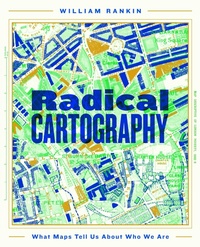
Radical Cartography
What Maps Tell Us About Who We Are
Published on 13. November 2025
240 pages
978-1-5098-8883-2 (ISBN)
Description

- How can the colours of a map reinforce our biases?
- What does a postcolonial map of the world look like?
- How do indigenous communities use maps to argue for self-determination?
A stunning, thought-provoking exploration of how maps shape our understanding of the world - featuring over 150 beautiful full-colour maps.
'This striking study . . . lavishly illustrated . . . stuns' - Publishers Weekly
'A true genius of cartography . . . Radical Cartography will make you see maps, and, indeed, your place on the planet, with fresh eyes' - Daniel Immerwahr, author of How to Hide an Empire
Maps are everywhere. They can change how cities are designed and how rivers flow, how wars are fought and how land claims are settled, how children learn about race and how colonialism becomes a habit of mind. Maps don't just show us information - they help construct our world.
Cartographer and historian William Rankin argues that it's time to reimagine what a map can be and how it can be used. Maps are not neutral. They are innately political, defining how the world is divided, what becomes visible and what stays hidden, and whose voices are heard.
Brimming with vibrant, radical maps created by Rankin and by other cutting-edge mapmakers, Radical Cartography challenges the map as a tool of the status quo. Changing our maps can change the questions we ask, the answers we accept - and the planet we build.
- What does a postcolonial map of the world look like?
- How do indigenous communities use maps to argue for self-determination?
A stunning, thought-provoking exploration of how maps shape our understanding of the world - featuring over 150 beautiful full-colour maps.
'This striking study . . . lavishly illustrated . . . stuns' - Publishers Weekly
'A true genius of cartography . . . Radical Cartography will make you see maps, and, indeed, your place on the planet, with fresh eyes' - Daniel Immerwahr, author of How to Hide an Empire
Maps are everywhere. They can change how cities are designed and how rivers flow, how wars are fought and how land claims are settled, how children learn about race and how colonialism becomes a habit of mind. Maps don't just show us information - they help construct our world.
Cartographer and historian William Rankin argues that it's time to reimagine what a map can be and how it can be used. Maps are not neutral. They are innately political, defining how the world is divided, what becomes visible and what stays hidden, and whose voices are heard.
Brimming with vibrant, radical maps created by Rankin and by other cutting-edge mapmakers, Radical Cartography challenges the map as a tool of the status quo. Changing our maps can change the questions we ask, the answers we accept - and the planet we build.
Reviews / Votes
This striking study . . . lavishly illustrated . . . stuns * Publishers Weekly * Edifying . . . An in-depth, revisionist plunge into the extraordinary world of maps * Kirkus Reviews * This is it: the full download from a true genius of cartography. Radical Cartography will make you see maps and, indeed, your place on the planet, with fresh eyes -- Daniel Immerwahr, author of <i>How to Hide an Empire</i> A fearless, fascinating examination of how maps shape our worldview. This revolutionary text . . . is essential reading for anyone who's ever taken a map at face value -- Gareth Cook, Pulitzer Prize-winning journalist and former series editor of <i>Best American Infographics</i> A significant addition to the literature on cartography . . . Readable and engaging -- Johanna Drucker, author of <i>Inventing the Alphabet</i> In Radical Cartography . . . we see mapmaking in all its complexity: messy, necessary, and full of promise -- Susan Schulten, author of <i>A History of America in 100 Maps</i> A groundbreaking and fascinating work that shatters our cartographic illusions about the world . . . Vividly illustrated and elegantly written -- Paul Richardson, author of <i>Myths of Geography</i> As rigorous as it is accessible, Radical Cartography offers a brilliant and imaginative approach to 'mapping differently.' In this landmark achievement, William Rankin establishes that mapping can be urgent and compelling -- Michael Ralph, author of <i>Forensics of Capital</i> Since the turn of this computer-generated century, William Rankin has been jolting cartographers out of ruts, inviting them to question defaults and see the world anew. In this essential volume, he gave me a good shake once more -- Oliver Uberti, coauthor and designer of <i>Atlas of the Invisible</i> An impressive guide to how maps can make a difference in how we see the world, Rankin's book will appeal to professional and armchair cartographers alike -- Professor James Cheshire, author of <i>The Library of Lost Maps</i> A must-read for anyone looking at a map occasionally! . . . an important plea for more empathy in cartography -- Sandra Rendgen, author of <i>Information Graphics</i>More details
Language
English
Place of publication
London
United Kingdom
Publishing group
Pan Macmillan
Target group
Interest Age: From 18 years
File size
87,45 MB
ISBN-13
978-1-5098-8883-2 (9781509888832)
Copyright in bibliographic data and cover images is held by Nielsen Book Services Limited or by the publishers or by their respective licensors: all rights reserved.
Schweitzer Classification
Other editions
Additional editions
Book
11/2025
Picador
€37.50
Available immediately
Person
William Rankin is a historian of science at Yale University, where he specializes in the history of mapping and the geographic sciences. Born and raised outside Chicago, he originally trained as an architect before receiving a dual PhD in the history of science and architecture from Harvard. In addition to his work as a historian, he is also an award-winning cartographer, and his maps have appeared in numerous books, magazines, and exhibits around the world. His work has been published in The Washington Post, Le Monde, The Economist, The Atlantic, Foreign Policy, Slate and Vox. Radical Cartography is his first book aimed at a general readership.
