

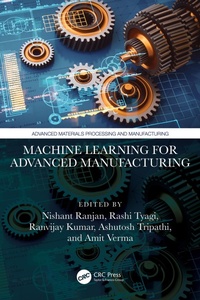
Machine Learning for Advanced Manufacturing
Published on 28. November 2025
206 pages
978-1-040-53065-8 (ISBN)
Description

This book presents the use of machine learning (ML) and artificial intelligence in advanced and new manufacturing processes, including core concepts and techniques of machine learning. It covers recent developments and research breakthroughs of tribological properties of polymer-, metal-, and ceramic-based additive manufactured components. It details the various technologies available to fortify the machine learning aspects in the advanced manufacturing processes, focusing on multidisciplinary domains of science and technology.
Features:
Establishes a relationship between ML and advanced manufacturing (AM) technology.
Helps understand the challenges and opportunities of using ML in materials processing, selection, and manufacturing for different areas.
Reviews the hybridization of techniques under ML for prediction and optimization for quality, productivity, and sustainability in manufacturing.
Provides a comprehensive overview of the state-of-the-art, future directions, latest developments, and recent developments in ML for AM.
Covers the basics of ML with implementation procedure and effectiveness
details to provide a roadmap.
This book is aimed at researchers and graduate students in mechanical, manufacturing, and industrial engineering.
Features:
Establishes a relationship between ML and advanced manufacturing (AM) technology.
Helps understand the challenges and opportunities of using ML in materials processing, selection, and manufacturing for different areas.
Reviews the hybridization of techniques under ML for prediction and optimization for quality, productivity, and sustainability in manufacturing.
Provides a comprehensive overview of the state-of-the-art, future directions, latest developments, and recent developments in ML for AM.
Covers the basics of ML with implementation procedure and effectiveness
details to provide a roadmap.
This book is aimed at researchers and graduate students in mechanical, manufacturing, and industrial engineering.
More details
Series
Language
English
Place of publication
London
United Kingdom
Publishing group
Taylor & Francis Ltd
Target group
College/higher education
Professional and scholarly
Illustrations
13 Tables, black and white; 60 Line drawings, black and white; 18 Halftones, black and white; 78 Illustrations, black and white
File size
15,90 MB
ISBN-13
978-1-040-53065-8 (9781040530658)
Copyright in bibliographic data and cover images is held by Nielsen Book Services Limited or by the publishers or by their respective licensors: all rights reserved.
Schweitzer Classification
Other editions
Additional editions
Nishant Ranjan | Rashi Tyagi | Ranvijay Kumar
Machine Learning for Advanced Manufacturing
Book
11/2025
1st Edition
CRC Press
€166.60
Shipment within 10-20 days
Persons
Nishant Ranjan is working as Assistant Professor at University Centre for Research and Development of Chandigarh University. He has won CII MILCA AWARD in the field of Additive Manufacturing in 2022. He has completed his PhD in Mechanical engineering from Punjabi University, Patiala, India. Fused deposition-modelling, extrusion, thermoplastic polymers, composition of thermoplastic polymers, natural and synthetic biopolymers, scaffolds printing, 3D printing technology, thermal, mechanical, morphological, and chemical properties of thermoplastic polymers, biocompatible and biodegradable fillers, reinforcement of materials are the main focus area of Nishant Ranjan.
Rashi Tyagi is currently working as an Assistant Professor in University centre for Research and Development at Chandigarh University. Dr. Tyagi has won CII MILCA AWARD in the field of electrical discharge coating in 2022. Dr. Tyagi has completed his PhD in Mechanical engineering from Indian Institute of Technology (Indian school of mines), Dhanbad, India. Her PhD work was focused on the surface modification by electrical discharge process for solid lubrication and enhanced tribological performance.
Ranvijay Kumar is an assistant professor in University Centre for Research and Development, Chandigarh University. He has received PhD in Mechanical Engineering from Punjabi University, Patiala. Additive manufacturing, shape memory polymers, smart materials, friction-based welding techniques, advance materials processing, polymer matrix composite preparations, reinforced polymer composites for 3D printing, plastic solid waste management, thermosetting recycling and destructive testing of materials are the skills of Kumar.
Ashutosh Tripathi is currently working as an Assistant Professor in University centre for Research and Development at Chandigarh University. He has worked in the field of composite preparation and simulation in 2022. He has completed his PhD in Mechanical engineering from Indian Institute of Technology (Indian school of mines), Dhanbad, India. His research work was focused on the acoustics properties of composite and its analytical prediction. He has completed his M.tech from IIT(ISM), Dhanbad, India.
Amit Verma is an accomplished Associate Professor at the School of Computer Science & Engineering (CSE) and the University Research Department at Bahra University. With over 12 years of academic experience, He has made significant contributions to the field of Artificial Intelligence (AI), particularly focusing on its applications in agriculture. His current research revolves around the detection of plant leaf diseases using advanced image processing and deep learning techniques.
Rashi Tyagi is currently working as an Assistant Professor in University centre for Research and Development at Chandigarh University. Dr. Tyagi has won CII MILCA AWARD in the field of electrical discharge coating in 2022. Dr. Tyagi has completed his PhD in Mechanical engineering from Indian Institute of Technology (Indian school of mines), Dhanbad, India. Her PhD work was focused on the surface modification by electrical discharge process for solid lubrication and enhanced tribological performance.
Ranvijay Kumar is an assistant professor in University Centre for Research and Development, Chandigarh University. He has received PhD in Mechanical Engineering from Punjabi University, Patiala. Additive manufacturing, shape memory polymers, smart materials, friction-based welding techniques, advance materials processing, polymer matrix composite preparations, reinforced polymer composites for 3D printing, plastic solid waste management, thermosetting recycling and destructive testing of materials are the skills of Kumar.
Ashutosh Tripathi is currently working as an Assistant Professor in University centre for Research and Development at Chandigarh University. He has worked in the field of composite preparation and simulation in 2022. He has completed his PhD in Mechanical engineering from Indian Institute of Technology (Indian school of mines), Dhanbad, India. His research work was focused on the acoustics properties of composite and its analytical prediction. He has completed his M.tech from IIT(ISM), Dhanbad, India.
Amit Verma is an accomplished Associate Professor at the School of Computer Science & Engineering (CSE) and the University Research Department at Bahra University. With over 12 years of academic experience, He has made significant contributions to the field of Artificial Intelligence (AI), particularly focusing on its applications in agriculture. His current research revolves around the detection of plant leaf diseases using advanced image processing and deep learning techniques.
Content
ContentsPreface......................................................................................................................vii
Editors.................................................................................................................... viii
Contributors..............................................................................................................xi
Acknowledgments...................................................................................................xiv
Chapter 1 Introduction to Machine Learning in Advanced Manufacturing.........1
Nishant Ranjan, Vinay Kumar, and Shivani
Chapter 2 Overview of Different Machine Learning Techniques and
Algorithms for Data Acquisition and Pre-processing in
Advanced Manufacturing................................................................... 17
Amit Vajpayee, Abhineet Anand, Ankit Sharma, Palakpreet
Kaur, Jaspreet Singh, and Amit Verma
Chapter 3 Recent Advancement of Machine Learning in Machining/
Joining/Forming Processes................................................................38
Tanmay Tiwari, Aswani Kumar Singh, Chandra Sekhar
Rakurty, Rashi Tyagi, and Gopal Nadkarni
Chapter 4 Machine Learning for Product Design and Customization in
Advanced Manufacturing Practices...................................................63
Vinay Kumar and Nishant Ranjan
Chapter 5 Machine Learning in Additive Manufacturing..................................77
Rajnish Prakash Modanwal, Aswani Kumar Singh, R. Durga
Prasad Reddy, Bhavesh Chaudhary, Varun Sharma, Rashi
Tyagi, Dan Sathiaraj, and Jayaprakash Murugesan
Chapter 6 Application of Machine Learning Beyond Manufacturing................94
Abhishek Bhattacharjee, Ajay Kumar Badhan, Raman Kumar,
Harpreet Kaur Channi, Rajender Kumar, and
Kulwinder Singh Mann
Chapter 7 Real-Time Monitoring and Control Using Machine Learning in
Industry ............................................................................................ 114
Harpreet Kaur Channi, Raman Kumar, Swapandeep Kaur,
Sehijpal Singh, Abhishek Bhattacharjee, and Rajender Kumar
Chapter 8 Emerging Applications of Machine Learning in the
Manufacturing Sector....................................................................... 139
Suraj Ghising, Ashish Pal Singh, Rashi Tyagi,
and Sujoy Kumar Dey
Chapter 9 Prediction of Drilling Process Parameters While Machining
Arhar Composite Using Random Forest Machine Learning
Algorithm......................................................................................... 153
Binduprathyusha Kodali and Aruna Kotlapati
Chapter 10 Beyond Manufacturing: The Expansion of Machine Learning
Applications...................................................................................... 175
Jaspreet Singh, Anshu Mehta, and Amit Verma
Index ...................................................................................................................... 187
Editors.................................................................................................................... viii
Contributors..............................................................................................................xi
Acknowledgments...................................................................................................xiv
Chapter 1 Introduction to Machine Learning in Advanced Manufacturing.........1
Nishant Ranjan, Vinay Kumar, and Shivani
Chapter 2 Overview of Different Machine Learning Techniques and
Algorithms for Data Acquisition and Pre-processing in
Advanced Manufacturing................................................................... 17
Amit Vajpayee, Abhineet Anand, Ankit Sharma, Palakpreet
Kaur, Jaspreet Singh, and Amit Verma
Chapter 3 Recent Advancement of Machine Learning in Machining/
Joining/Forming Processes................................................................38
Tanmay Tiwari, Aswani Kumar Singh, Chandra Sekhar
Rakurty, Rashi Tyagi, and Gopal Nadkarni
Chapter 4 Machine Learning for Product Design and Customization in
Advanced Manufacturing Practices...................................................63
Vinay Kumar and Nishant Ranjan
Chapter 5 Machine Learning in Additive Manufacturing..................................77
Rajnish Prakash Modanwal, Aswani Kumar Singh, R. Durga
Prasad Reddy, Bhavesh Chaudhary, Varun Sharma, Rashi
Tyagi, Dan Sathiaraj, and Jayaprakash Murugesan
Chapter 6 Application of Machine Learning Beyond Manufacturing................94
Abhishek Bhattacharjee, Ajay Kumar Badhan, Raman Kumar,
Harpreet Kaur Channi, Rajender Kumar, and
Kulwinder Singh Mann
Chapter 7 Real-Time Monitoring and Control Using Machine Learning in
Industry ............................................................................................ 114
Harpreet Kaur Channi, Raman Kumar, Swapandeep Kaur,
Sehijpal Singh, Abhishek Bhattacharjee, and Rajender Kumar
Chapter 8 Emerging Applications of Machine Learning in the
Manufacturing Sector....................................................................... 139
Suraj Ghising, Ashish Pal Singh, Rashi Tyagi,
and Sujoy Kumar Dey
Chapter 9 Prediction of Drilling Process Parameters While Machining
Arhar Composite Using Random Forest Machine Learning
Algorithm......................................................................................... 153
Binduprathyusha Kodali and Aruna Kotlapati
Chapter 10 Beyond Manufacturing: The Expansion of Machine Learning
Applications...................................................................................... 175
Jaspreet Singh, Anshu Mehta, and Amit Verma
Index ...................................................................................................................... 187
