

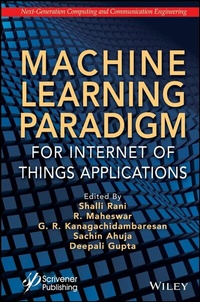
Machine Learning Paradigm for Internet of Things Applications
Description

As companies globally realize the revolutionary potential of the IoT, they have started finding a number of obstacles they need to address to leverage it efficiently. Many businesses and industries use machine learning to exploit the IoT's potential and this book brings clarity to the issue.
Machine learning (ML) is the key tool for fast processing and decision-making applied to smart city applications and next-generation IoT devices, which require ML to satisfy their working objective. Machine learning has become a common subject to all people like engineers, doctors, pharmacy companies, and business people. The book addresses the problem and new algorithms, their accuracy, and their fitness ratio for existing real-time problems.
Machine Learning Paradigm for Internet of Thing Applications provides the state-of-the-art applications of machine learning in an IoT environment. The most common use cases for machine learning and IoT data are predictive maintenance, followed by analyzing CCTV surveillance, smart home applications, smart-healthcare, in-store 'contextualized marketing', and intelligent transportation systems. Readers will gain an insight into the integration of machine learning with IoT in these various application domains.
Audience
Scholars and scientists working in artificial intelligence and electronic engineering, industry engineers, software and computer hardware specialists.
Shalli Rani, PhD is an associate professor in the Department of CSE, Chitkara University, Punjab, India.
R. Maheswar, PhD is the Dean and associate professor, School of EEE, VIT Bhopal University, Madya Pradesh, India.
G. R. Kanagachidambaresan, PhD associate professor, Department of CSE, Vel Tech Rangarajan Dr. Sagunthala R&D Institute of Science and Technology, Tamil Nadu, India.
Sachin Ahuja, PhD is a professor in the Department of CSE, Chitkara University, Punjab, India.
Deepali Gupta, PhD is a professor, Department of CSE, Chitkara University, Punjab, India.
More details
Other editions
Additional editions
Persons
Audience
Scholars and scientists working in artificial intelligence and electronic engineering, industry engineers, software and computer hardware specialists.
Shalli Rani, PhD is an associate professor in the Department of CSE, Chitkara University, Punjab, India.
R. Maheswar, PhD is the Dean and associate professor, School of EEE, VIT Bhopal University, Madya Pradesh, India.
G. R. Kanagachidambaresan, PhD associate professor, Department of CSE, Vel Tech Rangarajan Dr. Sagunthala R&D Institute of Science and Technology, Tamil Nadu, India.
Sachin Ahuja, PhD is a professor in the Department of CSE, Chitkara University, Punjab, India.
Deepali Gupta, PhD is a professor, Department of CSE, Chitkara University, Punjab, India.
Content
Preface xiii
1 Machine Learning Concept-Based IoT Platforms for Smart Cities' Implementation and Requirements 1
M. Saravanan, J. Ajayan, R. Maheswar, Eswaran Parthasarathy and K. Sumathi
1.1 Introduction 2
1.2 Smart City Structure in India 3
1.2.1 Bhubaneswar City 3
1.2.1.1 Specifications 3
1.2.1.2 Healthcare and Mobility Services 3
1.2.1.3 Productivity 4
1.2.2 Smart City in Pune 4
1.2.2.1 Specifications 5
1.2.2.2 Transport and Mobility 5
1.2.2.3 Water and Sewage Management 5
1.3 Status of Smart Cities in India 5
1.3.1 Funding Process by Government 6
1.4 Analysis of Smart City Setup 7
1.4.1 Physical Infrastructure-Based 7
1.4.2 Social Infrastructure-Based 7
1.4.3 Urban Mobility 8
1.4.4 Solid Waste Management System 8
1.4.5 Economical-Based Infrastructure 9
1.4.6 Infrastructure-Based Development 9
1.4.7 Water Supply System 10
1.4.8 Sewage Networking 10
1.5 Ideal Planning for the Sewage Networking Systems 10
1.5.1 Availability and Ideal Consumption of Resources 10
1.5.2 Anticipating Future Demand 11
1.5.3 Transporting Networks to Facilitate 11
1.5.4 Control Centers for Governing the City 12
1.5.5 Integrated Command and Control Center 12
1.6 Heritage of Culture Based on Modern Advancement 13
1.7 Funding and Business Models to Leverage 14
1.7.1 Fundings 15
1.8 Community-Based Development 16
1.8.1 Smart Medical Care 16
1.8.2 Smart Safety for The IT 16
1.8.3 IoT Communication Interface With ML 17
1.8.4 Machine Learning Algorithms 17
1.8.5 Smart Community 18
1.9 Revolutionary Impact With Other Locations 18
1.10 Finding Balanced City Development 20
1.11 E-Industry With Enhanced Resources 20
1.12 Strategy for Development of Smart Cities 21
1.12.1 Stakeholder Benefits 21
1.12.2 Urban Integration 22
1.12.3 Future Scope of City Innovations 22
1.12.4 Conclusion 23
References 24
2 An Empirical Study on Paddy Harvest and Rice Demand Prediction for an Optimal Distribution Plan 27
W. H. Rankothge
2.1 Introduction 28
2.2 Background 29
2.2.1 Prediction of Future Paddy Harvest and Rice Consumption Demand 29
2.2.2 Rice Distribution 31
2.3 Methodology 31
2.3.1 Requirements of the Proposed Platform 32
2.3.2 Data to Evaluate the 'isRice" Platform 34
2.3.3 Implementation of Prediction Modules 34
2.3.3.1 Recurrent Neural Network 35
2.3.3.2 Long Short-Term Memory 36
2.3.3.3 Paddy Harvest Prediction Function 37
2.3.3.4 Rice Demand Prediction Function 39
2.3.4 Implementation of Rice Distribution Planning Module 40
2.3.4.1 Genetic Algorithm-Based Rice Distribution Planning 41
2.3.5 Front-End Implementation 44
2.4 Results and Discussion 45
2.4.1 Paddy Harvest Prediction Function 45
2.4.2 Rice Demand Prediction Function 46
2.4.3 Rice Distribution Planning Module 46
2.5 Conclusion 49
References 49
3 A Collaborative Data Publishing Model with Privacy Preservation Using Group-Based Classification and Anonymity 53
Carmel Mary Belinda M. J., K. Antonykumar, S. Ravikumar and Yogesh R. Kulkarni
3.1 Introduction 54
3.2 Literature Survey 56
3.3 Proposed Model 58
3.4 Results 61
3.5 Conclusion 64
References 64
4 Production Monitoring and Dashboard Design for Industry 4.0 Using Single-Board Computer (SBC) 67
Dineshbabu V., Arul Kumar V. P. and Gowtham M. S.
4.1 Introduction 68
4.2 Related Works 69
4.3 Industry 4.0 Production and Dashboard Design 69
4.4 Results and Discussion 70
4.5 Conclusion 73
References 73
5 Generation of Two-Dimensional Text-Based CAPTCHA Using Graphical Operation 75
S. Pradeep Kumar and G. Kalpana
5.1 Introduction 75
5.2 Types of CAPTCHAs 78
5.2.1 Text-Based CAPTCHA 78
5.2.2 Image-Based CAPTCHA 80
5.2.3 Audio-Based CAPTCHA 80
5.2.4 Video-Based CAPTCHA 81
5.2.5 Puzzle-Based CAPTCHA 82
5.3 Related Work 82
5.4 Proposed Technique 82
5.5 Text-Based CAPTCHA Scheme 83
5.6 Breaking Text-Based CAPTCHA's Scheme 85
5.6.1 Individual Character-Based Segmentation Method 85
5.6.2 Character Width-Based Segmentation Method 86
5.7 Implementation of Text-Based CAPTCHA Using Graphical Operation 87
5.7.1 Graphical Operation 87
5.7.2 Two-Dimensional Composite Transformation Calculation 89
5.8 Graphical Text-Based CAPTCHA in Online Application 91
5.9 Conclusion and Future Enhancement 93
References 94
6 Smart IoT-Enabled Traffic Sign Recognition With High Accuracy (TSR-HA) Using Deep Learning 97
Pradeep Kumar S., Jayanthi K. and Selvakumari S.
6.1 Introduction 98
6.1.1 Internet of Things 98
6.1.2 Deep Learning 98
6.1.3 Detecting the Traffic Sign With the Mask R-CNN 99
6.1.3.1 Mask R-Convolutional Neural Network 99
6.1.3.2 Color Space Conversion 100
6.2 Experimental Evaluation 101
6.2.1 Implementation Details 101
6.2.2 Traffic Sign Classification 101
6.2.3 Traffic Sign Detection 102
6.2.4 Sample Outputs 103
6.2.5 Raspberry Pi 4 Controls Vehicle Using OpenCV 103
6.2.5.1 Smart IoT-Enabled Traffic Signs Recognizing With High Accuracy Using Deep Learning 103
6.2.6 Python Code 108
6.3 Conclusion 109
References 110
7 Offline and Online Performance Evaluation Metrics of Recommender System: A Bird's Eye View 113
R. Bhuvanya and M. Kavitha
7.1 Introduction 114
7.1.1 Modules of Recommender System 114
7.1.2 Evaluation Structure 115
7.1.3 Contribution of the Paper 115
7.1.4 Organization of the Paper 116
7.2 Evaluation Metrics 116
7.2.1 Offline Analytics 116
7.2.1.1 Prediction Accuracy Metrics 116
7.2.1.2 Decision Support Metrics 118
7.2.1.3 Rank Aware Top-N Metrics 120
7.2.2 Item and List-Based Metrics 122
7.2.2.1 Coverage 122
7.2.2.2 Popularity 123
7.2.2.3 Personalization 123
7.2.2.4 Serendipity 123
7.2.2.5 Diversity 123
7.2.2.6 Churn 124
7.2.2.7 Responsiveness 124
7.2.3 User Studies and Online Evaluation 125
7.2.3.1 Usage Log 125
7.2.3.2 Polls 126
7.2.3.3 Lab Experiments 126
7.2.3.4 Online A/B Test 126
7.3 Related Works 127
7.3.1 Categories of Recommendation 129
7.3.2 Data Mining Methods of Recommender System 129
7.3.2.1 Data Pre-Processing 129
7.3.2.2 Data Analysis 131
7.4 Experimental Setup 135
7.5 Summary and Conclusions 142
References 143
8 Deep Learning-Enabled Smart Safety Precautions and Measures in Public Gathering Places for COVID-19 Using IoT 147
Pradeep Kumar S., Pushpakumar R. and Selvakumari S.
8.1 Introduction 148
8.2 Prelims 148
8.2.1 Digital Image Processing 148
8.2.2 Deep Learning 149
8.2.3 WSN 149
8.2.4 Raspberry Pi 152
8.2.5 Thermal Sensor 152
8.2.6 Relay 152
8.2.7 TensorFlow 153
8.2.8 Convolution Neural Network (CNN) 153
8.3 Proposed System 154
8.4 Math Model 156
8.5 Results 158
8.6 Conclusion 161
References 161
9 Route Optimization for Perishable Goods Transportation System 167
Kowsalyadevi A. K., Megala M. and Manivannan C.
9.1 Introduction 167
9.2 Related Works 168
9.2.1 Need for Route Optimization 170
9.3 Proposed Methodology 171
9.4 Proposed Work Implementation 174
9.5 Conclusion 178
References 178
10 Fake News Detection Using Machine Learning Algorithms 181
M. Kavitha, R. Srinivasan and R. Bhuvanya
10.1 Introduction 181
10.2 Literature Survey 183
10.3 Methodology 193
10.3.1 Data Retrieval 195
10.3.2 Data Pre-Processing 195
10.3.3 Data Visualization 196
10.3.4 Tokenization 196
10.3.5 Feature Extraction 196
10.3.6 Machine Learning Algorithms 197
10.3.6.1 Logistic Regression 197
10.3.6.2 Naïve Bayes 198
10.3.6.3 Random Forest 200
10.3.6.4 XGBoost 200
10.4 Experimental Results 202
10.5 Conclusion 203
References 203
11 Opportunities and Challenges in Machine Learning With IoT 209
Sarvesh Tanwar, Jatin Garg, Medini Gupta and Ajay Rana
11.1 Introduction 209
11.2 Literature Review 210
11.2.1 A Designed Architecture of ML on Big Data 210
11.2.2 Machine Learning 211
11.2.3 Types of Machine Learning 212
11.2.3.1 Supervised Learning 212
11.2.3.2 Unsupervised Learning 215
11.3 Why Should We Care About Learning Representations? 217
11.4 Big Data 218
11.5 Data Processing Opportunities and Challenges 219
11.5.1 Data Redundancy 219
11.5.2 Data Noise 220
11.5.3 Heterogeneity of Data 220
11.5.4 Discretization of Data 220
11.5.5 Data Labeling 221
11.5.6 Imbalanced Data 221
11.6 Learning Opportunities and Challenges 221
11.7 Enabling Machine Learning With IoT 223
11.8 Conclusion 224
References 225
12 Machine Learning Effects on Underwater Applications and IoUT 229
Mamta Nain, Nitin Goyal and Manni Kumar
12.1 Introduction 229
12.2 Characteristics of IoUT 231
12.3 Architecture of IoUT 232
12.3.1 Perceptron Layer 233
12.3.2 Network Layer 234
12.3.3 Application Layer 234
12.4 Challenges in IoUT 234
12.5 Applications of IoUT 235
12.6 Machine Learning 240
12.7 Simulation and Analysis 241
12.8 Conclusion 242
References 242
13 Internet of Underwater Things: Challenges, Routing Protocols, and ML Algorithms 247
Monika Chaudhary, Nitin Goyal and Aadil Mushtaq
13.1 Introduction 248
13.2 Internet of Underwater Things 248
13.2.1 Challenges in IoUT 249
13.3 Routing Protocols of IoUT 250
13.4 Machine Learning in IoUT 255
13.4.1 Types of Machine Learning Algorithms 258
13.5 Performance Evaluation 259
13.6 Conclusion 260
References 260
14 Chest X-Ray for Pneumonia Detection 265
Sarang Sharma, Sheifali Gupta and Deepali Gupta
14.1 Introduction 266
14.2 Background 267
14.3 Research Methodology 268
14.4 Results and Discussion 271
14.4.1 Results 271
14.4.2 Discussion 271
14.5 Conclusion 273
Acknowledgment 273
References 274
Index 275
1
Machine Learning Concept-Based IoT Platforms for Smart Cities' Implementation and Requirements
M. Saravanan1*, J. Ajayan2, R. Maheswar3, Eswaran Parthasarathy4 and K. Sumathi5
1Sri Eshwar College of Engineering, Coimbatore, Tamilnadu, India
2SR University Warangal, Telangana, India
3School of EEE, VIT Bhopal University, Bhopal, India
4SRM Institute of Science and Technology, Chennai, India
5Sri Krishna College of Technology, Coimbatore, India
Abstract
In developing countries, smart cities are a challenge due to the exponential rise in population. With the rise in demand and availability for goods and facilities, it is now one of the world's most dynamic networks. Intelligent machines are crucial in the construction of critical infrastructure and smart cities in this new age. The increase in population has created new opportunities for smart city management and administration. In the smart city model, information and communication technology (ICT) plays a vital role in policy formulation, decision-making, implementation, and, finally, effective resource allocation. The study's key objective is to explore the role of artificial intelligence, machine learning, and deep reinforcement learning in the evolution of cities. Rapid advancements in computing and hardware, as well as high-speed internet connectivity, have enabled large amounts of data to be transmitted into the physical world.
Keywords: Smart city, process management, sewage treatment plan (STP), neural networks, control centers, cloud storage
1.1 Introduction
The idea of smart cities is the concept applied to the programs that uses the digital and the ICT-based innovation to increase the urban infrastructure quality and create the new economic and the prospect in the cities, and more is focused in the need of gaining the cost of the smart cities that are the distributed through all sectors with in the society emergence of the smart city projects around the world, such as analyzing the distributional impact of the individuals of the earth and the locations. The concept of smart city in the technical manner which will lead to debate the smart city varies across the countries according to the geopolitics; it implies more advanced and the necessary need to develop the city to both economically stable and more pollution-free concept. Initiatives that use the digital innovation with properly document are commitment of smart cities to enhancing the people's lives while providing the sectoral and the multi-sectoral solutions to some of the most common urban challenges; stack-holders' involvement in the local government and the strategic collaborations to improve the public engagement is maximized in private sectors positions in decision-making, and other benefits of the public access experimentation on open data with the interstate connectivity combined with the public and private people collaboration. Different regions of the world managed to establish their own smart city architecture in different manners also with approach of same belief [1]. The operable concept is complex for new setup process of the related to the increase in population to contribute in the development of technology with the social and political and the economy growth. The data that generated smart city concept are included in the networking application to monitor the application of various constrains like water monitoring and environment monitoring. Urban local bodies in particular for management service providers would be a crucial factor in evaluating the progress of smart cities mainly in India. Implementation approach will be consulted with pervious established architecture already present in various region of the globe. The well-developed cities like Singapore and Dubai UAE have the well-integrated business models, and the creative local collaborations will resolve the problems to get faced in India in nearly future [1]. In order to manage the data intelligently, IoT requires data to either represent improved customer services or optimize the effectiveness of the IoT system. In this way, applications should be able to access raw data across the network from different resources and evaluate this data to extract information.
Figure 1.1 Bhubaneswar smart city structure.
1.2 Smart City Structure in India
1.2.1 Bhubaneswar City
In India, Bhubaneswar has the best infrastructural setup of smart city project. It is the city where center of economic and having more religious importance in Eastern part of India. Consistently, this city has proved its efficiency in assessment among top smart city around the globe. It plays vital role in digital communication with advanced technologies. Figure 1.1 shows the Bhubaneswar smart city structure. This project included with construction engineering and green and park areas with road and development accessibility and slum accommodation.
1.2.1.1 Specifications
For government entities smart city specifications are, technology for the traffic, parking, emergency response, and emergency control, digitalized payment services via command payment methods schema capital of business planning and e-governance in this smart project [2].
1.2.1.2 Healthcare and Mobility Services
The smart city's primary focus is more on the child and elderly friendly option. Most of the homeless camp, however, defecate in the open. In an integrated safe urban transport scheme, several positive measures have been taken, including low carbon mobility program, and the e-rickshaws are introduced to reduce the carbon emission in environment and also to control the pollution-free society [2]. It is still in the planning stage, and a variety of commuters are debating that it is continuous to have the poor transport facilities.
1.2.1.3 Productivity
Few centers for the skill development and the microbusiness incubators have also been developed. Most of these projects are small. Despite of that nearly 85 lakhs are unemployed in the year 2018, the rate of unemployment has soared to 6.77 from the past year percent of 4.7. In the first quarter of 2018, this state has ranked as the 7th among the state in India. In Bhubaneswar, there are 565 buses are linking the 67 wards with the help of the IT-backend support options the e-mobility attempt to update and develop the service under the Atal mission.
1.2.2 Smart City in Pune
Vision of smart city in Pune is to redesign its streets and roads and its equal for all people. Pune Smart City overview is shown in Figure 1.2. Design of the city is based upon the universal accessibility for the elderly and physically challenged and increased focus on the pedestrians, modern world infrastructure through the creation of appropriate arrangements for underground utilities [3]. Allocation is mainly to motorized traffic, continuous excavation of roads, and weak pedestrian crossing for layout facilities.
Figure 1.2 Pune smart city overview.
1.2.2.1 Specifications
This city has been developed to create an overall master plan based on a patented econometric model that will make Pune fit for the future up to 2030 comprehensive infrastructure specifications that have been completed for the next 5 years. It aims at a comprehensive range of urban options, including job opportunities creation, socio-economic growth, and beyond infrastructure and habitability [4].
1.2.2.2 Transport and Mobility
Real monitoring system of the live ongoing buses in the city is to track the location of different locations. Smart bus stops with the public information systems. This live tracking of the buses is availed through the mobile app by the people in this eco system. Around 319 signals are present in the city where the pedestrian right get the way for the emergency response system [4]. Also, advanced traffic management system by using the CCTV and the mobile GPS-based traffic system analysis is similar to Google live traffic system and intelligent road asset management system to help all.
1.2.2.3 Water and Sewage Management
New advanced technologies for water management are introduced in the smart bulk meters with the SCADA, for the commercial establishment; it used for the domestic households through the campaign along with a revised telescopic traffic.
1.3 Status of Smart Cities in India
According to the report the government of India has planned to launch 100 smart city missions (SCMs). These cities are able to provide decent roads, to build housing for everyone in the city, and also to create green spaces. Five years back, a substantial portion of the capital earmarked was no spent. A single network is yet to be completed by many smart cities. Actually, the project initial proposed for smart city was around 5,151 projects but only 3,629 have been actively pursued. In those number, only 25% of the projects are only have been completed [6]. But in the terms of value, the proportion of work done is just 11% of the total.
1.3.1 Funding Process by Government
Over 5 years, the central government has allocated Rs 48,000 crore to the mission. That amounts to an average of Rs 96 crore per city per year, maybe enough in many cities to create a sewage drain. An equivalent amount would have to be contributed by the states and urban local bodies of amount 96 crore....
