

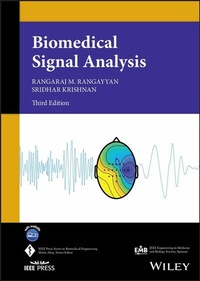
Biomedical Signal Analysis
Description

Comprehensive resource covering recent developments, applications of current interest, and advanced techniques for biomedical signal analysis
Biomedical Signal Analysis provides extensive insight into digital signal processing techniques for filtering, identification, characterization, classification, and analysis of biomedical signals with the aim of computer-aided diagnosis, taking a unique approach by presenting case studies encountered in the authors' research work.
Each chapter begins with the statement of a biomedical signal problem, followed by a selection of real-life case studies and illustrations with the associated signals. Signal processing, modeling, or analysis techniques are then presented, starting with relatively simple "textbook" methods, followed by more sophisticated research-informed approaches. Each chapter concludes with solutions to practical applications. Illustrations of real-life biomedical signals and their derivatives are included throughout. The third edition expands on essential background material and advanced topics without altering the underlying pedagogical approach and philosophy of the successful first and second editions. The book is enhanced by a large number of study questions and laboratory exercises as well as an online repository with solutions to problems and data files for laboratory work and projects.
Biomedical Signal Analysis provides theoretical and practical information on:
- The origin and characteristics of several biomedical signals
- Analysis of concurrent, coupled, and correlated processes, with applications in monitoring of sleep apnea
- Filtering for removal of artifacts, random noise, structured noise, and physiological interference in signals generated by stationary, nonstationary, and cyclostationary processes
- Detection and characterization of events, covering methods for QRS detection, identification of heart sounds, and detection of the dicrotic notch
- Analysis of waveshape and waveform complexity
- Interpretation and analysis of biomedical signals in the frequency domain
- Mathematical, electrical, mechanical, and physiological modeling of biomedical signals and systems
- Sophisticated analysis of nonstationary, multicomponent, and multisource signals using wavelets, time-frequency representations, signal decomposition, and dictionary-learning methods
- Pattern classification and computer-aided diagnosis
Biomedical Signal Analysis is an ideal learning resource for senior undergraduate and graduate engineering students. Introductory sections on signals, systems, and transforms make this book accessible to students in disciplines other than electrical engineering.
More details
Other editions
Additional editions
Persons
RANGARAJ M. RANGAYYAN is Professor Emeritus of Electrical and Computer Engineering, University of Calgary. Dr. Rangayyan has developed several algorithms for biomedical signal and image processing for computer-aided diagnosis. He is a Life Fellow of the IEEE, Fellow of the Royal Society of Canada, and Fellow of the Canadian Medical and Biological Engineering Society, and has been recognized with several other fellowships and awards, including the Outstanding Engineer Medal of IEEE Canada.
SRIDHAR KRISHNAN is Professor in the Electrical, Computer, and Biomedical Engineering Department, Toronto Metropolitan University, Canada. He served as Associate Dean (Research and Development), Faculty of Engineering and Architectural Science, and is the Founding Co-Director of the Institute for Biomedical Engineering, Science, and Technology. Dr. Krishnan held the Canada Research Chair position in Biomedical Signal Analysis and is a Fellow of the Canadian Academy of Engineering.
Content
About the Authors xvi
Foreword by Prof. Willis J. Tompkins xviii
Foreword by Prof. Alan V. Oppenheim xix
Preface xxii
Acknowledgments xxviii
Symbols and Abbreviations xxxi
About the Companion Website xxxix
1 Introduction to Biomedical Signals 1
1.1 The Nature of Biomedical Signals 1
1.2 Examples of Biomedical Signals 4
1.2.1 The action potential of a cardiac myocyte 5
1.2.2 The action potential of a neuron 9
1.2.3 The electroneurogram (ENG) 10
1.2.4 The electromyogram (EMG) 12
1.2.5 The electrocardiogram (ECG) 20
1.2.6 The electroencephalogram (EEG) 29
1.2.7 Event-related potentials (ERPs) 35
1.2.8 The electrogastrogram (EGG) 36
1.2.9 The phonocardiogram (PCG) 37
1.2.10 The carotid pulse 40
1.2.11 The photoplethysmogram (PPG) 41
1.2.12 Signals from catheter-tip sensors 43
1.2.13 The speech signal 44
1.2.14 The vibroarthrogram (VAG) 48
1.2.15 The vibromyogram (VMG) 52
1.2.16 Otoacoustic emission (OAE) signals 52
1.2.17 Bioacoustic signals 52
1.3 Objectives of Biomedical Signal Analysis 52
1.4 Challenges in Biomedical Signal Analysis 55
1.5 Why Use Computer-aided Monitoring and Diagnosis? 58
1.6 Remarks 60
1.7 Study Questions and Problems 60
1.8 Laboratory Exercises and Projects 62
References 63
2 Analysis of Concurrent, Coupled, and Correlated Processes 71
2.1 Problem Statement 71
2.2 Illustration of the Problem with Case Studies 72
2.2.1 The ECG and the PCG 72
2.2.2 The PCG and the carotid pulse 73
2.2.3 The ECG and the atrial electrogram 73
2.2.4 Cardiorespiratory interaction 75
2.2.5 Heart-rate variability 75
2.2.6 The EMG and VMG 77
2.2.7 The knee-joint and muscle-vibration signals 77
2.3 Application: Segmentation of the PCG 78
2.4 Application: Diagnosis and Monitoring of Sleep Apnea 79
2.4.1 Monitoring of sleep apnea by polysomnography 80
2.4.2 Home monitoring of sleep apnea 80
2.4.3 Multivariate and multiorgan analysis 82
2.5 Remarks 85
2.6 Study Questions and Problems 85
2.7 Laboratory Exercises and Projects 86
References 86
3 Filtering for Removal of Artifacts 91
3.1 Problem Statement 91
3.2 Random, Structured, and Physiological Noise 92
3.2.1 Random noise 92
3.2.2 Structured noise 98
3.2.3 Physiological interference 98
3.2.4 Stationary, nonstationary, and cyclostationary processes 99
3.3 Illustration of the Problem with Case Studies 101
3.3.1 Noise in event-related potentials 102
3.3.2 High-frequency noise in the ECG 102
3.3.3 Motion artifact in the ECG 102
3.3.4 Power-line interference in ECG signals 103
3.3.5 Maternal ECG interference in fetal ECG 105
3.3.6 Muscle-contraction interference in VAG signals 105
3.3.7 Potential solutions to the problem 106
3.4 Fundamental Concepts of Filtering 106
3.4.1 Linear shift-invariant filters and convolution 107
3.4.2 Transform-domain analysis of signals and systems 117
3.4.3 The pole-zero plot 123
3.4.4 The Fourier transform 125
3.4.5 The discrete Fourier transform 126
3.4.6 Convolution using the DFT 131
3.4.7 Properties of the Fourier transform 133
3.5 Synchronized Averaging 135
3.6 Time-domain Filters 139
3.6.1 Moving-average filters 139
3.6.2 Derivative-based operators to remove low-frequency artifacts 145
3.6.3 Various specifications of a filter 152
3.7 Frequency-domain Filters 153
3.7.1 Removal of high-frequency noise: Butterworth lowpass filters 154
3.7.2 Removal of low-frequency noise: Butterworth highpass filters 161
3.7.3 Removal of periodic artifacts: Notch and comb filters 162
3.8 Order-statistic Filters 169
3.9 The Wiener Filter 171
3.10 Adaptive Filters for Removal of Interference 180
3.10.1 The adaptive noise canceler 181
3.10.2 The least-mean-squares adaptive filter 184
3.10.3 The RLS adaptive filter 185
3.11 Selecting an Appropriate Filter 190
3.12 Application: Removal of Artifacts in ERP Signals 193
3.13 Application: Removal of Artifacts in the ECG 196
3.14 Application: Maternal-Fetal ECG 197
3.15 Application: Muscle-contraction Interference 199
3.16 Remarks 202
3.17 Study Questions and Problems 202
3.18 Laboratory Exercises and Projects 208
References 209
4 Detection of Events 213
4.1 Problem Statement 213
4.2 Illustration of the Problem with Case Studies 214
4.2.1 The P, QRS, and T waves in the ECG 214
4.2.2 The first and second heart sounds 215
4.2.3 The dicrotic notch in the carotid pulse 215
4.2.4 EEG rhythms, waves, and transients 215
4.3 Detection of Events and Waves 218
4.3.1 Derivative-based methods for QRS detection 218
4.3.2 The Pan-Tompkins algorithm for QRS detection 220
4.3.3 Detection of the P wave in the ECG 224
4.3.4 Detection of the T wave in the ECG 226
4.3.5 Detection of the dicrotic notch 228
4.4 Correlation Analysis of EEG Rhythms 228
4.4.1 Detection of EEG rhythms 228
4.4.2 Template matching for EEG spike-and-wave detection 231
4.4.3 Detection of EEG rhythms related to seizure 234
4.5 Cross-spectral Techniques 235
4.5.1 Coherence analysis of EEG channels 235
4.6 The Matched Filter 237
4.6.1 Derivation of the transfer function of the matched filter 237
4.6.2 Detection of EEG spike-and-wave complexes 241
4.7 Homomorphic Filtering 242
4.7.1 Generalized linear filtering 244
4.7.2 Homomorphic deconvolution 244
4.7.3 Extraction of the vocal-tract response 245
4.8 Application: ECG Rhythm Analysis 253
4.9 Application: Identification of Heart Sounds 254
4.10 Application: Detection of the Aortic Component of S 2 256
4.11 Remarks 259
4.12 Study Questions and Problems 259
4.13 Laboratory Exercises and Projects 261
References 262
5 Analysis of Waveshape and Waveform Complexity 267
5.1 Problem Statement 267
5.2 Illustration of the Problem with Case Studies 268
5.2.1 The QRS complex in the case of bundle-branch block 268
5.2.2 The effect of myocardial ischemia on QRS waveshape 268
5.2.3 Ectopic beats 268
5.2.4 Complexity of the EMG interference pattern 268
5.2.5 PCG intensity patterns 269
5.3 Analysis of ERPs 269
5.4 Morphological Analysis of ECG Waves 269
5.4.1 Correlation coefficient 270
5.4.2 The minimum-phase correspondent and signal length 270
5.4.3 ECG waveform analysis 274
5.5 Envelope Extraction and Analysis 277
5.5.1 Amplitude demodulation 278
5.5.2 Synchronized averaging of PCG envelopes 280
5.5.3 The envelogram 281
5.6 Analysis of Activity 283
5.6.1 The RMS value 283
5.6.2 Zero-crossing rate 285
5.6.3 Turns count 285
5.6.4 Form factor 286
5.7 Application: Normal and Ectopic ECG Beats 287
5.8 Application: Analysis of Exercise ECG 288
5.9 Application: Analysis of the EMG in Relation to Force 290
5.10 Application: Analysis of Respiration 292
5.11 Application: Correlates of Muscular Contraction 294
5.12 Application: Statistical Analysis of VAG Signals 295
5.12.1 Acquisition of knee-joint VAG signals 297
5.12.2 Estimation of the PDFs of VAG signals 297
5.12.3 Screening of VAG signals using statistical parameters 299
5.13 Application: Fractal Analysis of the EMG in Relation to Force 302
5.13.1 Fractals in nature 302
5.13.2 Fractal dimension 303
5.13.3 Fractal analysis of physiological signals 304
5.13.4 Fractal analysis of EMG signals 305
5.14 Remarks 306
5.15 Study Questions and Problems 307
5.16 Laboratory Exercises and Projects 309
References 310
6 Frequency-domain Characterization of Signals and Systems 317
6.1 Problem Statement 318
6.2 Illustration of the Problem with Case Studies 318
6.2.1 The effect of myocardial elasticity on heart sound spectra 318
6.2.2 Frequency analysis of murmurs to diagnose valvular defects 319
6.3 Estimation of the PSD 321
6.3.1 Considerations in the computation of the ACF 321
6.3.2 The periodogram 323
6.3.3 The need for averaging PSDs 325
6.3.4 The use of windows: spectral resolution and leakage 326
6.3.5 Estimation of the ACF from the PSD 330
6.3.6 Synchronized averaging of PCG spectra 331
6.4 Measures Derived from PSDs 333
6.4.1 Moments of PSD functions 334
6.4.2 Spectral power ratios 337
6.5 Application: Evaluation of Prosthetic Heart Valves 337
6.6 Application: Fractal Analysis of VAG Signals 339
6.6.1 Fractals and the 1/f model 339
6.6.2 F D via power spectral analysis 341
6.6.3 Examples of synthesized fractal signals 341
6.6.4 Fractal analysis of segments of VAG signals 342
6.7 Application: Spectral Analysis of EEG Signals 345
6.8 Remarks 349
6.9 Study Questions and Problems 350
6.10 Laboratory Exercises and Projects 351
References 353
7 Modeling of Biomedical Signal-generating Processes and Systems 357
7.1 Problem Statement 357
7.2 Illustration of the Problem 358
7.2.1 Motor-unit firing patterns 358
7.2.2 Cardiac rhythm 358
7.2.3 Formants and pitch in speech 359
7.2.4 Patellofemoral crepitus 360
7.3 Point Processes 360
7.4 Parametric System Modeling 365
7.5 Autoregressive or All-pole Modeling 369
7.5.1 Spectral matching and parameterization 374
7.5.2 Optimal model order 377
7.5.3 AR and cepstral coefficients 384
7.6 Pole-Zero Modeling 384
7.6.1 Sequential estimation of poles and zeros 387
7.6.2 Iterative system identification 389
7.6.3 Homomorphic prediction and modeling 393
7.7 Electromechanical Models of Signal Generation 395
7.7.1 Modeling of respiratory sounds 396
7.7.2 Modeling sound generation in coronary arteries 400
7.7.3 Modeling sound generation in knee joints 402
7.8 Electrophysiological Models of the Heart 404
7.8.1 Electrophysiological modeling at the cellular level 405
7.8.2 Electrophysiological modeling at the tissue and organ levels 410
7.8.3 Extensions to the models of the heart 412
7.8.4 Challenges and future considerations in modeling the heart 414
7.9 Application: Heart-rate Variability 416
7.10 Application: Spectral Modeling and Analysis of PCG Signals 418
7.11 Application: Coronary Artery Disease 421
7.12 Remarks 423
7.13 Study Questions and Problems 424
7.14 Laboratory Exercises and Projects 425
References 426
8 Adaptive Analysis of Nonstationary Signals 431
8.1 Problem Statement 432
8.2 Illustration of the Problem with Case Studies 432
8.2.1 Heart sounds and murmurs 432
8.2.2 EEG rhythms and waves 433
8.2.3 Articular cartilage damage and knee-joint vibration 433
8.3 Time-variant Systems 435
8.3.1 Characterization of nonstationary signals and dynamic systems 436
8.4 Fixed Segmentation 438
8.4.1 The short-time Fourier transform 438
8.4.2 Considerations in short-time analysis 441
8.5 Adaptive Segmentation 445
8.5.1 Spectral error measure 445
8.5.2 ACF distance 450
8.5.3 The generalized likelihood ratio 450
8.5.4 Comparative analysis of the ACF, SEM, and GLR methods 452
8.6 Use of Adaptive Filters for Segmentation 452
8.6.1 Monitoring the RLS filter 453
8.6.2 The RLS lattice filter 456
8.7 The Kalman Filter 463
8.8 Wavelet Analysis 474
8.8.1 Approximation of a signal using wavelets 474
8.9 Bilinear TFDs 479
8.10 Application: Adaptive Segmentation of EEG Signals 485
8.11 Application: Adaptive Segmentation of PCG Signals 489
8.12 Application: Time-varying Analysis of HRV 490
8.13 Application: Analysis of Crying Sounds of Infants 493
8.14 Application: Wavelet Denoising of PPG Signals 493
8.15 Application: Wavelet Analysis for CPR Studies 494
8.16 Application: Detection of Ventricular Fibrillation in ECG Signals 499
8.17 Application: Detection of Epileptic Seizures in EEG Signals 503
8.18 Application: Neural Decoding for Control of Prostheses 505
8.19 Remarks 506
8.20 Study Questions and Problems 507
8.21 Laboratory Exercises and Projects 507
References 508
9 Signal Analysis via Adaptive Decomposition 515
9.1 Problem Statement 517
9.2 Illustration of the Problem with Case Studies 517
9.2.1 Separation of the fetal ECG from a single-channel abdominal Ecg 517
9.2.2 Patient-specific EEG channel selection for BCI applications 518
9.2.3 Detection of microvolt T-wave alternans in long-term ECG recordings 518
9.3 Matching Pursuit 518
9.4 Empirical Mode Decomposition 520
9.4.1 Variants of empirical mode decomposition 521
9.5 Dictionary Learning 523
9.6 Decomposition-based Adaptive TFD 525
9.7 Separation of Mixtures of Signals 531
9.7.1 Principal component analysis 533
9.7.2 Independent component analysis 539
9.7.3 Nonnegative matrix factorization 542
9.7.4 Comparison of PCA, ICA, and NMF 546
9.8 Application: Detection of Epileptic Seizures Using Dictionary Learning Methods 553
9.9 Application: Adaptive Time-Frequency Analysis of VAG Signals 560
9.10 Application: Detection of T-wave Alternans in ECG Signals 568
9.11 Application: Extraction of the Fetal ECG from Single-channel Maternal ECG 572
9.12 Application: EEG Analysis for Brain-Computer Interfaces 577
9.12.1 NMF-based channel selection 579
9.12.2 Feature extraction 579
9.13 Remarks 586
9.14 Study Questions and Problems 586
9.15 Laboratory Exercises and Projects 586
References 587
10 Computer-aided Diagnosis and Healthcare 595
10.1 Problem Statement 596
10.2 Illustration of the Problem with Case Studies 596
10.2.1 Diagnosis of bundle-branch block 596
10.2.2 Normal or ectopic ECG beat? 597
10.2.3 Is there an alpha rhythm? 598
10.2.4 Is a murmur present? 598
10.2.5 Detection of sleep apnea using multimodal biomedical signals 598
10.3 Pattern Classification 599
10.4 Supervised Pattern Classification 600
10.4.1 Discriminant and decision functions 600
10.4.2 Fisher linear discriminant analysis 601
10.4.3 Distance functions 605
10.4.4 The nearest-neighbor rule 605
10.4.5 The support vector machine 606
10.5 Unsupervised Pattern Classification 607
10.5.1 Cluster-seeking methods 607
10.6 Probabilistic Models and Statistical Decision 611
10.6.1 Likelihood functions and statistical decision 611
10.6.2 Bayes classifier for normal patterns 613
10.7 Logistic Regression Analysis 614
10.8 Neural Networks 615
10.8.1 ANNs with radial basis functions 617
10.8.2 Deep learning 620
10.9 Measures of Diagnostic Accuracy and Cost 620
10.9.1 Receiver operating characteristics 623
10.9.2 McNemar's test of symmetry 625
10.10 Reliability of Features, Classifiers, and Decisions 627
10.10.1 Separability of features 628
10.10.2 Feature selection 630
10.10.3 The training and test steps 631
10.11 Application: Normal versus Ectopic ECG Beats 633
10.11.1 Classification with a linear discriminant function 633
10.11.2 Application of the Bayes classifier 637
10.11.3 Classification using the K-means method 637
10.12 Application: Detection of Knee-joint Cartilage Pathology 637
10.13 Application: Detection of Sleep Apnea 644
10.14 Application: Monitoring Parkinson's Disease Using Multimodal Signal Analysis 647
10.15 Strengths and Limitations of CAD 650
10.16 Remarks 656
10.17 Study Questions and Problems 657
10.18 Laboratory Exercises and Projects 658
References 659
Index 665
PREFACE
From the Second to the Third Edition
The field of biomedical signal analysis has been advancing rapidly over the past few years. More and more techniques are being developed to analyze not only the well-known signals from the previous century, but new types of biomedical signals are being explored, acquired, studied, and analyzed for various novel applications. Courses on biomedical instrumentation and signal analysis are increasingly common and popular elements in engineering curricula.
The previous editions of the book were adopted for study by several students, teachers, and researchers around the world. Keeping in mind the appreciative comments received, we have maintained the first six chapters of the book with minimal change. We have also maintained the style and spirit of the original book.
The minor modifications in the new edition include the following: additional discussions and illustrations related to the neuron, action potential, and photoplethysmography (Chapter 1); the discrete Fourier transform, frequency response, pole-zero plots, and the relationships between various representations of signals, systems, and transforms (Chapter 3); and turning points, zero-crossings, and turns count (Chapter 5). Several equations and figures have been revised and reformatted for improved comprehension. A few sections have been relocated and revised for improved connection to related sections.
The major changes in the Third Edition are present in the last four chapters, which represent thoroughly revised, expanded, updated, and reorganized versions of the last three chapters in the Second Edition. Substantial new material has been added on modeling and analysis of nonstationary and multicomponent signals as well as pattern recognition and diagnostic decision. Detailed discussions have been added on the Kalman filter, dictionary learning, electrophysiological modeling, detection of epileptic seizures, analysis of ventricular fibrillation, and diagnosis of Parkinson's disease. Additional discussions on the strengths and limitations of computer-aided diagnosis are provided at the end of Chapter 10.
The following list describes some of the new topics, techniques, and applications presented in the Third Edition:
- Mathematical and electrophysiological modeling of the heart at the cellular, tissue, and organ levels.
- The Kalman filter and dictionary-learning methods for sophisticated analysis of nonstationary, multicomponent, and multisource signals.
- Detection of ventricular fibrillation and wavelet analysis for studies on cardiopulmonary resuscitation.
- Neural decoding for control of prostheses using the Kalman filter.
- Techniques for adaptive decomposition of multicomponent and multisource signals, including dictionary learning, nonnegative matrix decomposition, and decomposition-based adaptive time-frequency distributions.
- Detection of epileptic seizures using dictionary learning.
- Detection of T-wave alternans in ECG signals.
- Extraction of the fetal ECG from single-channel maternal ECG.
- EEG analysis for brain-computer interfaces.
- Detection of sleep apnea.
- Monitoring Parkinson's disease using multimodal signal analysis.
References appear at the end of each chapter to facilitate chapter-by-chapter access to pdf files through digital libraries. The pdf files include hyperlinks to sections, figures, equations, references, and websites cited for efficient navigation.
In order to control and limit the number of pages in the book, the page size has been increased. This change has facilitated improved formatting and layout of the text and figures. In spite of the addition of substantial new material, the number of pages in the Third Edition is almost the same as that in the Second Edition.
Expanded and improved teaching and learning resources are available at
the companion website: https://wiley.com/go/rangayyan3e, and also at
https://github.com/srikrishnan1972/Biomedical-Signal-Analysis
The Intended Audience
As with the previous editions, the Third Edition is directed at engineering students in their final (senior) year of undergraduate studies or in their graduate studies. Electrical Engineering students with a good background in signals and systems will be well prepared for the material in the book. Students in other engineering disciplines, or in computer science, physics, mathematics, or geosciences, should also be able to appreciate the material in the book. A course on digital signal processing or digital filters would form a useful link to the material in the present book, but a capable student without this background should be able to gain a basic understanding of the subject matter. The introductory materials on systems, filters, and transforms provided in Chapter 3 should assist the reader without formal training on the same topics. Practicing engineers, computer scientists, information technologists, medical physicists, and specialists in machine learning, artificial intelligence, and data processing working in diverse areas such as telecommunications, seismic and geophysical applications, biomedical applications, and hospital information systems may find the book useful in their quest to learn advanced techniques for signal analysis. They could draw inspiration from other applications of signal processing or analysis, and satisfy their curiosity regarding computer applications in medicine, digital healthcare, and computer-aided medical diagnosis.
Teaching and Learning Plans
The book starts with an illustrated introduction to biomedical signals in Chapter 1. Chapter 2 continues the introduction, with emphasis on the analysis of multiple channels of correlated signals.
Chapter 3 deals exclusively with filtering of signals for removal of artifacts as an important step before signal analysis. The basic properties of systems and transforms as well as signal processing techniques are reviewed and described where required. The chapter is written as a mix of theory and application so as to facilitate easy comprehension of the basics of signals, systems, and transforms. The emphasis is on the application of filters to particular problems in biomedical signal analysis. A large number of illustrations are included to provide a visual representation of the problem and the effectiveness of the various filtering methods described.
Chapter 4 presents techniques that are particularly useful in the detection of events in biomedical signals. Analysis of waveshape and waveform complexity of events and components of signals is the focus of Chapter 5. Techniques for frequency-domain characterization of biomedical signals and systems are presented in Chapter 6. A number of diverse examples are provided in all of the chapters. Attention is directed to the characteristics of the problems that are encountered when analyzing and interpreting biomedical signals, rather than to any specific diagnostic application with particular signals.
The material in the book up to and including Chapter 6 provides more than adequate material for a one-semester (13-week) course at the senior (fourth-year) engineering level. Our own teaching experience indicates that this material will require about hours of lectures. It would be desirable to augment the lectures with about 12 hours of tutorials (problem-solving sessions) and 10 laboratory sessions.
Modeling biomedical signal-generating processes and systems for parametric representation and analysis is the subject of Chapter 7. Chapters 8 and 9 deal with adaptive analysis of nonstationary, multicomponent, and multisource signals. The topics in these chapters are of high mathematical complexity and are not suitable for undergraduate courses. Some sections may be selected and included in a first course on biomedical signal analysis if there is particular interest in these topics. Otherwise, the three chapters could be left for self-study by those in need of the techniques, or included in an advanced course.
Chapter 10 presents the final aspect of biomedical signal analysis, and provides an introduction to pattern classification, diagnostic decision-making, computer-aided diagnosis, and computer-aided healthcare. Although this topic is advanced in nature and could form a graduate-level course on its own, the material is introduced so as to draw the entire exercise of biomedical signal analysis to its concluding stage of diagnostic decision and healthcare. It is recommended that a few sections from this chapter be included even in a first course on biomedical signal analysis so as to give the students a flavor of the end result.
Each chapter includes a number of study questions and problems to facilitate preparation for tests and examinations. A number of laboratory exercises are also provided at the end of each chapter, which could be used to formulate hands-on exercises with real-life signals. Data files related to the problems and exercises at the end of each chapter are available at the site
https://github.com/srikrishnan1972/Biomedical-Signal-Analysis
It is strongly recommended that the first one or two laboratory sessions in the course include visits to a local hospital, health sciences center, or clinical laboratory to view and experience procedures related to biomedical signal acquisition and analysis in a practical (clinical) setting. Signals acquired from fellow students and instructors could form interesting and motivating...
