

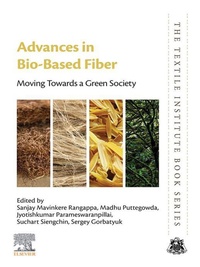
Advances in Bio-Based Fiber
Moving Towards a Green Society
Published on 1. December 2021
834 pages
978-0-12-824544-6 (ISBN)
Description

Advances in Bio-Based Fibres: Moving Towards a Green Society describes many novel natural fibers, their specific synthesis and characterization methods, their environmental sustainability values, their compatibility with polymer composites, and a wide range of innovative commercial engineering applications. As bio-based fiber polymer composites possess excellent mechanical, electrical and thermal properties, along with highly sustainable properties, they are an important technology for manufacturers and materials scientists seeking to improve the sustainability of their industries. This cutting-edge book draws on the latest industry practice and academic research to provide advice on technologies with applications in industries, including packaging, automotive, aerospace, biomedical and structural engineering.
- Provides technical data on advanced material properties, including electrical and rheological
- Gives a comprehensive guide to appraising and applying this technology to improve sustainability, including lifecycle assessment and recyclability
- Includes advice on the latest modeling techniques for designing with these materials
More details
Other editions
Additional editions
Sanjay Mavinkere Rangappa | Madhu Puttegowda | Jyotishkumar Parameswaranpillai
Advances in Bio-Based Fiber
Moving Towards a Green Society
Book
12/2021
Woodhead Publishing
€241.41
Shipment within 15-20 days
Content
1. Introduction to bio-based fibers and their composites2. Synthesis and surface treatments of bio-based fibers3. Properties of bio-based fibers4. Preparation methods of biofiber-based polymer composites5. Static mechanical properties of biofiber-based polymer composites6. Thermal properties of biofiber-based polymer composites7. Dielectric properties of biofiber-based polymer composites8. Tribological properties of biofiber-based polymer composites9. Advances and applications of biofiber-based polymer composites10. Optimization of parametric study on drilling characteristics of sheep wool reinforced composites11. Investigating the tribological behavior of biofiber-based polymer composites and scope of computational tools12. Properties of filler added biofiber-based polymer composite13. Advances and applications of biofiber polymer composites in regenerative medicine14. Keratin-based biofibers and their composites15. Biofiber composites in building and construction16. Evaluating biofibers' properties and products by NIR spectroscopy17. Impact strength retention and service life prediction of 0 degree laminate jute fiber woven mat reinforced epoxy composites18. Acoustic and mechanical properties of biofibers and their composites19. Identification of the elastic and damping properties of jute and luffa fiber-reinforced biocomposites20. Tribological characterization of biofiber-reinforced brake friction composites21. Investigation of the mechanical properties of treated and untreated Vachellia farnesiana fiber based epoxy composites22. Study on the degradation behavior of natural fillers based PLA composites23. Fabrication technology of biofiber-based biocomposites24. Rheological properties of biofibers in cementitious composite matrix25. Advances and applications of biofiber-based polymer composites26. Future scope of biofiber-based polymer composites27. Engineering applications of biofibers28. Performance of cementitious composites incorporating coconut fibers as reinforcement29. The effect of modified natural fibers on the mechanical properties of cementitious composites30. Challenges and solutions for the use of natural fibers in cementitious composites31. Biofibers of papaya tree bast: a statistical study of the mechanical properties for use potential in polymeric composites32. Coir fiber as reinforcement in cement-based materials33. Environmental impact analysis of plant fibers and their composites relative to their synthetic counterparts based on life cycle assessment approach
