

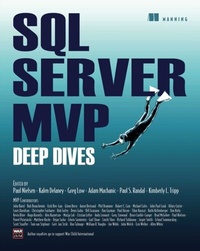
SQL Server MVP Deep Dives
1st Edition
Published on 31. October 2009
848 pages
978-1-63835-220-4 (ISBN)
Description

This is not an ordinary SQL Server Book. SQL Server MVP Deep Dives brings together the world's most highly-regarded SQL Server experts to create a masterful collection of tips, techniques, and experience-driven best practices for SQL Server development and administration. These SQL Server MVPs-53 in all-each selected a topic of great interest to them, and in this unique book, they share their knowledge and passion with you.
SQL Server MVP Deep Dives is organized into five parts: Design and Architecture, Development, Administration, Performance Tuning and Optimization, and Business Intelligence. Within each part, you'll find a collection of brilliantly concise and focused chapters that take on key topics like mobile data strategies, Dynamic Management Views, or query performance. The range of subjects covered is comprehensive, from database design tips to data profiling strategies for BI.
Additionally, the authors of this book have generously donated 100% of their royalties to support War Child International. War Child International is a network of independent organizations, working across the world to help children affected by war. War Child was founded upon a fundamental goal: to advance the cause of peace through investing hope in the lives of children caught up in the horrors of war. War Child works in many different conflict areas around the world, helping hundreds of thousands of children every year. Visit www.warchild.org for more information.
Purchase of the print book comes with an offer of a free PDF, ePub, and Kindle eBook from Manning. Also available is all code from the book.
SQL Server MVP Deep Dives is organized into five parts: Design and Architecture, Development, Administration, Performance Tuning and Optimization, and Business Intelligence. Within each part, you'll find a collection of brilliantly concise and focused chapters that take on key topics like mobile data strategies, Dynamic Management Views, or query performance. The range of subjects covered is comprehensive, from database design tips to data profiling strategies for BI.
Additionally, the authors of this book have generously donated 100% of their royalties to support War Child International. War Child International is a network of independent organizations, working across the world to help children affected by war. War Child was founded upon a fundamental goal: to advance the cause of peace through investing hope in the lives of children caught up in the horrors of war. War Child works in many different conflict areas around the world, helping hundreds of thousands of children every year. Visit www.warchild.org for more information.
Purchase of the print book comes with an offer of a free PDF, ePub, and Kindle eBook from Manning. Also available is all code from the book.
More details
Other editions
Additional editions
Paul Nielsen | Kalen Delaney | Adam Machanic
SQL Server MVP Deep Dives in Action
Book
11/2009
Manning Publications
€56.00
Article exhausted; check different version
Persons
Kimberly Tripp is a SQL Server MVP.
Adam Machanic is a SQL Server MVP.
Paul Nielsen is a SQL Server MVP.
Adam Machanic is a SQL Server MVP.
Paul Nielsen is a SQL Server MVP.
Content
- Intro
- Copyright
- Dedication
- Brief Table of Contents
- Table of Contents
- List of Figures
- List of Tables
- List of Listings
- MVP contributors and their chapters
- Preface
- Acknowledgments
- About War Child
- About this Book
- About SQL Server MVPs
- Part 1. Database design and architecture
- Chapter 1. Louis and Paul's 10 key relational database design ideas
- Chapter 2. SQL Server tools for maintaining data integrity
- Chapter 3. Finding functional dependencies
- Part 2. Database Development
- Chapter 4. Set-based iteration, the third alternative
- Chapter 5. Gaps and islands
- Chapter 6. Error handling in SQL Server and applications
- Chapter 7. Pulling apart the FROM clause
- Chapter 8. What makes a bulk insert a minimally logged operation?
- Chapter 9. Avoiding three common query mistakes
- Chapter 10. Introduction to XQuery on SQL Server
- Chapter 11. SQL Server XML frequently asked questions
- Chapter 12. Using XML to transport relational data
- Chapter 13. Full-text searching
- Chapter 14. Simil: an algorithm to look for similar strings
- Chapter 15. LINQ to SQL and ADO.NET Entity Framework
- Chapter 16. Table-valued parameters
- Chapter 17. Build your own index
- Chapter 18. Getting and staying connected-or not
- Chapter 19. Extending your productivity in SSMS and Query Analyzer
- Chapter 20. Why every SQL developer needs a tools database
- Chapter 21. Deprecation feature
- Chapter 22. Placing SQL Server in your pocket
- Chapter 23. Mobile data strategies
- Part 3. Database Administration
- Chapter 24. What does it mean to be a DBA?
- Chapter 25. Working with maintenance plans
- Chapter 26. PowerShell in SQL Server
- Chapter 27. Automating SQL Server Management using SMO
- Chapter 28. Practical auditing in SQL Server 2008
- Chapter 29. My favorite DMVs, and why
- Chapter 30. Reusing space in a table
- Chapter 31. Some practical issues in table partitioning
- Chapter 32. Partitioning for manageability (and maybe performance)
- Chapter 33. Efficient backups without indexes
- Chapter 34. Using database mirroring to become a superhero!
- Chapter 35. The poor man's SQL Server log shipping
- Chapter 36. Understated changes in SQL Server 2005 replication
- Chapter 37. High-performance transactional replication
- Chapter 38. Successfully implementing Kerberos delegation
- Chapter 39. Running SQL Server on Hyper-V
- Part 4. Performance Tuning and Optimization
- Chapter 40. When is an unused index not an unused index?
- Chapter 41. Speeding up your queries with index covering
- Chapter 42. Tracing the deadlock
- Chapter 43. How to optimize tempdb performance
- Chapter 44. Does the order of columns in an index matter?
- Chapter 45. Correlating SQL Profiler with PerfMon
- Chapter 46. Using correlation to improve query performance
- Chapter 47. How to use Dynamic Management Views
- Chapter 48. Query performance and disk I/O counters
- Chapter 49. XEVENT: the next event infrastructure
- Part 5. Business intelligence
- Chapter 50. BI for the relational guy
- Chapter 51. Unlocking the secrets of SQL Server 2008 Reporting Services
- Chapter 52. Reporting Services tips and tricks
- Chapter 53. SQL Server Audit, change tracking, and change data capture
- Chapter 54. Introduction to SSAS 2008 data mining
- Chapter 55. To aggregate or not to aggregate-is there really a question?
- Chapter 56. Incorporating data profiling in the ETL process
- Chapter 57. Expressions in SQL Server Integration Services
- Chapter 58. SSIS performance tips
- Chapter 59. Incremental loads using T-SQL and SSIS
- Index
