

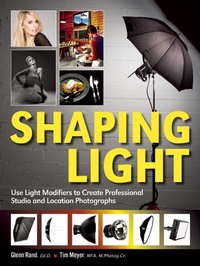
Shaping Light
Use Light Modifiers to Create Amazing Studio and Location Photographs
1st Edition
Published on 13. May 2014
128 pages
978-1-60895-706-4 (ISBN)
Description

Whether shooting portraits or products, skillful lighting can be the difference between a bland snapshot and a stunning, well-defined image. Capturing the ideal photograph requires many technical factors to work in tandem, the most fundamental of which is lighting. While we may take it for granted that light is required to create a photograph, light by itself usually does not produce the style, energy, emotion or feeling that makes a photograph exceptional. It is the way the light has been modified and shaped that gives the photographer the ability to create an image that communicates their feeling about the subject. It's necessary to understand how light works in order to know how to modify it in the most desirous way.
Beginning with simplified light concepts, Rand delves into the basics of light. Light's natural tendency is to go off in all directions. To give a better understanding of how to control the light that you use in your photographs, Rand guides the reader through a series of discussions defining the light itself, the surfaces that will interact with the light in the photographs, the look of light that we wish to create and the tools, modifiers and shapers that are commonly available for use. Whether you want to add contrast with highlights and shadows or use the softness of diffuse light to add volume to the subject, the fundamentals of these concepts are covered here. Images, diagrams and descriptions are used to illustrate the manners in which light can be modified.
From there, the book moves onto the main tools of light modification. Rand discusses the primary functions of each tool and defines the issues of the light's characteristics after the modification. Techniques are presented for using reflectors, spotlights, softboxes, diffusers, umbrellas, barndoors, gels, scrims, shoots and more. Each chapter is highly illustrated with images of the tools being discussed, diagrams, and examples for the use of these tools in both commercial and portrait photography. Variations in control and problems that may occur with specific modifiers are discussed as well.
The goal of this book is to show the effect of modifiers and shapers on the quality of light rather than to discuss the merits of a particular light source. By focusing on the methods to shape light, the photographer is open to improvise in scenarios where they may not have control over the light source. Whether you shoot commercial or portrait photography, this book provides you with the basis for not only successfully, but elegantly shaping light to create your desired result.
Beginning with simplified light concepts, Rand delves into the basics of light. Light's natural tendency is to go off in all directions. To give a better understanding of how to control the light that you use in your photographs, Rand guides the reader through a series of discussions defining the light itself, the surfaces that will interact with the light in the photographs, the look of light that we wish to create and the tools, modifiers and shapers that are commonly available for use. Whether you want to add contrast with highlights and shadows or use the softness of diffuse light to add volume to the subject, the fundamentals of these concepts are covered here. Images, diagrams and descriptions are used to illustrate the manners in which light can be modified.
From there, the book moves onto the main tools of light modification. Rand discusses the primary functions of each tool and defines the issues of the light's characteristics after the modification. Techniques are presented for using reflectors, spotlights, softboxes, diffusers, umbrellas, barndoors, gels, scrims, shoots and more. Each chapter is highly illustrated with images of the tools being discussed, diagrams, and examples for the use of these tools in both commercial and portrait photography. Variations in control and problems that may occur with specific modifiers are discussed as well.
The goal of this book is to show the effect of modifiers and shapers on the quality of light rather than to discuss the merits of a particular light source. By focusing on the methods to shape light, the photographer is open to improvise in scenarios where they may not have control over the light source. Whether you shoot commercial or portrait photography, this book provides you with the basis for not only successfully, but elegantly shaping light to create your desired result.
More details
Other editions
Additional editions
Nelson Rand | Tim Meyer
Shaping Light
Use Light Modifiers to Create Amazing Studio and Location Photographs
Book
05/2014
Amherst Media
€50.94
Article exhausted; check different version
Persons
Glenn Rand has also produced, taught and written about imaging. His photographs are in thirty public museums collections in the United States, Europe and Japan and he has exhibit widely. Since 2001 he has taught in the graduate program at Brooks Institute in Santa Barbara, California. He received his Bachelor and Master of Arts from Purdue University with a Doctorate from the University of Cincinnati centering on the Psychology of educational spaces with post-doctoral research as a Visiting Scholar at the University of Michigan. He has lectured extensively about photography and digital imaging ranging from commercial aesthetics to the technical fine points lighting.
Photographer, educator and author, Tim Meyer is passionate about the field of photography. Drawing from 30 years as a professional photographer, he brings experience and sustained energy to his work. Mixing our rich artistic heritage with today's modern styles, his images enlighten and inspire.
Tim possesses the Professional Photographers of America's coveted Masters and Craftsman Degrees, and earned an academic Master of Arts Degree and a Master of Fine Arts Degree, both in Fine Art Photography. In addition to numerous one-man exhibitions of his fine art work, his photography has been internationally recognized for its innovative style and technique.
He currently teaches full-time and serves as the Lead Portrait Instructor at Brooks Institute. His nationally acclaimed portrait and wedding studio, Meyer Photography, is managed by his partner in business and life, Dea Meyer.
Tim is honored to be sponsored by H&H Color Lab, Big Folio and Triple Scoop Music. He also speaks and teaches internationally for the MAC Group Pro Educational Team, representing, among others, Sekonic, Pocket Wizard, Profoto and Creative Light product lines.
Tim's writings on photography and art have been published internationally and his book, The Portrait - Understanding Portrait Photography, co-written with Glenn Rand and published by Rocky Nook, Inc., is available worldwide.
Tim's Credentials
. Master of Fine Arts, Fine Art Photography, Brooks Institute
. Master of Arts, Creative Photography, California State University, Fullerton
. Bachelor of Arts, Communication, California State University, Fullerton
. Master of Photography, Professional Photographers of America
. Craftsman Degree, Professional Photographers of America
. Certified Professional Photographer, Professional Photographers of America
Photographer, educator and author, Tim Meyer is passionate about the field of photography. Drawing from 30 years as a professional photographer, he brings experience and sustained energy to his work. Mixing our rich artistic heritage with today's modern styles, his images enlighten and inspire.
Tim possesses the Professional Photographers of America's coveted Masters and Craftsman Degrees, and earned an academic Master of Arts Degree and a Master of Fine Arts Degree, both in Fine Art Photography. In addition to numerous one-man exhibitions of his fine art work, his photography has been internationally recognized for its innovative style and technique.
He currently teaches full-time and serves as the Lead Portrait Instructor at Brooks Institute. His nationally acclaimed portrait and wedding studio, Meyer Photography, is managed by his partner in business and life, Dea Meyer.
Tim is honored to be sponsored by H&H Color Lab, Big Folio and Triple Scoop Music. He also speaks and teaches internationally for the MAC Group Pro Educational Team, representing, among others, Sekonic, Pocket Wizard, Profoto and Creative Light product lines.
Tim's writings on photography and art have been published internationally and his book, The Portrait - Understanding Portrait Photography, co-written with Glenn Rand and published by Rocky Nook, Inc., is available worldwide.
Tim's Credentials
. Master of Fine Arts, Fine Art Photography, Brooks Institute
. Master of Arts, Creative Photography, California State University, Fullerton
. Bachelor of Arts, Communication, California State University, Fullerton
. Master of Photography, Professional Photographers of America
. Craftsman Degree, Professional Photographers of America
. Certified Professional Photographer, Professional Photographers of America
Content
- Cover
- DEDICATION
- Copyright
- CONTENTS
- ACKNOWLEDGMENTS
- 1. INTRODUCTION
- 2. SIMPLIFIED LIGHT CONCEPTS
- Light
- Direction
- Intensity and the Law of the Inverse Square
- Color
- Surfaces
- SIDEBAR: Light's Dynamic Edge (LDE)
- SIDEBAR: About Highlights
- Shadows
- Complexity of Light and Shadow
- Perception and Light
- SIDEBAR: In Review
- 3. SPECULAR LIGHT
- Highlights and Shadows
- Shaping
- SIDEBAR: In Review
- 4. DIFFUSED LIGHT
- Highlights and Shadows
- Shaping
- SIDEBAR: In Review
- 5. BEAM MODIFICATION
- Reflectors
- Shape
- Surfaces
- Source Placement and Direction
- Controlling Beam Spread
- Lens Beam Control
- SIDEBAR: In Review
- 6. SPECULAR MODIFIERS
- Bare Bulb
- Floodlights
- Spotlights
- SIDEBAR: In Review
- 7. DIFFUSE MODIFIERS
- Diffuser Panels
- Tents
- Softboxes
- Banks
- Reflector Boards and Kites
- SIDEBAR: In Review
- 8. UMBRELLAS
- Surfaces and Shape
- Giant Reflectors
- SIDEBAR: In Review
- 9. SHAPE, INTENSITY, AND ACCENTS
- Shapers and Masks
- SIDEBAR: Softbox Masks
- SIDEBAR: Highly Reflective Subjects
- Pattern Projections
- Barndoors
- Gels
- Scrims, Dots, and Fingers
- Cones and Snoots
- Mirrors
- Other Tools for Adding Light Intensity
- SIDEBAR: In Review
- 10. FILLS, NON-FILLS, AND BLOCKING
- Fill Light
- SIDEBAR: Silver Reflectors
- Reducing Fill Light
- Blocking Light
- Complex Main/Fill
- SIDEBAR: Complex Lighting for Portrait Variety
- SIDEBAR: In Review
- Biographies
- Index
