

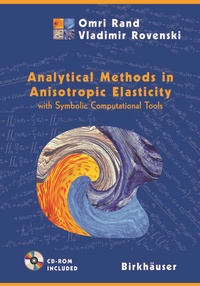
Analytical Methods in Anisotropic Elasticity
Description

Reviews / Votes
From the reviews:
"The book emphasizes the applications of analytical methods in the solutions of boundary value problems (BVPs) in anisotropic elasticity, but the focus is on the procedure of obtaining analytical solutions. It starts with a condensed, mathematically flavored summary of basics of anisotropic elasticity in the first 4 chapters. The primary methods, the global polynomial analysis and the method of complex potentials are then introduced. The methods are applied to various two dimensional and three dimensional BVPs, with a focus on beams with different levels of anisotropy. A feature of this book is that the solution for each type of problems is preceded with a complete mathematical formulation of the BVP. It also contains many solved problems and an extensive list of references. It should be noted that the authors do not discuss how to use symbolic computational tools. The book can be used as a reference for those who are familiar with the theory of elasticity and are interested in analytical solutions of BVPs in anisotropic elasticity."--MATHEMATICAL REVIEWS
"The book is intended to be a self-contained reference for the topic and aimed at practicing engineers who put the analytical approaches for anisotropic elasticity problems to practical use. Graduate, postgraduate and doctoral students of mechanical engineering could benefit from using the book as well. This well-written book is a reader-friendly and well organized handbook in the field of anisotropic elasticity. It can be highly recommended for experts in Mechanics of Solids, engineers, and for graduate, postgraduate and doctoral students."(ZENTRALBLATT MATH)
More details
Other editions
Additional editions
Persons
Omri Rand is a Professor of Aerospace Engineering at the Technion - Israel Institute of Technology. He has been involved in research on theoretical modeling and analysis in the area of anisotropic elasticity for the last fifteen years, he is the author of many journal papers and conference presentations in this area. Dr. Rand has been extensively active in composite rotor blade analysis, and established many well recognized analytical and numerical approaches. He teaches graduate courses in the area of anisotropic elasticity, serves as the Editor-in-Chief of Science and Engineering of Composite Materials , as a reviewer for leading professional journals, and as a consultant to various research and development organizations.
Vladimir Rovenski is a Professor of Mathematics and a well known researcher in the area of Riemannian and computational geometry. He is a corresponding member of the Natural Science Academy of Russia, a member of the American Mathematical Society, and serves as a reviewer of Zentralblatt für Mathematik . He is the author of many journal papers and books, including Foliations on Riemannian Manifolds and Submanifolds (Birkhäuser, 1997), and Geometry of Curves and Surfaces with MAPLE (Birkhäuser, 2000). Since 1999, Dr. Rovenski is a senior scientist at the faculty of Aerospace Engineering at the Technion - Israel Institute of Technology, and a lecturer at Haifa University.
