

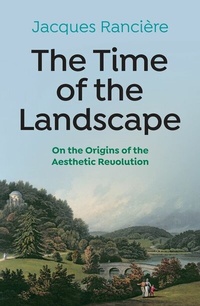
The Time of the Landscape
Description

The time of the landscape is not the time when people started describing gardens, mountains and lakes in poems or representing them in works of art: it is the time when the landscape imposed itself as a specific object of thought. It is the time when both the harmony of arranged gardens and the disharmony of wild nature led to a revolution in the criteria of the beautiful and in the meaning of the word “art.” It coincided with the birth of aesthetics, understood as a regime for shaping how art is seen and thought, and also with the French Revolution, understood as a revolution in the very idea of what binds together a human community. The time of the landscape is the time when the conjunction of these two upheavals brought into focus, however hazily, a common horizon: that of a revolution that no longer concerns only the laws of the state or the norms of art, but the very forms of sensible experience.
This brilliant and wide-ranging book will be of interest to students and scholars in philosophy, literature, the visual arts, and the humanities generally, and to anyone interested in critical theory and philosophy.
Jacques Rancière is Professor Emeritus of Philosophy at the University of Paris-St. Denis.
More details
Other editions
Additional editions
Persons
Content
List of Illustrations
Foreword
I. A Newcomer to the Fine Arts
II. Scenes of Nature
III. The Landscape as Painting
IV. Beyond the Visible
V. Politics of the Landscape
Epilogue
Notes
I
A Newcomer to the Fine Arts
Painting, as the second kind of formative art, which presents sensible appearance in artful combination with ideas, I would divide into that of the beautiful depiction of nature, and that of the beautiful arrangement of its products. The first is painting proper, the second landscape gardening.1
That is how Kant introduced a newcomer to the classification of the fine arts in 1790: the art of "landscape gardening," which consists in the "beautiful arrangement" of the "products" of nature. In so doing, Kant was confirming something that a few seminal works from the period had already recognized. Thomas Whately published his Observations on Modern Gardening in London in 1770, and a French translation appeared the following year. In 1779, Christian Cay Lorenz Hirschfeld's five-volume Theorie der Gartenkunst appeared simultaneously in German and French.2 In 1782, Jacques Delille put the new theories into verse in Les Jardins, a poem in four cantos that enjoyed considerable success at the time.3 It was Whately, in fact, who defined the art of landscape gardening as the art of arranging the products of nature in the most perfect manner. And it was also Whately who, in the opening sentence of his Introduction, proclaimed the recent consecration of this art: "Gardening, in the perfection to which it has lately been brought in England, is entitled to a place of considerable rank among the liberal arts."4
The question, then, is to know what accounts for this novelty and perfection. The claim would certainly have surprised connoisseurs. Books about the art of landscape gardening had by then been circulating for two centuries already. Some among them had proclaimed its ancient lineage by evoking the orchards of Alcinous (in Book Seven of the Odyssey), the mythical hanging gardens of Babylon, and the painted Roman villas described in two often-cited letters by Pliny the Younger. Closer to Whately's time, the Garden of Venus celebrated in The Dream of Poliphilus5 and the Garden of Eden sung by Milton had captured many an imagination, and the culture of Italian literati had inspired the sophisticated architecture of symbolic gardens. Poets and travelers in the seventeenth century had admired the wonders that Salomon de Caus built for the Elector Palatinate in Heidelberg, and that Le Nôtre designed for the French king at Versailles. The arrangement of embroidered parterres (parterres en broderie), green rooms (cabinets de verdure), bowling-greens, porticos, or labyrinths had been formalized and abundantly illustrated since 1629, when Daniel Loris published Le Thrésor des parterres in Geneva. Indeed, the art of gardening seemed already to be celebrating its perfection in 1709, when Dezallier d'Argenville published La Théorie et la pratique du jardinage, an encyclopedic work whose full title promises "new designs of parterres, groves, grass-plots, mazes, banqueting rooms, galleries, porticos, terraces, stairs, fountains, cascades," as well as the "manner of making the ground, forming designs suitable to the place, and putting them in execution, according to the principles of geometry," and the "method of setting and raising in little time, all the plants requisite in fine gardens: also the way to find water, to convey it into gardens, and to make basons and fountains for the same. Together with remarks and general rules in all that concerns the art of gardening."6 We might conclude that the perfection attained there belies the novelty that Whately claimed seventy years later. That conclusion, however, would hide the core of the problem, which turns precisely on knowing what is to be understood by "art" and "perfection." The fact is that, although Dezallier d'Argenville promised innumerable marvels, he was not at all interested in getting the fine arts to welcome into its ranks the art of Le Nôtre and his emulators. On the contrary, it was just at the moment when this science of parterres, bowling-greens, labyrinths, canals, and porticos had fallen into discredit that Whately - and Kant after him - claimed this dignity for it.
This seeming paradox teaches an essential lesson: the dignity of an art is something other than its formal perfection. In general, what we call art is the skill (savoir-faire) that a will deploys in order to give matter a form. The ingenuity of the conception and the virtuosity of its execution are one way to recognize the perfection acquired in the exercise of a skill. But that is not the same as knowing what objects they produce, and to what end. Traditionally, the excellence of an art had been defined solely in relation to the latter; indeed, that is how the liberal arts had distinguished themselves from the mechanical arts. The latter produced objects that served the needs of human beings, while the former provided pleasure to those whose spheres of existence extended beyond the simple circle of needs. In order to become a liberal art, the art of gardening had to do more than just increase the amount of science that went into its creations. It had to separate its ends from the two needs - the medicinal and the alimentary - usually associated with the cultivation of plants. It was easy for the art of gardening to distance itself both from the traditional collection of medicinal plants, and from the vegetable garden, whose products were destined for the kitchen. For a long time, though, the art of gardening kept its links to the orchard, where the useful was closely tied to the agreeable. Recent studies have pointed out that the famous gardens of the Villa Lante, in Bagnaia, which served as archetypes for Renaissance gardens in Italy, were sites for the intense cultivation of fruit.7 John Parkinson, for his part, reminded readers of his Paradisi in Sole. Paradisus Terrestris, published in London in 1629, that the plants of the Garden of Eden were not just meant to satisfy hunger, but to please the eyes. On the book's frontispiece, vines, apple trees, pineapples, and date palms are combined with tulips, carnations, cyclamen, and fritillaries to convey the image of an earthly paradise.
The architectural magnificence of Le Nôtre's gardens cut the knot that bound the art of vistas and embroidered parterres to the cultivation of fruit trees. Still, the distance that Le Nôtre established between his art and utility proved to be no more efficient than the perfection of garden designs in gaining for the art of gardening a place among the liberal arts. That is because the excellence that separated the liberal from the mechanical arts could not be measured solely through the pleasure that the talent of the architect provided to members of the very upper classes. In the course of the eighteenth century, the liberal arts had taken on a new name: the fine arts. For an art to gain the title of fine art, it had to do more than provide refined pleasure to the well born. It had to satisfy an autonomous criterion of beauty by producing a specific pleasure rooted in the imitation of nature. "Nature - that is, all of reality plus all that we can readily conceive to be possible - is the prototype or model for the arts."8 So writes Batteux in The Fine Arts Reduced to the Same Principle, a book that was still considered an authority in Kant's time. For Batteux, the word nature does not evoke images of greenery. Rather, to have nature as a model meant two things: to imitate the traits presented by the objects and beings of nature so as to make them recognizable while also rendering them more beautiful; and to imitate - by assembling the visible traits of nature - an invisible nature defined as the perfect combination of its elements into a coherent whole.
For the art of gardening to be elevated to the rank of fine art, it had to do more than simply separate itself from every useful end. It also had to satisfy the criterion through which beautiful works are recognized. In other words, it had to imitate nature - or, rather, "beautiful nature," which is not satisfied with reproducing the traits that render things recognizable, but goes further and assembles the traits, borrowed from the most beautiful models, into a perfect figure that is not to be found in simple nature. This principle is illustrated by the example, so oft-repeated, of Zeuxis, who availed himself of the traits of five different women in order to compose the ideal image of Helen. That is what the "beautiful arrangement" of nature's "products" had to do: not just transform nature, but imitate it by composing, on the ground itself and using the sparse beauties it dispenses, a superior beauty. A problem emerges, however, when the word nature also starts to mean rolling hills and valleys, green trees and meadows, and trickling streams: how can one imitate nature by using its products? After all, to imitate nature had meant to reproduce its traits in objects that are not natural. Batteux had been quite explicit on this point: unlike the mechanical arts, the fine arts do not use nature, they only imitate it. The products of the fine arts are not just different from nature, they are its exact opposite: artificial beings. How, then, can the art of gardening - the art that imitates nature with...
