

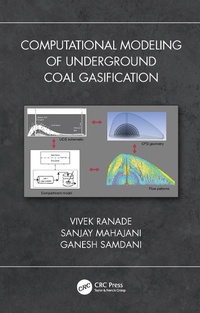
Computational Modeling of Underground Coal Gasification
1st Edition
Published on 15. July 2019
356 pages
978-1-351-60865-7 (ISBN)
Description

The book deals with development of comprehensive computational models for simulating underground coal gasification (UCG). It starts with an introduction to the UCG process and process modelling inputs in the form of reaction kinetics, flow patterns, spalling rate, and transport coefficient that are elaborated with methods to generate the same are described with illustrations. All the known process models are reviewed, and relative merits and limitations of the modeling approaches are highlighted and compared. The book describes all the necessary steps required to determine the techno-economic feasibility of UCG process for a given coal reserve, through modeling and simulation.
More details
Edition
1. Auflage
Language
English
Place of publication
London
United Kingdom
Publishing group
Taylor & Francis Ltd
Target group
Professional and scholarly
Illustrations
40 Tables, black and white; 133 Illustrations, black and white
ISBN-13
978-1-351-60865-7 (9781351608657)
Copyright in bibliographic data and cover images is held by Nielsen Book Services Limited or by the publishers or by their respective licensors: all rights reserved.
Schweitzer Classification
Other editions
Additional editions
Vivek V. Ranade | Sanjay M. Mahajani | Ganesh Arunkumar Samdani
Computational Modeling of Underground Coal Gasification
Book
08/2019
1st Edition
CRC Press
€297.12
Shipment within 10-20 days
Persons
Vivek Ranade is a Professor of Chemical Engineering at the School of Chemistry and Chemical Engineering of Queen's University Belfast. His research focus is on developing insights, innovations & intensified solutions for sustainable energy, water and chemicals. He uses computational flow modelling, hydrodynamic cavitation and MAGIC (modular, agile, intensified & continuous) processes to achieve this. Before moving to Queen's, he led chemical engineering at CSIR - National Chemical Laboratory, Pune, India. Contributed significantly to chemical engineering science and practice. Developed performance enhancement solutions, software products and fluidic devices for variety of applications which are commercialized. Developed new insights and methodologies for process intensification. He is an Associate Editor of 'Industrial & Engineering Chemistry Research' and serves on editorial boards of 'Chemical Engineering Research & Design' and 'Indian Chemical Engineer' journals. He is a recipient of numerous awards including highest Indian Scientific award Shanti Swarup Bhatnagar award for scientists under 45 years. He is a fellow of Institute of Chemical Engineers, UK; Indian National Academy Sciences; Indian National Academy of Engineering and Indian Academy of Sciences. Published more than 150 papers and 6 books (> 6500 citations, h index=45: from Google Scholar). Co-inventor of more than 20 patents. Co-founded two technology companies: Tridiagonal Solutions and VIVIRA Process Technologies.
Prof. Sanjay Mahajani received his Bachelors and Ph. D. Degrees in Chemical Engineering from UDCT (now known as ICT), Mumbai in 1989 and 1996, respectively, and the Master's degree from IIT Bombay in 1992. After completing his Ph.D., he worked in Monash University, Australia (1996-2000) as post-doctoral research fellow. He joined IIT-Bombay as Assistant Professor in 2000, and is presently a full professor (2008-date) in Department of Chemical engineering. He also holds a position of Professor-in-charge of the newly formed Tata Centre of Technology and Design at IIT Bombay. Prof. Mahajani's research interests are: reaction engneering and applied catalysis, process intensification, and gasification of coal and biomass. He has worked on several industry sponsored projects that include, underground coal gasification, catalyst development, reactive distillation and its applications. He was part of the faculty team responsible for developing a laboratory facility and building a research group to conduct laboratory research on Underground Coal gasification for Indian coals. He has over 120 international research papers and notable awards in research and teaching to his credit.
Ganesh Samdani is a chemical engineer by training and he received his Ph.D. in Chemical Engineering from Indian Institute of Technology Bombay with a strong focus on computational modelling of underground coal gasification. He has published his work in peer-reviewed journals and he has provided several talks on the computational modelling UCG as well as other reactive flow processes. From last 4 years, he is with Honeywell India Technology center (HITC), Gurgaon, India where he leads the kinetic and CFD modelling team. He has received green belt in six-sigma for its application in process improvement. His work at Honeywell is related to application of multiphase and reactive flow modelling for process development and equipment design in the field of refinery and petrochemicals.Ho His current research interests are related to refinery-residue upgradation, novel reactors for petrochemicals, upscaling of industrial reactors, coal and biomass utilization and renewable feedstocks for standard refinery units. He has also received various Honeywell internal awards for his technical excellence and process development efforts.
Prof. Sanjay Mahajani received his Bachelors and Ph. D. Degrees in Chemical Engineering from UDCT (now known as ICT), Mumbai in 1989 and 1996, respectively, and the Master's degree from IIT Bombay in 1992. After completing his Ph.D., he worked in Monash University, Australia (1996-2000) as post-doctoral research fellow. He joined IIT-Bombay as Assistant Professor in 2000, and is presently a full professor (2008-date) in Department of Chemical engineering. He also holds a position of Professor-in-charge of the newly formed Tata Centre of Technology and Design at IIT Bombay. Prof. Mahajani's research interests are: reaction engneering and applied catalysis, process intensification, and gasification of coal and biomass. He has worked on several industry sponsored projects that include, underground coal gasification, catalyst development, reactive distillation and its applications. He was part of the faculty team responsible for developing a laboratory facility and building a research group to conduct laboratory research on Underground Coal gasification for Indian coals. He has over 120 international research papers and notable awards in research and teaching to his credit.
Ganesh Samdani is a chemical engineer by training and he received his Ph.D. in Chemical Engineering from Indian Institute of Technology Bombay with a strong focus on computational modelling of underground coal gasification. He has published his work in peer-reviewed journals and he has provided several talks on the computational modelling UCG as well as other reactive flow processes. From last 4 years, he is with Honeywell India Technology center (HITC), Gurgaon, India where he leads the kinetic and CFD modelling team. He has received green belt in six-sigma for its application in process improvement. His work at Honeywell is related to application of multiphase and reactive flow modelling for process development and equipment design in the field of refinery and petrochemicals.Ho His current research interests are related to refinery-residue upgradation, novel reactors for petrochemicals, upscaling of industrial reactors, coal and biomass utilization and renewable feedstocks for standard refinery units. He has also received various Honeywell internal awards for his technical excellence and process development efforts.
Content
1. Introduction. 2. Underground Coal Gasification: State of the Art. Part I. Pre-requisites of Computational Modeling. 3. Physico-chemical Properties of Coal. 4. Kinetics of Coal Gasification. 5. Laboratory Studies on Underground Coal Gasification. Part II. Computational Modeling. 6. Approach towards computational modeling of UCG. 7. Thermodynamic & Reaction Engineering Models. 8. Multi-zonal and CFD Models. Part III. Chapter 9. Summary, Conclusions and Path Forward.
