

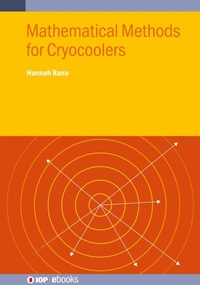
Mathematical Methods for Cryocoolers
Description

Mathematical Methods for Cryocoolers provides the first comprehensive treatment of the mathematical frameworks that underpin modern cryogenic refrigeration systems. Cryocoolers are critical technologies enabling astronomy, quantum science, particle physics, and advanced aerospace applications. This book bridges theory and practice by combining thermodynamic principles, applied mathematics, and computational tools into a unified approach for understanding, modelling, and optimising cryocoolers. This book is intended for researchers, physicists, astronomers, engineers, and advanced students in cryogenics, applied physics, astronomy, engineering, and instrumentation. By blending physical insight with modern modelling strategies, it provides a definitive reference for both academic study and applied cryocooler development.
Key Features:
- Presents key mathematical methods for modelling physical phenomena of cryocooler systems
- Includes introductory context and background information that enables a student at graduate level and upwards to get up to speed for the required modelling methodologies
- Includes helpful examples throughout each chapter to demonstrate how calculations and modelling can be performed
- Relates the theory and mathematics to practical examples that are relevant to current research in the field, referencing literature throughout the book
More details
Other editions
Additional editions
Person
Hannah Rana is a Clay Fellow at the Center for Astrophysics | Harvard & Smithsonian and the Black Hole Initiative at Harvard University. She works on the Black Hole Explorer (BHEX) space mission concept and is the Cryogenics Co-Lead for the BHEX instrument. Prior to this, Hannah was a Schmidt Science Fellow, also at Harvard, and has held previous appointments at the NASA Jet Propulsion Laboratory, the California Institute of Technology, the European Space Agency, and CERN. She completed her D.Phil. at the University of Oxford. Over the years, her research has focused on astrophysics instrumentation, black hole science, thermodynamics, and mathematical modelling.
Content
Author biography
Symbols
1 Cryocooler fundamentals
2 Mathematical fundamentals
3 Thermodynamics
4 Harmonic approximations
5 Numerical modelling
6 Thermoacoustic modelling
7 Hydrodynamic modelling
8 Data analysis and optimisation methods
9 Conclusions
