

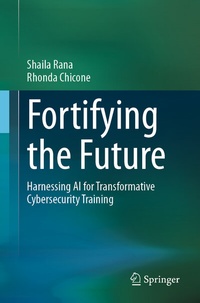
Fortifying the Future
Description

This comprehensive handbook explores how artificial intelligence is transforming cybersecurity training, with a specific focus on practical implementation strategies for organizations. The book examines AI-driven approaches including personalized learning systems, gamification techniques, and immersive training environments using virtual and augmented reality. It provides detailed guidance on creating adaptive learning programs that respond to individual learner needs while addressing emerging cybersecurity threats.
Key topics include AI-powered personalization of training content, development of realistic threat scenarios, integration of VR/AR technologies for hands-on practice, and implementation of gamification elements to boost engagement. The book offers concrete strategies for organizations to leverage AI in building more effective and engaging cybersecurity training programs that adapt to evolving security challenges. This handbook distinguishes itself from existing cybersecurity literature by focusing specifically on AI's application in training and skill development, rather than general cybersecurity operations. It serves both as a practical guide for professionals implementing AI-driven training programs and as a valuable resource for researchers and educators in cybersecurity, artificial intelligence, and organizational learning.
More details
Other editions
Additional editions
Persons
Dr. Shaila Rana is the Founder of CyberSecure, a cybersecurity consulting firm and a Professor of Cybersecurity and IT. She is also the co-founder of the ACT Research Institute, which is an AI, cybersecurity, and technology focused thinktank. Dr. Rana is also the chair of an IEEE Standards Association (SA) for ZTA in Healthcare, an Author at Pluralsight, and an Instructor at O'Reilly. Her research focuses primarily on AI, cybersecurity, and VR/AR. She has authored multiple courses focusing on security risks associated with AI, security governance, and cybersecurity laws and regulations. She holds a PhD specializing in Information Systems Security and holds an MS in Computer Information Systems specializing in Cybersecurity. Dr. Rana publishes and presents at multiple conferences annually and serves as a review for multiple journals.
Dr. Rhonda Chicone is a dedicated academic, professor, researcher, and software engineer with dual passions for software product development and cybersecurity. Throughout her career, she has held various positions, including software engineer, software engineering manager, director of software development, CTO (Chief Technology Officer), CSO (Chief Security Officer), and Professor, primarily focusing on commercial software products. Her significant contributions to program development within academia demonstrate her strong passion for the intersection of innovation, education, and technology. She is the Co-Founder of the ACT Research Institute, an AI, cybersecurity and technology focused thinktank. In addition to her professional achievements, she frequently publishes and presents at national conferences.
Content
Introduction to AI in Cybersecurity Training.- AI Driven Personalized Learning in Cybersecurity Training.- Gamification and Immersive Learning with AI.- AI Generated Realistic Threat Scenarios.- AI Enhanced Virtual and Augmented Reality for Cybersecurity Training.
