

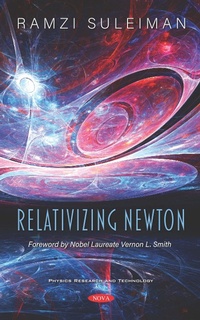
Relativizing Newton
Published on 14. November 2019
250 pages
978-1-5361-6636-1 (ISBN)
Description

"Relativizing Newton" is a first step towards a simple and beautiful theory of everything. The theory, termed "Information Relativity" (IR) takes a novel approach to physics that overlooks all post-Newtonian physics. It stands on the shoulders of Newtonian dynamics, but modifies it by accounting for the time-travel of information from one reference-frame to another, a fact which somehow was ignored by Galileo Galilee and Isaac Newton, and which remained ill-treated by all post-Newtonian theories, including Einstein's relativity and quantum theories. Except for the aforementioned correction of classical physics, IR has no axiomatic presumptions, nor arbitrary free parameters. Astonishingly, accounting for the aforementioned delays in information results in a set of simple and beautiful transformations, which explain and predict a great deal of physical phenomena. Most importantly, IR's transformations reveal the mysteries of dark matter, dark energy, and gravity. They also provide a unifying platform for the physics of the too-big (astrophysics and cosmology), and the too-small (small particles dynamics and quantum mechanics). The phenomena explained and predicted successfully by IR include the "time-dilation" of decaying muons, the neutrino velocities measured by OPERA and other collaborations, particle diffraction in the double-slit experiment, Sagnac Effects, the quantization of orbits in Bohr's hydrogen atom, entanglement, quantum criticality, confinement, asymptotic freedom, solar light bending, gravitational redshift, the Pioneer anomaly, dark matter in galaxies, and the Schwarzschild's black hole.
More details
Other editions
Additional editions
Ramzi Suleiman
Relativizing Newton
Book
12/2019
Nova Science Publishers Inc
€257.42
Shipment within 15-20 days
Content
- Intro
- Contents
- Foreword
- References
- Acknowledgments
- A Personal Note
- Overview
- Part 1: On the Dynamics of Bodies in Rectilinear Motion
- Chapter 1
- How Newton's Laws Were Relativized
- 1.1. The Basic Idea
- 1.2. Theory Transformations for Inertial Rectilinear Motion
- 1.2.1. Time Duration Transformation
- 1.2.2. Length Transformation
- 1.2.3. Mass Density Transformation
- 1.2.4. Energy Density Transformation
- 1.3. Summary and Concluding Remarks
- 1.3.1. Matter-Dark Matter Duality
- 1.3.2. Quantum Phase Transition and Quantum Criticality
- 1.3.3. Beautiful Symmetries
- Chapter 2
- Applications to Small Particle Physics I
- 2.1. Predicting the "Time Dilation" of Decaying Muons
- 2.2. Prediction of Neutrino Velocities
- 2.3. Concluding Remarks
- Chapter 3
- The Twin Paradox: A Commonsensical Solution
- 3.1. Introduction
- 3.2. A Commonsensical Solution to the Twin Paradox
- Earth Star
- Star Earth
- Earth Star Earth
- 3.3. Body Dimensions and Mass of a Traveling Twin
- 3.4. Concluding Remarks
- Chapter 4
- Application to Quantum Mechanics I: Particles Diffraction in the Double-Slit Experiment
- 4.1. Introduction
- 4.2. Theoretical Explanations
- 4.2.1. Quantum Theory
- 4.2.2. de Broglie-Bohm's Theory
- 4.3. Information Relativity Solution
- 4.3.1. Quantitative Considerations
- 4.4. Concluding Remarks
- Chapter 5
- Application to Cosmology I: Dark Energy
- 5.1. Introduction
- 5.2. Recession Velocity and Redshift
- 5.3. The Pattern of Recession Velocity
- 5.4. Matter: Dark Matter Dynamics in the Receding Universe
- 5.5. What Is Dark Energy?
- 5.6. Summary and Main Conclusion
- Chapter 6
- Relativizing Newton's Law of Gravitation
- 6.1. Relativistic Gravity in Rectilinear Systems
- 6.2. Velocity as a Function of Distance from a Gravitating Body
- 6.3. Time Duration and Length Transformations in a Body's Gravitational Field
- 6.4. Relativistic Force as a Function of Distance from a Gravitating Body
- 6.5. Matter and Dark Matter Duality in a Gravitational Field
- 6.6. Summary of Main Results
- Chapter 7
- Application to Astrophysics I: Light Bending
- 7.1. Introduction
- 7.2. Measurement of Solar Light Bending
- 7.3. Light Bending in General Relativity and Newtonian Dynamics
- 7.4. The 1919 Eclipse Tests
- 7.5. Information Relativity Theory Prediction of Light-Bending
- 7.6. Comparisons between the Predictions of IR and GR
- 7.7. Prediction of Light Deflection by the Sun during the 2017 Eclipse
- 7.8. Summary and Conclusion
- Chapter 8
- Application to Astrophysics II: Gravitational Redshift
- 8.1. Introduction
- 8.2. Information Relativity Prediction of the Gravitational Redshift
- 8.3. Concluding Remarks
- Chapter 9
- Application to Astrophysics III: Relativizing Newton's Second Law and the Pioneer Anomaly
- 9.1. Introduction
- 9.2. Relativizing Newton's Second Law
- 9.3. Explaining the Pioneer Anomaly
- 9.4. Concluding Remarks
- Part 2: On the Dynamics of Bodies in Rotational Motion
- Chapter 10
- Rethinking Newton's First Law
- 10.1. Introduction
- 10.2. On the Equivalence between Rectilinear and Circular Motion
- 10.3. Implications to the Case of Uniform Motion
- 10.4. Restatement and Formalization of Newton's First Law
- 10.5. Some Implications to Classical and Relativistic Physics
- 10.6. Concluding Remarks
- Chapter 11
- Application to Small Particle Physics II: Circular and Rectilinear Sagnac Effects
- 11.1. Introduction
- 11.2. Linear Sagnac Effect
- 11.3. Circular and Linear Sagnac Effects Are Dynamically Equivalent
- 11.4. Summary and Concluding Remarks
- Chapter 12
- Application to Quantum Mechanics II: Solving the Hydrogen Atom Problem
- 12.1. Introduction
- 12.2 Proposed Solution
- 12.3. Concluding Remarks
- Chapter 13
- Matter and Dark Matter Dynamics in Rotating Bodies
- 13.1. Matter and Dark Matter Dynamics in a Rotating Disk
- 13.2. Matter and Dark Matter Dynamics in a Rotating Sphere
- Chapter 14
- Application to Cosmology II: Matter and Dark Matter Dynamics in Rotationally Supported Galaxies
- 14.1. Introduction
- 14.2. The Model
- 14.3. Model Testing
- 14.4. Concluding Remarks
- Chapter 15
- Application to Cosmology III: Does Ultra-Diffuse Galaxies NGC 1052-DF2 and NGC 1052-DF4 Lack Dark Matter?
- 15.1. Introduction
- 15.2. Predicting the Dynamics of Matter - Dark Matter in Galaxy NGC 1052 - DF2
- The Simulation
- Results
- 15.3. Predicting the Dynamics of Matter-Dark Matter in Galaxy NGC 1052 - DF4
- 15.4. Summary and Conclusion
- Chapter 16
- Application to Cosmology IV: The Schwarzschild Black Hole
- 16.1. Introduction
- 16.2. A Nonsingular Solution for the Schwarzschild Black Hole
- 16.3. Summary and Concluding Remarks
- Chapter 17
- On Gravity and Dark Matter
- 17.1. Introduction
- 17.2. Current Views of Gravity
- 17.3. Newton's Gravity
- 17.4. Gravity Enacted by Dark Matter
- 17.4.1. Gravity in the Solar System
- 17.4.2. Back to Newton's Apple
- 17.5. Concluding Remarks
- Chapter 18
- Integrative Summary
- 18.1. Basic Idea
- 18.2. Matter - Dark Matter Duality
- 18.3. Dark Matter as Gravity
- 18.4. Dark Energy
- 18.5. Locality and Realism of Quantum Phenomena
- 18.5.1. Entanglement
- 18.5.2. Quantization of Orbits Is Deterministic
- 18.5.3. Quantum Criticality
- 18.5.4. Asymptotic Freedom and Confinement
- 18.6. Addendum
- References
- About the Author
- Index
- Blank Page
