

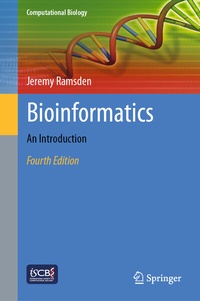
Bioinformatics
Description

This invaluable textbook presents a self-contained introduction to the field of bioinformatics. Providing a comprehensive breadth of coverage while remaining accessibly concise, the text promotes a deep understanding of the field, supported by basic mathematical concepts, an emphasis on biological knowledge, and a holistic approach that highlights the connections unifying bioinformatics with other areas of science.
The thoroughly revised and enhanced fourth edition features new chapters focusing on regulation and control networks, the origins of life, evolution, statistics and causation, viruses, the microbiome, single cell analysis, drug discovery and forensic applications. This edition additionally includes new and updated material on the ontology of bioinformatics, data mining, ecosystems, and phenomics. Also covered are new developments in sequencing technologies, gene editing methods, and modelling of the brain, as well as state-of-the-art medical applications. Of specialtopicality is a new chapter on bioinformatics aspects of the coronavirus pandemic.
Topics and features:
- Explains the fundamentals of set theory, combinatorics, probability, likelihood, causality, clustering, pattern recognition, randomness, complexity, systems, and networks
- Discusses topics on ontogeny, phylogeny, genome structure, and regulation, as well as aspects of molecular biology
- Critically examines the most significant practical applications, offering detailed descriptions of both the experimental process and the analysis of the data
- Provides a varied selection of problems throughout the book, to stimulate further thinking
- Encourages further reading through the inclusion of an extensive bibliography
This classic textbook builds upon the successful formula of previous editions with coverage of the latest advances in this exciting and fast-moving field. With its interdisciplinary scope, this unique guide will prove to be an essential study companion to a broad audience of undergraduate and beginning graduate students, spanning computer scientists focusing on bioinformatics, students of the physical sciences seeking a helpful primer on biology, and biologists desiring to better understand the theory underlying important applications of information science in biology.
Dr. Jeremy Ramsden is Hon. Prof. of Nanotechnology in the Department of Biomedical Research at the University of Buckingham, UK.
Reviews / Votes
"This book serves as a complete study companion for undergraduates and graduate students. With its invaluable insights into the state-of-the-art of bioinformatics, the book is also ideal for physical scientists seeking a succinct guide to biology, and for biological scientists wishing to better understand the physicochemical and mathematical aspects underpinning the applications." (Junliang Lu, zbMATH 1536.92001, 2024)
More details
Other editions
Additional editions
Previous edition
Person
Content
Introduction.- Part I: Overview .- Genotype, Phenotype and Environment.- Regulation and Control.- Evolution.- Origins of Life and Earth Prehistory.- Part II: Information .- The Nature of Information.- The Transmission of Information.- Sets and Combinatorics.- Probability and Likelihood.- Statistics and Causation.- Randomness and Complexity.- Systems and Networks.- Useful Algorithms.- Part III: Biology.- The Nature of Living Things.- The Molecules of Life.- Environment and Ecology.- Part IV: Omics.- Genomics.- Transcriptomics and Proteomics.- Microbiomics.- Viruses.- Single Cell Analysis and Multiomics.- Biological Signaling.- Regulatory Networks.- The Nervous System.- Phenomics.- Part V: Applications .- Medicine and Disease.- Drug Discovery.- Forensic investigation.- Pandemics.- Domestication.- The Organization of Knowledge
