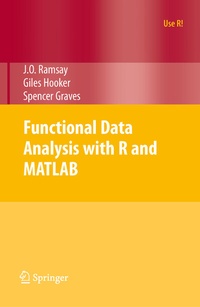
Functional Data Analysis with R and MATLAB
Description

Scientists often collect samples of curves and other functional observations, and develop models where parameters are also functions. This volume in the UseR! Series is aimed at a wide range of readers, and especially those who would like apply these techniques to their research problems. It complements Functional Data Analysis , Second Edition and Applied Functional Data Analysis: Methods and Case Studies by providing computer code in both the R and Matlab languages for a set of data analyses that showcase functional data analysis techniques. The authors make it easy to get up and running in new applications by adapting the code for the examples, and by being able to access the details of key functions within these pages. This book is accompanied by additional web-based support at http://www.functionaldata.org for applying existing functions and developing new ones in either language. The companion 'fda' package for R includes script files to reproduce nearly all the examples in the book including all but one of the 76 figures.
Reviews / Votes
From the reviews:
"The book is intended as a means of introducing functional data analysis to those who would like to use it as a research tool in a variety of applications. It gives a brief but clear description of the concepts and methods together with a strong focus on implementation. The mixture of R and RATLAB illustrative code works well and the latter computing environment, together with the material on dynamics, will suit those from an engineering or physical sciences background. It therefore provides an excellent starting point for those who would like to make use of these very powerful techniques in analyzing data." (Journal of Statistical Software, April 2010, Vol. 34, Book Review 3)
"This well-written book provides a great, intuitive introduction to functional data analysis . . I recommend this book for statisticians wanting to learn about the basics of functional data analysis, as well as practitioners wanting to explore their own data and perform some analyses on their own. . it would be a good basis for an applied course in functional data analysis that could be taken by statistics and biostatistics M.S. and Ph.D. students as well as other scientists with a reasonably deep quantitative background." (Jeffrey S. Morris, The American Statistician, Vol. 65 (4), November, 2011)
"The intended audience is anybody performing FDA who must implement or use FDA software. . The goal is to educate and equip the reader for research in and/or implementation of FDA. I strongly recommend the book and will briefly describe each chapter. Most chapters include exercises so the text could easily be used as a text in a course on FDA. . In conclusion, this is a very welcome fda book." (Tom Burr, Technometrics, Vol. 52 (4), November, 2010)
More details
Other editions
Additional editions