

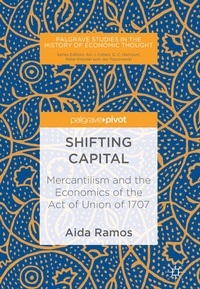
Shifting Capital
Description

When the Act of Union was passed in 1707, Scottish parliament was dissolved and the nation's capital became London. While the general public balked at the perceived unfairness of the treaty, the majority of Scottish ministers seemed satisfied with its terms. This book offers an explanation of how that outcome came about. By examining the influence of a particular strain of mercantilist thought, Ramos demonstrates how the negotiations preceding the passage of the Act of Union were shaped by ideas of value, wealth, trade and power, and, accordingly, how the model of positive balance was used to justify the necessity of the Act.
Utilizing contemporary evidence from the English and Scottish ministers involved, this book explores alternative arguments regarding the Union, from before 1707 and in early Scottish political economy, thus highlighting the differing economic and political views that have persisted between England and Scotland for centuries. With twenty-first century discontent leading to the Scottish independence referendum and arguments that persist in the wake of the Brexit decision, Ramos produces timely research that investigates ideas of protectionism that feed into mercantilist economic thought.
More details
Other editions
Additional editions
Person
Content
Chapter 1: Introduction.- Chapter 2: The Political and Economic Contest and Context: Scotland and England Before the Union.- Chapter 3: Beyond Trade: Mercantilist Ideas of Dependency, Value, and Transmutation and Justification of Union.- Chapter 4: Trick or Treaty: The Negotiation and Articles of Union in the Context of Mercantilist Ideas.- Chapter 5: Balancing Act: The Equivalent, Political Arithmetic, and Mercantilist Structural Violence.- Chapter 6: Shifting Capital.- Chapter 7: Unintended Consequences: Scottish Political Economy as a Reaction to Mercantilism.
