

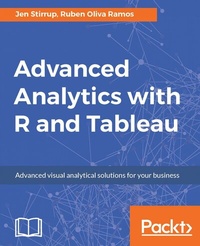
Advanced Analytics with R and Tableau
Advanced analytics using data classification, unsupervised learning and data visualization
Published on 13. January 2025
178 pages
978-1-78646-024-0 (ISBN)
Description

No detailed description available for "Advanced Analytics with R and Tableau".
All prices
More details
Edition
Digital original
Language
English
Place of publication
Birmingham
United Kingdom
Target group
Professional and scholarly
US School Grade: College Graduate Student
Edition type
Digital original
File size
3,62 MB
ISBN-13
978-1-78646-024-0 (9781786460240)
Copyright in bibliographic data and cover images is held by Nielsen Book Services Limited or by the publishers or by their respective licensors: all rights reserved.
Schweitzer Classification
Other editions
Additional editions
Ruben Oliva Ramos | Jen Stirrup | Roberto Roesler
Advanced Analytics with R and Tableau
Book
08/2017
Packt Publishing
€50.00
Shipment within 3-4 weeks
Persons
Oliva Ramos Ruben :
Ruben Oliva Ramos is a computer systems engineer from Tecnologico de Leon Institute, with a master's degree in computer and electronic systems engineering and a specialization in teleinformatics and networking from the University of Salle Bajio in Leon, Guanajuato, Mexico. He has more than 5 years of experience of developing web applications to control and monitor devices connected with Arduino and Raspberry Pi, using web frameworks and cloud services to build the Internet of Things applications. He is a mechatronics teacher at the University of Salle Bajio and teaches students of the master's degree in design and engineering of mechatronics systems. Ruben also works at Centro de Bachillerato Tecnologico Industrial 225 teaching subjects such as electronics, robotics and control, automation, and microcontrollers. He is a consultant and developer for projects in areas such as monitoring systems and datalogger data using technologies (such as Android, iOS, HTML5, and ASP.NET), databases (such as SQlite, MongoDB, and MySQL), web servers, hardware programming, and control and monitor systems for data acquisition and programming.Stirrup Jen :
Jen Stirrup is a data strategist and technologist, a Microsoft Most Valuable Professional (MVP), and a Microsoft Regional Director, a tech community advocate, a public speaker and blogger, a published author, and a keynote speaker. Jen is the founder of a boutique consultancy based in the UK, Data Relish, which focuses on delivering successful business intelligence and artificial intelligence solutions that add real value to customers worldwide. She has featured on the BBC as a guest expert on topics relating to data.
Ruben Oliva Ramos is a computer systems engineer from Tecnologico de Leon Institute, with a master's degree in computer and electronic systems engineering and a specialization in teleinformatics and networking from the University of Salle Bajio in Leon, Guanajuato, Mexico. He has more than 5 years of experience of developing web applications to control and monitor devices connected with Arduino and Raspberry Pi, using web frameworks and cloud services to build the Internet of Things applications. He is a mechatronics teacher at the University of Salle Bajio and teaches students of the master's degree in design and engineering of mechatronics systems. Ruben also works at Centro de Bachillerato Tecnologico Industrial 225 teaching subjects such as electronics, robotics and control, automation, and microcontrollers. He is a consultant and developer for projects in areas such as monitoring systems and datalogger data using technologies (such as Android, iOS, HTML5, and ASP.NET), databases (such as SQlite, MongoDB, and MySQL), web servers, hardware programming, and control and monitor systems for data acquisition and programming.Stirrup Jen :
Jen Stirrup is a data strategist and technologist, a Microsoft Most Valuable Professional (MVP), and a Microsoft Regional Director, a tech community advocate, a public speaker and blogger, a published author, and a keynote speaker. Jen is the founder of a boutique consultancy based in the UK, Data Relish, which focuses on delivering successful business intelligence and artificial intelligence solutions that add real value to customers worldwide. She has featured on the BBC as a guest expert on topics relating to data.
Content
- Cover
- Copyright
- Credits
- About the Authors
- About the Reviewers
- www.PacktPub.com
- Customer Feedback
- Table of Contents
- Preface
- Chapter 1: Advanced Analytics with R and Tableau
- Installing R for Windows
- RStudio
- Prerequisites for RStudio installation
- Implementing the scripts for the book
- Testing the scripting
- Tableau and R connectivity using Rserve
- Installing Rserve
- Configuring an Rserve Connection
- Summary
- Chapter 2: The Power of R
- Core essentials of R programming
- Variables
- Creating variables
- Working with variables
- Data structures in R
- Vector
- Lists
- Matrices
- Factors
- Data frames
- Control structures in R
- Assignment operators
- Logical operators
- For loops and vectorization in R
- For loops
- Functions
- Creating your own function
- Making R run more efficiently in Tableau
- Summary
- Chapter 3: A Methodology for Advanced Analytics Using Tableau and R
- Industry standard methodologies for analytics
- CRISP-DM
- Business understanding/data understanding
- CRISP-DM model - data preparation
- CRISP-DM - modeling phase
- CRISP-DM - evaluation
- CRISP-DM - deployment
- CRISP-DM - process restarted
- CRISP-DM summary
- Team Data Science Process
- Business understanding
- Data acquisition and understanding
- Modeling
- Deployment
- TDSP Summary
- Working with dirty data
- Introduction to dplyr
- Summarizing the data with dplyr
- Summary
- Chapter 4: Prediction with R and Tableau Using Regression
- Getting started with regression
- Simple linear regression
- Using lm() to conduct a simple linear regression
- Coefficients
- Residual standard error
- Comparing actual values with predicted results
- Investigating relationships in the data
- Replicating our results using R and Tableau together
- Getting started with multiple regression?
- Building our multiple regression model
- Confusion matrix
- Prerequisites
- Instructions
- Solving the business question
- What do the terms mean?
- Understanding the performance of the result
- Next steps
- Sharing our data analysis using Tableau
- Interpreting the results
- Summary
- Chapter 5: Classifying Data with Tableau
- Business understanding
- Understanding the data
- Data preparation
- Describing the data
- Data exploration
- Modeling in R
- Analyzing the results of the decision tree
- Model deployment
- Decision trees in Tableau using R
- Bayesian methods
- Graphs
- Terminology and representations
- Graph implementations
- Summary
- Chapter 6: Advanced Analytics Using Clustering
- What is Clustering?
- Finding clusters in data
- Why can't I drag my Clusters to the Analytics pane?
- Clustering in Tableau
- How does k-means work?
- How to do Clustering in Tableau
- Creating Clusters
- Clustering example in Tableau
- Creating a Tableau group from cluster results
- Constraints on saving Clusters
- Interpreting your results
- How Clustering Works in Tableau
- The clustering algorithm
- Scaling
- Clustering without using k-means
- Hierarchical modeling
- Statistics for Clustering
- Describing Clusters - Summary tab
- Testing your Clustering
- Describing Clusters - Models Tab
- Introduction to R
- Summary
- Chapter 7: Advanced Analytics with Unsupervised Learning
- What are neural networks?
- Different types of neural networks
- Backpropagation and Feedforward neural networks
- Evaluating a neural network model
- Neural network performance measures
- Receiver Operating Characteristic curve
- Precision and Recall curve
- Lift scores
- Visualizing neural network results
- Neural network in R
- Modeling and evaluating data in Tableau
- Using Tableau to evaluate data
- Summary
- Chapter 8: Interpreting Your Results for Your Audience
- Introduction to decision system and machine learning
- Decision system-based Bayesian
- Decision system-based fuzzy logic
- Bayesian Theory
- Fuzzy logic
- Building a simple decision system-based Bayesian theory
- Integrating a decision system and IoT project
- Building your own decision system-based IoT
- Wiring
- Writing the program
- Testing
- Enhancement
- Summary
- References
- Index

