

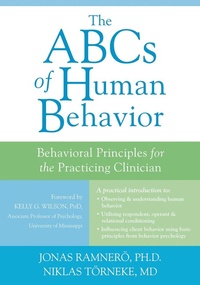
ABCs of Human Behavior
Description

When cognitive behavior therapy emerged in the 1950s, driven by the work of Albert Ellis and Aaron Beck, basic behavior principles were largely sidelined in clinical psychology curricula. Issues in cognition became the focus of case conceptualization and intervention planning for most therapists. But as the new third-wave behavior therapies begin to address weaknesses in the traditional cognitive behavioral models-principally the modest effectiveness of thought stopping and cognitive restructuring techniques-basic behavior principles are once again attracting the interest of front-line clinicians. Many of today's clinicians, though, received their training during the years in which classical behaviorism was not a major part of clinical education. In order to make the best use of the new contextual behaviorism, they need to revisit basic behavioral principles from a practical angle. This book addresses this need.
The ABCs of Human Behavior offers practicing clinicians...
More details
Other editions
Additional editions
Person
Niklas Törneke, MD, is a psychiatrist, and has worked as a senior psychiatrist in the department of general psychiatry in his hometown of Kalmar, Sweden, from 1991 until he started a private practice in 1998. He earned his license as a psychotherapist in 1996, and was originally trained as a cognitive therapist. Since 1998, he has worked mainly with acceptance and commitment therapy (ACT), both in his own practice and as a teacher and clinical supervisor. His clinical experience ranges from psychiatric disorders such as schizophrenia to common anxiety and mood disorders with high prevalence in the general population.
Content
- Intro
- Foreword
- Our Thanks
- Introduction
- Building on Behaviorism: Cognitive/Behavioral Therapies, Behavioral Psychotherapy, and Functional Contextualism
- Part 1
- Describing Behavior
- Chapter 1
- Topographical Aspects of Behavior
- Chapter 2
- Observing Behavior: When, Where, and How Much?
- Chapter 3
- Knowing Your ABCs
- Part 2
- Explaining Behavior
- Chapter 4
- Learning by Association: Respondent Conditioning
- Chapter 5
- Learning by Consequences: Operant Conditioning
- Chapter 6
- Operant Conditioning: Stimulus Control
- Chapter 7
- Learning by Relational Framing: Language and Cognition
- Chapter 8
- Applying Your ABCs
- Part 3
- Changing Behavior
- Chapter 9
- Functional Knowledge
- Chapter 10
- Dialogue Toward Change
- Chapter 11
- Principles and Practices
- Chapter 12
- Principles of Treatment: One
- Chapter 13
- Principles of Treatment: Two
- Afterword
- Suggested Reading
- References
- Index
