

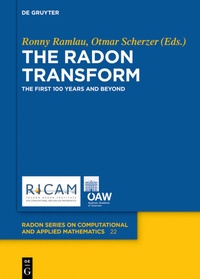
The Radon Transform
The First 100 Years and Beyond
1st Edition
Published on 17. June 2019
VI, 341 pages
978-3-11-056085-5 (ISBN)
Description

In 1917, Johann Radon published his fundamental work, where he introduced what is now called the Radon transform. Including important contributions by several experts, this book reports on ground-breaking developments related to the Radon transform throughout these years, and also discusses novel mathematical research topics and applications for the next century.
More details
Other editions
Additional editions
Book
02/2024
1st Edition
De Gruyter
€179.95
Shipment within 7-9 days
E-Book
06/2019
1st Edition
De Gruyter
€179.95
Available for download
Persons
Ronny Ramlau , Johannes Kepler U. Linz and Johann Radon Inst., Austria; Otmar Scherzer , U. of Vienna and Johann Radon Inst., Austria.
Content
- Intro
- Contents
- 100 years of Mathematical Tomography
- 1. Johann Radon 1887-1956
- 2. On blind imaging, NMF and PET
- 3. From Radon to Leray
- 4. Integral geometry on manifolds with boundary and applications
- 5. Non-Abelian Radon transform and its applications
- 6. Remarks on the second century of the Funk-Radon theory
- 7. V-line and conical Radon transforms with applications in imaging
- 8. Uncertainty, ghosts, and resolution in Radon problems
- 9. The importance of the Radon transform in vector field tomography
- 10. Iterative reconstruction techniques and their superiorization for the inversion of the Radon transform
- 11. Quantitative photoacoustic tomography in Bayesian framework
- 12. Inverse Born series
- 13. On the reconstruction of static and dynamic discrete structures
