

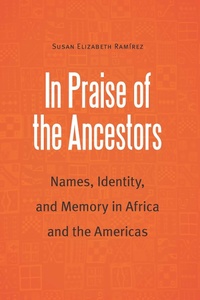
In Praise of the Ancestors
Names, Identity, and Memory in Africa and the Americas
1st Edition
Published on 1. June 2022
244 pages
978-1-4962-3207-6 (ISBN)
Description

Apart from collective memories of lived experiences, much of the modern world's historical sense comes from written sources stored in the archives of the world, and some scholars in the not-so-distant past have described unlettered civilizations as "peoples without history." In Praise of the Ancestors is a revisionist interpretation of early colonial accounts that reveal incongruities in accepted knowledge about three Native groups.
Susan Elizabeth RamIrez reevaluates three case studies of oral traditions using positional inheritance-a system in which names and titles are inherited from one generation by another and thereby contribute to the formation of collective memories and a group identity. RamIrez begins by examining positional inheritance and perpetual kinship among the Kazembes in central Africa from the eighteenth to the mid-twentieth centuries. Next, her analysis moves to the Native groups of the Iroquois Confederation and their practice of using names to memorialize remarkable leaders in the seventeenth and eighteenth centuries. Finally, RamIrez surveys naming practices of the Andeans, based on sixteenth-century manuscript sources and later testimonies found in Spanish and Andean archives, questioning colonial narratives by documenting the use of this alternative system of memory perpetuation, which was initially unrecognized by the Spaniards.
In the process of reexamining the histories of Native peoples on three continents, RamIrez broaches a wider issue: namely, understanding of the nature of knowledge as fundamental to understanding and evaluating the knowledge itself.
Susan Elizabeth RamIrez reevaluates three case studies of oral traditions using positional inheritance-a system in which names and titles are inherited from one generation by another and thereby contribute to the formation of collective memories and a group identity. RamIrez begins by examining positional inheritance and perpetual kinship among the Kazembes in central Africa from the eighteenth to the mid-twentieth centuries. Next, her analysis moves to the Native groups of the Iroquois Confederation and their practice of using names to memorialize remarkable leaders in the seventeenth and eighteenth centuries. Finally, RamIrez surveys naming practices of the Andeans, based on sixteenth-century manuscript sources and later testimonies found in Spanish and Andean archives, questioning colonial narratives by documenting the use of this alternative system of memory perpetuation, which was initially unrecognized by the Spaniards.
In the process of reexamining the histories of Native peoples on three continents, RamIrez broaches a wider issue: namely, understanding of the nature of knowledge as fundamental to understanding and evaluating the knowledge itself.
Reviews / Votes
"In Praise of the Ancestors will be of immense value to historians, anthropologists, folklorists, and anyone striving to understand oral tradition as history, the cultural logics underpinning succession, and the constitution of personhood itself."-Kirstin C. Erickson, Journal of Folklore Research Reviews "What's in a name? In this concise and well-arranged comparative history, Susan Elizabeth RamIrez offers an arresting answer regarding the nature of historical consciousness in societies without writing."-Christopher Heaney, Hispanic American Historical Review "This book expresses a fresh and durably important answer to questions about how 'precapitalist' states and federations envisioned time and change. Ethnographers on four continents have repeatedly intuited that kingdoms and federations purposely made history in a patterned way. But on what pattern, and why? This book is a big deal. It's short, original, engrossing, and brightly lit up with cross-cultural insight."-Frank Salomon, John V. Murra Professor Emeritus of Anthropology at the University of Wisconsin-Madison and past president of the American Society for EthnohistoryMore details
Series
Language
English
Place of publication
Lincoln
United States
Target group
College/higher education
Illustrations
6 photographs, 6 illustrations, 3 maps, 11 tables, appendix, index
File size
11,10 MB
ISBN-13
978-1-4962-3207-6 (9781496232076)
Copyright in bibliographic data and cover images is held by Nielsen Book Services Limited or by the publishers or by their respective licensors: all rights reserved.
Schweitzer Classification
Other editions
Additional editions
Susan Elizabeth Ramirez
In Praise of the Ancestors
Names, Identity, and Memory in Africa and the Americas
Book
06/2022
University of Nebraska Press
€117.96
Shipment within 15-20 days
Susan Elizabeth Ramirez
In Praise of the Ancestors
Names, Identity, and Memory in Africa and the Americas
Book
06/2022
University of Nebraska Press
€29.00
Shipment within 15-20 days
Person
Susan Elizabeth RamIrez is the Neville G. Penrose Chair of History and Latin American Studies at Texas Christian University. She is the author of several books, including To Feed and Be Fed: The Cosmological Bases of Authority and Identity in the Andes and A History of Colonial Latin America from First Encounters to Independence.
Content
List of Illustrations
List of Maps
List of Tables
Acknowledgments
1. Alternative Ways of Remembering and Knowing
2. "Positional Inheritance" in Africa
3. The Narration of Ho-De'-No-Sau-Nee (Iroquois) History
4. The Making of Andean Ancestral Traditions
5. Reflections on Oral Traditions as History
Appendix: The Accomplishments of the Pachacuti(s) according to Betanzos and Montesinos
Notes
References
Index
List of Maps
List of Tables
Acknowledgments
1. Alternative Ways of Remembering and Knowing
2. "Positional Inheritance" in Africa
3. The Narration of Ho-De'-No-Sau-Nee (Iroquois) History
4. The Making of Andean Ancestral Traditions
5. Reflections on Oral Traditions as History
Appendix: The Accomplishments of the Pachacuti(s) according to Betanzos and Montesinos
Notes
References
Index
