

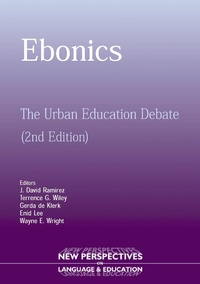
Ebonics
The Urban Education Debate
2nd Edition
Published on 22. March 2005
224 pages
978-1-85359-798-5 (ISBN)
Description

Controversy erupted in 1996 when the Oakland Unified School District's 'Ebonics Resolution' proposed an approach to teaching Standard English that recognized the variety of English spoken by African American students. With new demands for accountability driven by the No Child Left Behind policy and its emphasis on high-stakes testing in Standard English, this debate will no doubt rise again. This book seeks to better inform this next episode.
In Part 1, leading scholars place the debate within its historical and contemporary context, provide clear explanations of what Ebonics is and is not, and offer practical approaches schools can and should follow to address the linguistic needs of African American students. Part 2 provides original documents that accompanied the debate, including the original resolutions, legislation, organization position papers, and commentary/analyses from leading linguists. This book is written for all those whose work impacts the lives of Ebonics speakers in our public schools.
In Part 1, leading scholars place the debate within its historical and contemporary context, provide clear explanations of what Ebonics is and is not, and offer practical approaches schools can and should follow to address the linguistic needs of African American students. Part 2 provides original documents that accompanied the debate, including the original resolutions, legislation, organization position papers, and commentary/analyses from leading linguists. This book is written for all those whose work impacts the lives of Ebonics speakers in our public schools.
More details
Series
Edition
2nd Revised edition
Language
English
Place of publication
Bristol
United Kingdom
Publishing group
Channel View Publications Ltd
Target group
Professional and scholarly
Edition type
Revised edition
ISBN-13
978-1-85359-798-5 (9781853597985)
Copyright in bibliographic data and cover images is held by Nielsen Book Services Limited or by the publishers or by their respective licensors: all rights reserved.
Schweitzer Classification
Other editions
Additional editions
Book
03/2005
2nd Edition
Multilingual Matters
€135.50
Shipment within 10-20 days
Book
03/2005
2nd Edition
Multilingual Matters
€41.70
Shipment within 10-20 days
E-Book
03/2005
1st Edition
Multilingual Matters
€14.49
Available for download
Previous edition
E-Book
03/2005
1st Edition
Multilingual Matters
€14.49
Available for download
Persons
J. David Ramirez is Dean of the School of Education at Long Island University's Brooklyn Campus. Dr Ramirez is a nationally recognized educational leader and the former principal investigator of the Ramirez Study (the most often cited longitudinal study on bilingual education in the US and the first national study of its kind).
Terrence G. Wiley is Director of the Division of Educational Leadership and Policy Studies in the College of Education at Arizona State University. He is the author of several books and numerous articles on language policy, literacy, biliteracy, and language diversity. He currently co-edits, with Thomas Ricento, the Journal of Language, Identity, and Education.
Gerda de Klerk is a doctoral student in the College of Education at Arizona State University. She has worked in language policy formulation and implementation issues in South Africa, where she was the editor of Bua!, a magazine popularizing sociolinguistic matters.
Enid Lee is the director of Enidlee Consultants. She consults internationally on anti-racist, inclusionary, and equitable education. Enid has been involved in the professional development of teachers for two decades. She is the author of over 30 publications, including Letters to Marcia: A Teacher's Guide to Anti-Racist Education.
Wayne E. Wright is an assistant professor in the Division of Bicultural-Bilingual Studies at the University of Texas, San Antonio. He also serves as the Co-Director of the Language Policy Research Unit of the Educational Policy Studies Laboratory at Arizona State University.
Terrence G. Wiley is Director of the Division of Educational Leadership and Policy Studies in the College of Education at Arizona State University. He is the author of several books and numerous articles on language policy, literacy, biliteracy, and language diversity. He currently co-edits, with Thomas Ricento, the Journal of Language, Identity, and Education.
Gerda de Klerk is a doctoral student in the College of Education at Arizona State University. She has worked in language policy formulation and implementation issues in South Africa, where she was the editor of Bua!, a magazine popularizing sociolinguistic matters.
Enid Lee is the director of Enidlee Consultants. She consults internationally on anti-racist, inclusionary, and equitable education. Enid has been involved in the professional development of teachers for two decades. She is the author of over 30 publications, including Letters to Marcia: A Teacher's Guide to Anti-Racist Education.
Wayne E. Wright is an assistant professor in the Division of Bicultural-Bilingual Studies at the University of Texas, San Antonio. He also serves as the Co-Director of the Language Policy Research Unit of the Educational Policy Studies Laboratory at Arizona State University.
Content
Acknowledgements
Introduction
Part 1: Ebonics in the Urban Education Debate
1 Terrence G. Wiley: Ebonics: Background to the Current Policy Debate
2 John R. Rickford: Using the Vernacular to Teach the Standard
3 John Baugh: Educational Implications of Ebonics
4 Geneva Smitherman: Black Language and the Education of Black Children: One Mo Once
5 Subira Kifano and Ernie A. Smith: Ebonics and Education in the Context of Culture: Meeting the Language and Cultural Needs of LEP African American Students
6 Carolyn Temple Adger: Language Varieties in the School Curriculum: Where Do They Belong and How Will They Get There?
Part 2: Background to the Ebonics Debate
Introduction
Oakland Unified School District's Resolution
Examples of Legislative Reaction
Legal Background
Linguists' Reactions
Organizational Responses
Recommended Readings on Ebonics
Introduction
Part 1: Ebonics in the Urban Education Debate
1 Terrence G. Wiley: Ebonics: Background to the Current Policy Debate
2 John R. Rickford: Using the Vernacular to Teach the Standard
3 John Baugh: Educational Implications of Ebonics
4 Geneva Smitherman: Black Language and the Education of Black Children: One Mo Once
5 Subira Kifano and Ernie A. Smith: Ebonics and Education in the Context of Culture: Meeting the Language and Cultural Needs of LEP African American Students
6 Carolyn Temple Adger: Language Varieties in the School Curriculum: Where Do They Belong and How Will They Get There?
Part 2: Background to the Ebonics Debate
Introduction
Oakland Unified School District's Resolution
Examples of Legislative Reaction
Legal Background
Linguists' Reactions
Organizational Responses
Recommended Readings on Ebonics
