

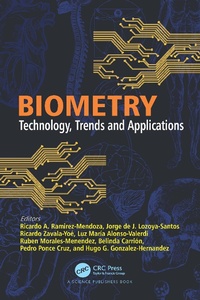
Biometry
Technology, Trends and Applications
1st Edition
Published on 7. July 2022
218 pages
978-1-000-62602-5 (ISBN)
Description

Biometrics provide quantitative representations of human features, physiological and behavioral. This book is a compilation of biometric technologies developed by various research groups in Tecnologico de Monterrey, Mexico. It provides a summary of biometric systems as a whole, explaining the principles behind physiological and behavioral biometrics and exploring different types of commercial and experimental technologies and current and future applications in the fields of security, military, criminology, healthcare education, business, and marketing.
Examples of biometric systems using brain signals or electroencephalography (EEG) are given. Mobile and home EEG use in children's natural environments is covered. At the same time, some examples focus on the relevance of such technology in monitoring epileptic encephalopathies in children.
Using reliable physiological signal acquisition techniques, functional Human Machine Interfaces (HMI) and Brain-Computer Interfaces (BCI) become possible. This is the case of an HMI used for assistive navigation systems, controlled via voice commands, head, and eye movements. A detailed description of the BCI framework is presented, and applications of user-centered BCIs, oriented towards rehabilitation, human performance, and treatment monitoring are explored.
Massive data acquisition also plays an essential role in the evolution of biometric systems. Machine learning, deep learning, and Artificial Intelligence (AI) are crucial allies here. They allow the construction of models that can aid in early diagnosis, seizure detection, and data-centered medical decisions. Such techniques will eventually lead to a more concise understanding of humans.
Examples of biometric systems using brain signals or electroencephalography (EEG) are given. Mobile and home EEG use in children's natural environments is covered. At the same time, some examples focus on the relevance of such technology in monitoring epileptic encephalopathies in children.
Using reliable physiological signal acquisition techniques, functional Human Machine Interfaces (HMI) and Brain-Computer Interfaces (BCI) become possible. This is the case of an HMI used for assistive navigation systems, controlled via voice commands, head, and eye movements. A detailed description of the BCI framework is presented, and applications of user-centered BCIs, oriented towards rehabilitation, human performance, and treatment monitoring are explored.
Massive data acquisition also plays an essential role in the evolution of biometric systems. Machine learning, deep learning, and Artificial Intelligence (AI) are crucial allies here. They allow the construction of models that can aid in early diagnosis, seizure detection, and data-centered medical decisions. Such techniques will eventually lead to a more concise understanding of humans.
More details
Edition
1. Auflage
Language
English
Place of publication
London
United Kingdom
Publishing group
Taylor & Francis Ltd
Target group
Professional and scholarly
Illustrations
20 Tables, black and white; 4 Line drawings, color; 48 Line drawings, black and white; 6 Halftones, color; 9 Halftones, black and white; 10 Illustrations, color; 57 Illustrations, black and white
ISBN-13
978-1-000-62602-5 (9781000626025)
Copyright in bibliographic data and cover images is held by Nielsen Book Services Limited or by the publishers or by their respective licensors: all rights reserved.
Schweitzer Classification
Other editions
Additional editions
Ricardo A. Ramirez-Mendoza | Jorge de J. Lozoya-Santos | Ricardo Zavala-Yoe
Biometry
Technology, Trends and Applications
Book
10/2024
1st Edition
CRC Press
€89.40
Shipment within 15-20 days
Ricardo A. Ramirez-Mendoza | Jorge de J. Lozoya-Santos | Ricardo Zavala-Yoe
Biometry
Technology, Trends and Applications
Book
07/2022
1st Edition
CRC Press
€222.30
Shipment within 15-20 days
Persons
Ricardo A. Ramirez-Mendoza is Professor and Associate Dean of Research and Graduate Studies at the School of Engineering and Sciences, Tecnologico de Monterrey, Mexico. He obtained a Ph.D. degree from Institut National Polytechnique de Grenoble, France, in 1997. His main research interests include applications in automatic control, biomedical signal processing, identification systems, and advanced control to automotive systems. He has authored 3 books, more than 150 papers in top journals, and more than 200 international conference papers. He has worked as an expert consultant for different industries and he is a certified reviewer for regional development projects (manufacturing, automotive, and aerospace). He is a member of the National Research Fellows System in Mexico.
Jorge de J. Lozoya-Santos received the B.Sc. Degree in Electronic Engineering from Instituto Tecnologico de la Laguna, Torreon, Mexico in 2000, the M.Sc. Degree in Automation, and the Ph.D. Degree in Engineering Sciences (advanced materials and mechatronics) from Tecnologico de Monterrey, Mexico, in86, 2005, and 2013, respectively. He has experience in industry cement, Li-ion battery manufacturing, and embedded systems development. As scholar, he has been research professor and dean of research. Jorge has been visiting researcher at University of Grenoble Alpes and Politecnico de Milano. He is the author of more than 50 scientific articles. His research areas are: monitoring, automotive control and biometric systems in engineering. Dr. Lozoya-Santos is a member of the National Researchers System of Mexico (Level I), the Mexican Academic of Sciences and the Engineering Academic of Mexico. Currently, He is a research professor in Tec de Monterrey, National Business Developer by Research and Innovation in the School of Engineering and Sciences, and Director of the Brain International Site of the IUCRC - NSF -Based center in Tecnologico de Monterrey, Monterrey, Mexico.
Ricardo Zavala-Yoe received the Ph.D. degree in Modelling and Control of Dynamical Systems from the University of Groningen, The Netherlands in 2006. Currently, he is Professor at Tecnologico de Monterrey within National School of Engineering and Science where he develops research in the fields of Serial and Parallel Robots, Analysis and Modelling of EEG (electroencephalographic signals), Modelling of Biotechnological Processes and some other Applied and Computational Mathematics areas. He is editor, reviewer, author and co-author of papers in top journals as well as writer of books and book chapters. He is a member of many scientific societies as the Deutsche Gesellschaft fuer Epileptologie (German Society of Epileptology) and he has been invited to give talks of Applied Math for EEG in Epilepsy to Hospitals of Europe and Mexico. He currently does joint research with European universities, plans international events and workshops and writes a new book.
Luz Maria Alonso-Valerdi completed her professional studies at the Faculty of Electronics Sciences at the Meritorious Autonomous University of Puebla. Subsequently, she achieved her master degree in Bioelectronics at the Center for Research and Advanced Studies of the National Polytechnic Institute, and finally, she was award as PhD in Computer Science and Electronic Engineering at the University of Essex, United Kingdom. She has been a teacher for 20 years in different national and international institutions, and has directed around 13 theses both professionally and postgraduate at the Meritorious Autonomous University of Puebla, the University of Guadalajara and the Tecnologico de Monterrey. She currently works at Tecnologico de Monterrey as a lecturer and researcher in Neuroengineering. In addition, she is the leader of the research group in Neuroengineering and Neuroacoustics, along with David Ibarra-Zarate, PhD. She is a member of the National System of Researchers, Level 1, and has published about 12 articles in refereed journals, 14 articles in international conferences, and 2 book chapters. In January 2017, she was awarded with, along with Dr. David Ibarra, one of the five projects that are transforming Mexico at Tecnologico de Monterrey. In October 2017, she obtained the Scholarship for Women in Science awarded by L'Oreal, UNESCO, CONACyT and the Mexican Academy of Sciences. In 2018, she was assigned as part of the jury that ruled the winners of the National Youth Award in the Science and Technology category. Finally, in January 2019, she was recognized by SINEMBARGO Magazine as one of the best ten Mexican scientists in the country.
Ruben Morales-Menendez received the B.Sc. Degree in Chemical Engineering and Systems, the M.Sc. Degrees in Process Systems and Automation, and the Ph.D. Degree in Artificial Intelligence from Tecnologico de Monterrey, Mexico, in 1984, 1986, 1992, and 2003, respectively. He was a Visiting Scholar with the Laboratory of Computational Intelligence, University of British Columbia, Vancouver, BC, Canada, from 2000 to 2003. He has been a Consultant specializing in the analysis and design of automatic control systems for continuous processes for more than 30 years. He is the Dean of Graduate Programs of the School of Engineering and Sciences at Tecnologico de Monterrey. His research areas are: fault diagnosis, monitoring systems, automotive control system and educational systems in engineering. Dr. Morales-Menendez is a member of the National Researchers System of Mexico (Level II), the Mexican Academic of Sciences and the Engineering Academic of Mexico.
Belinda Carrion School of Medicine and Health Science, Tecnologico de Monterrey, Monterrey Campus. She obtained her MD degree in 1998 with honors, afterwards her Pediatrics specialty in 2002 and Child Neurology degree in 2005. All of them from Tecnologico de Monterrey-SSNL in Monterrey Mexico. She later got a PhD from the Molecular Mechanisms of Disease School affiliated to Copenhagen University in Denmark. In 2017 she was appointed as Academic Regional Director of Basic Medical Sciences at the National Health School of Tecnologico de Monterrey, position she holds today. She is a researcher at the Growth and Development Group at Innovation and Science Transfer Center and Child Neurologist at the Neurology and Neurosurgery Institute in Hospital Zambrano Hellion Tec de Monterrey. Her main areas of interests are Technological devices for Challenge Based Learning in Health Sciences, Neurodevelopment in vulnerable child population and biomarkers in Parkinson.
Pedro Ponce Cruz is a Senior Researcher Scientist and member of the Product Innovation Research Group at Tecnologico de Monterrey in Mexico City. He received the B.Eng. Degree in Automation and Control, the M.Sc., and a Ph.D. degree in Electrical Engineering focused on Automatic Control Systems, respectively. He worked for more than 12 years as a field and design engineer in Control Systems and Automation. Also, He has authored and co-authored more than 100 research articles, 14 books, and 6 inventions, including one US Patent. His research interests include Mechatronics, Control Systems, Smart Grids, Machine Learning, Product Design, Optimization, Electric Engineering, Education, and Artificial Intelligence. He is a member of the Mexican National Researchers System and Mexican Academy of science. Besides, He is an associate editor in the international journal of advanced robotics systems and the international journal on interactive design and manufacturing.
Hugo G. Gonzalez-Hernandez obtained his BEng from Universidad La Salle Mexico in 1991, MSc in Automatic Control and PhD in Mechatronics from CINVESTAV in 1995 and 2002, respectively. He made a postdoctoral fellowship at CICESE, Mexico. He is Associate Professor at Tecnologico de Monterrey since 2006. He has published several research papers in journals and conferences on topics related to Biosignal Analysis, System Dynamics, Chaos and Robotics.
Jorge de J. Lozoya-Santos received the B.Sc. Degree in Electronic Engineering from Instituto Tecnologico de la Laguna, Torreon, Mexico in 2000, the M.Sc. Degree in Automation, and the Ph.D. Degree in Engineering Sciences (advanced materials and mechatronics) from Tecnologico de Monterrey, Mexico, in86, 2005, and 2013, respectively. He has experience in industry cement, Li-ion battery manufacturing, and embedded systems development. As scholar, he has been research professor and dean of research. Jorge has been visiting researcher at University of Grenoble Alpes and Politecnico de Milano. He is the author of more than 50 scientific articles. His research areas are: monitoring, automotive control and biometric systems in engineering. Dr. Lozoya-Santos is a member of the National Researchers System of Mexico (Level I), the Mexican Academic of Sciences and the Engineering Academic of Mexico. Currently, He is a research professor in Tec de Monterrey, National Business Developer by Research and Innovation in the School of Engineering and Sciences, and Director of the Brain International Site of the IUCRC - NSF -Based center in Tecnologico de Monterrey, Monterrey, Mexico.
Ricardo Zavala-Yoe received the Ph.D. degree in Modelling and Control of Dynamical Systems from the University of Groningen, The Netherlands in 2006. Currently, he is Professor at Tecnologico de Monterrey within National School of Engineering and Science where he develops research in the fields of Serial and Parallel Robots, Analysis and Modelling of EEG (electroencephalographic signals), Modelling of Biotechnological Processes and some other Applied and Computational Mathematics areas. He is editor, reviewer, author and co-author of papers in top journals as well as writer of books and book chapters. He is a member of many scientific societies as the Deutsche Gesellschaft fuer Epileptologie (German Society of Epileptology) and he has been invited to give talks of Applied Math for EEG in Epilepsy to Hospitals of Europe and Mexico. He currently does joint research with European universities, plans international events and workshops and writes a new book.
Luz Maria Alonso-Valerdi completed her professional studies at the Faculty of Electronics Sciences at the Meritorious Autonomous University of Puebla. Subsequently, she achieved her master degree in Bioelectronics at the Center for Research and Advanced Studies of the National Polytechnic Institute, and finally, she was award as PhD in Computer Science and Electronic Engineering at the University of Essex, United Kingdom. She has been a teacher for 20 years in different national and international institutions, and has directed around 13 theses both professionally and postgraduate at the Meritorious Autonomous University of Puebla, the University of Guadalajara and the Tecnologico de Monterrey. She currently works at Tecnologico de Monterrey as a lecturer and researcher in Neuroengineering. In addition, she is the leader of the research group in Neuroengineering and Neuroacoustics, along with David Ibarra-Zarate, PhD. She is a member of the National System of Researchers, Level 1, and has published about 12 articles in refereed journals, 14 articles in international conferences, and 2 book chapters. In January 2017, she was awarded with, along with Dr. David Ibarra, one of the five projects that are transforming Mexico at Tecnologico de Monterrey. In October 2017, she obtained the Scholarship for Women in Science awarded by L'Oreal, UNESCO, CONACyT and the Mexican Academy of Sciences. In 2018, she was assigned as part of the jury that ruled the winners of the National Youth Award in the Science and Technology category. Finally, in January 2019, she was recognized by SINEMBARGO Magazine as one of the best ten Mexican scientists in the country.
Ruben Morales-Menendez received the B.Sc. Degree in Chemical Engineering and Systems, the M.Sc. Degrees in Process Systems and Automation, and the Ph.D. Degree in Artificial Intelligence from Tecnologico de Monterrey, Mexico, in 1984, 1986, 1992, and 2003, respectively. He was a Visiting Scholar with the Laboratory of Computational Intelligence, University of British Columbia, Vancouver, BC, Canada, from 2000 to 2003. He has been a Consultant specializing in the analysis and design of automatic control systems for continuous processes for more than 30 years. He is the Dean of Graduate Programs of the School of Engineering and Sciences at Tecnologico de Monterrey. His research areas are: fault diagnosis, monitoring systems, automotive control system and educational systems in engineering. Dr. Morales-Menendez is a member of the National Researchers System of Mexico (Level II), the Mexican Academic of Sciences and the Engineering Academic of Mexico.
Belinda Carrion School of Medicine and Health Science, Tecnologico de Monterrey, Monterrey Campus. She obtained her MD degree in 1998 with honors, afterwards her Pediatrics specialty in 2002 and Child Neurology degree in 2005. All of them from Tecnologico de Monterrey-SSNL in Monterrey Mexico. She later got a PhD from the Molecular Mechanisms of Disease School affiliated to Copenhagen University in Denmark. In 2017 she was appointed as Academic Regional Director of Basic Medical Sciences at the National Health School of Tecnologico de Monterrey, position she holds today. She is a researcher at the Growth and Development Group at Innovation and Science Transfer Center and Child Neurologist at the Neurology and Neurosurgery Institute in Hospital Zambrano Hellion Tec de Monterrey. Her main areas of interests are Technological devices for Challenge Based Learning in Health Sciences, Neurodevelopment in vulnerable child population and biomarkers in Parkinson.
Pedro Ponce Cruz is a Senior Researcher Scientist and member of the Product Innovation Research Group at Tecnologico de Monterrey in Mexico City. He received the B.Eng. Degree in Automation and Control, the M.Sc., and a Ph.D. degree in Electrical Engineering focused on Automatic Control Systems, respectively. He worked for more than 12 years as a field and design engineer in Control Systems and Automation. Also, He has authored and co-authored more than 100 research articles, 14 books, and 6 inventions, including one US Patent. His research interests include Mechatronics, Control Systems, Smart Grids, Machine Learning, Product Design, Optimization, Electric Engineering, Education, and Artificial Intelligence. He is a member of the Mexican National Researchers System and Mexican Academy of science. Besides, He is an associate editor in the international journal of advanced robotics systems and the international journal on interactive design and manufacturing.
Hugo G. Gonzalez-Hernandez obtained his BEng from Universidad La Salle Mexico in 1991, MSc in Automatic Control and PhD in Mechatronics from CINVESTAV in 1995 and 2002, respectively. He made a postdoctoral fellowship at CICESE, Mexico. He is Associate Professor at Tecnologico de Monterrey since 2006. He has published several research papers in journals and conferences on topics related to Biosignal Analysis, System Dynamics, Chaos and Robotics.
Content
1. Current and Future Biometrics: Technology and Applications 2. Analysis of Electrophysiological Activity of the Nervous System: Towards Neural Engineering Applications 3. Applications of Machine Learning Classifiers in Epileptic Seizure Detection 4. Simultaneous Evaluation of Children Epileptic Encephalopathies with Long-Term EEG via Space-Time Dynamic Entropies 5. Mobile and Home Electroencephalography in the Usual Environment of Children 6. Health: Human-Machine Interaction, Medical Robotics, Patient Rehabilitation 7. APSoC-Based Implementation of an EEG Classifier using Chaotic Descriptors
