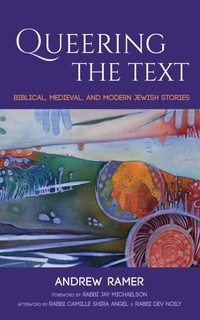
Queering the Text
Biblical, Medieval, and Modern Jewish Stories
Andrew Ramer(Author)
Wipf and Stock Publishers
Published on 24. March 2020
284 pages
978-1-7252-7477-8 (ISBN)
System requirements
for PDF without DRM
E-Book Single Licence
You are acquiring a single user licence for this eBook, which you might not transfer. [L]
Available for download
Description
Alles über E-Books | Antworten auf Fragen rund um E-Books, Kopierschutz und Dateiformate finden Sie in unserem Info- & Hilfebereich.
Queering the Text: Biblical, Medieval, and Modern Jewish Stories grapples with traditional midrashim, plays with homoerotic love poems from medieval Spain, and envisions alternate versions of the present. Inspired by the pioneering work of Jewish feminists, using the same narrative tools as the rabbis of old, Ramer has crafted stories that anchor queer lives in the three-thousand-year-old history of the Jewish people.
More details
Language
English
Place of publication
Eugene
United States
ISBN-13
978-1-7252-7477-8 (9781725274778)
Schweitzer Classification
Other editions
Additional editions


Person
Andrew Ramer is the author of three other books of midrashim: Torah Told Different: Stories for a Pan/Poly/Post-Denominational World; Deathless: The Complete, Uncensored, Heartbreaking, and Amazing Autobiography of Serach bat Asher, the Oldest Woman in the World; and Fragments of the Brooklyn Talmud. The world's first ordained interfaith maggid (sacred storyteller), he lives in Oakland, California, up the street from an amusement park called Fairyland.

System requirements
File format: PDF
Copy protection: without DRM (Digital Rights Management)
System requirements:
- Computer (Windows; MacOS X; Linux): Use the free software Adobe Reader, Adobe Digital Editions, or any other PDF viewer of your choice (see eBook Help).
- Tablet/Smartphone (Android; iOS): Install the free app Adobe Digital Editions or another reading app for eBooks, e.g., PocketBook (see eBook Help).
- E-reader: Bookeen, Kobo, Pocketbook, Sony, Tolino and many more (only limited: Kindle).
The file format PDF always displays a book page identically on any hardware. This makes PDF suitable for complex layouts such as those used in textbooks and reference books (images, tables, columns, footnotes). Unfortunately, on the small screens of e-readers or smartphones, PDFs are rather annoying, requiring too much scrolling.
This eBook does not use copy protection or Digital Rights Management.
For more information, see our eBook Help page.