

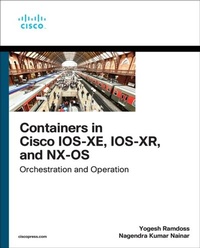
Containers in Cisco IOS-XE, IOS-XR, and NX-OS
Orchestration and Operation
1st Edition
Published on 23. March 2021
496 pages
978-0-13-578301-6 (ISBN)
Description

Acomprehensive guide to learning container and application hosting capabilitiesin Cisco platforms, and implementing them to achieve higher efficiency innetwork deployments and operations
Cisco architectures offer comprehensive compute virtualizationcapabilities to accommodate both native and third-party container hosting, soyou can containerize and instantiate any application or network service andgain unprecedented value from your networks.
Direct from Cisco, this is the complete guide to deploying andoperating containerized application andnetwork services on Cisco platforms. First, the authors review essentialvirtualization and containerization concepts for all network professionals andintroduce leading orchestration tools. Next, they take a deep dive intocontainer networking, introducing Cisco architectural support for containerinfrastructures. You'll find modular coverage of configuration, activation,orchestration, operations, and application hosting for each key Cisco softwareplatform: IOS-XE, IOS-XR, and NX-OS.
The authors explore diverse orchestration tools, including LXC,Docker, and Kubernetes, and cover both Cisco and open-source tools for buildingand testing applications. They conclude with multiple use cases that show howcontainerization can improve agility and efficiency in a wide range of networkenvironments.
Reviewthe motivation, drivers, and concepts of computing virtualization
Learnhow Cisco platforms are achieving infrastructure virtualization
Explorethe Cisco reference model for developing cloud-native services and moving tocloud-native network functions
MasterCisco container networking fundamentals, supported modes, and configuration
Enable,install, activate, and orchestrate containerized applications in Cisco IOS-XE,IOS-XR, and NX-OS
Comparetools and methods for developing, testing, hosting, and orchestratingcontainerized applications
Discoverreal-world use cases for Day-0, Day-1, and Day-2 operations, with practicaldeployment examples
Previewemerging trends in network containerization
Cisco architectures offer comprehensive compute virtualizationcapabilities to accommodate both native and third-party container hosting, soyou can containerize and instantiate any application or network service andgain unprecedented value from your networks.
Direct from Cisco, this is the complete guide to deploying andoperating containerized application andnetwork services on Cisco platforms. First, the authors review essentialvirtualization and containerization concepts for all network professionals andintroduce leading orchestration tools. Next, they take a deep dive intocontainer networking, introducing Cisco architectural support for containerinfrastructures. You'll find modular coverage of configuration, activation,orchestration, operations, and application hosting for each key Cisco softwareplatform: IOS-XE, IOS-XR, and NX-OS.
The authors explore diverse orchestration tools, including LXC,Docker, and Kubernetes, and cover both Cisco and open-source tools for buildingand testing applications. They conclude with multiple use cases that show howcontainerization can improve agility and efficiency in a wide range of networkenvironments.
Reviewthe motivation, drivers, and concepts of computing virtualization
Learnhow Cisco platforms are achieving infrastructure virtualization
Explorethe Cisco reference model for developing cloud-native services and moving tocloud-native network functions
MasterCisco container networking fundamentals, supported modes, and configuration
Enable,install, activate, and orchestrate containerized applications in Cisco IOS-XE,IOS-XR, and NX-OS
Comparetools and methods for developing, testing, hosting, and orchestratingcontainerized applications
Discoverreal-world use cases for Day-0, Day-1, and Day-2 operations, with practicaldeployment examples
Previewemerging trends in network containerization
All prices
More details
Series
Edition
1. Auflage
Language
English
Place of publication
Indianapolis
United States
Publishing group
Pearson Education (US)
Target group
Professional and scholarly
File size
40,43 MB
ISBN-13
978-0-13-578301-6 (9780135783016)
Copyright in bibliographic data and cover images is held by Nielsen Book Services Limited or by the publishers or by their respective licensors: all rights reserved.
Schweitzer Classification
Other editions
Additional editions
Yogesh Ramdoss | Nagendra Kumar Nainar
Containers in Cisco IOS-XE, IOS-XR, and NX-OS: Orchestration and Operation
Orchestration and Operation
Book
09/2020
1st Edition
Cisco Press
€55.49
Shipment within 15-20 days
Persons
YogeshRamdoss (CCIE No. 16183) is a principalengineer with the Cisco Customer Experience (CX) organization focusing on datacenter technologies such as Nexus switching platforms (standalone as well asVXLAN fabric), application-centric infrastructure (ACI), and hyperconvergedinfrastructure HyperFlex. Associated with Cisco since 2003, Yogesh is adistinguished speaker at Cisco Live, where he shares his knowledge and educatescustomers and partners on data center platforms and technologies, telemetry, analytics,network programmability, and various troubleshooting and packet capturing tools.He is a machine and behavior learning coinventor.
NagendraKumar Nainar (CCIE No. 20987, CCDE No. 20190014) isa principal engineer with the Cisco Customer Experience (CX) organization(formerly TAC), focusing on enterprise networking. He is the coinventor of morethan 100 patent applications on various cutting-edge technologies and thecoarchitect for various recent technologies. He has coauthored multipleInternet RFCs and IEEE papers. Serving as Technical Program Committee (TPC)member for various IEEE and other international conferences, he is an activespeaker in various industry forums.
NagendraKumar Nainar (CCIE No. 20987, CCDE No. 20190014) isa principal engineer with the Cisco Customer Experience (CX) organization(formerly TAC), focusing on enterprise networking. He is the coinventor of morethan 100 patent applications on various cutting-edge technologies and thecoarchitect for various recent technologies. He has coauthored multipleInternet RFCs and IEEE papers. Serving as Technical Program Committee (TPC)member for various IEEE and other international conferences, he is an activespeaker in various industry forums.
Content
Foreword xxv
Introduction xxvii
PartI Virtualization and Containers
Chapter1 Introduction to Virtualization 1
History of Computer Evolution 1
History of Virtualization 2
Virtualization-Architecture Definition andTypes 6
Computing Virtualization Elements andTechniques 14
Virtualization Scale and DesignConsideration 18
Multitenancy in Virtualization 19
Summary 20
References in This Chapter 21
Chapter2 Virtualization and Cisco 23
History of Virtualization in Cisco 23
Virtualization in Enterprise and ServiceProvider Environments 30
The Era of Software-Defined Networking 32
SDN Enablers 33
Control Plane Virtualization 33
Summary 58
References in This Chapter 59
Chapter3 Container Orchestration and Management 61
Introduction to the Cloud-Native ReferenceModel 61
The Journey from Virtual Network Function(VNF) to Cloud Native Function (CNF) 63
Container Deployment and OrchestrationOverview 65
Container Deployment and Orchestration 81
Summary 95
References 95
Chapter4 Container Networking Concepts 97
Container Networking-Introduction andEssentials 97
Container Networking 99
Container Network Models and Interfaces 105
Setting Up Container Networking 115
Summary 136
References 137
PartII Container Deployment and Operation in Cisco Products
Chapter5 Container Orchestration in Cisco IOS-XE Platforms 139
Cisco IOS-XE Architecture 139
IOS-XE Architecture: Application Hosting146
IOx Applications 149
Developing and Hosting Applications 157
Licensing Requirements 185
Summary 186
References 187
Chapter6 Container Orchestration in Cisco IOS-XR Platforms 189
Cisco IOS-XR Architecture 189
Application Hosting Architecture 192
Hosting Environment Readiness 198
Types of Application Hosting in Cisco XRPlatform 201
Network Configuration and Verification 216
Docker Images and Registry 218
Network Configuration and Verification 224
Application Hosting in VRF Namespace 226
Container Management 232
Summary 234
References 234
Chapter7 Container Orchestration in Cisco NX-OS Platforms 235
Cisco NX-OS Software Architecture 235
Hosting Environment Readiness 239
Container Infrastructure Configuration andInstantiation 242
Bash 256
Summary 288
References 289
Chapter8 Application Developers' Tools and Resources 291
Cisco Development Tool Kits and Resources291
Open-Source and Commercial Tools 336
Building and Deploying Container Images 341
Configuration and Application ManagementTools 345
Summary 357
References 357
Chapter9 Container Deployment Use Cases 361
General Use Cases for Enterprise, ServiceProvider, and Data Center
IOS-XR Use Case: Disaggregated Seamless BFDas a Virtual Network Function for Rapid Failure Detection 384
Seamless BFD Overview 385
Creating and Hosting S-BFD as a VirtualNetwork Function 387
NX-OS Use Case: Control Plane Health CheckUsing an Anomaly Detector 391
NX-OS Use Case: NX-OS Docker Health Check398
Summary 404
Chapter10 Current NFV Offering and Future Trends in Containers 405
App Hosting Services 405
Cisco NFV Offerings 411
Containers and Service Chaining 418
Serverless Computing and Network Functions421
Summary 423
References 423
TOC, 9780135895757, 6/9/2020
Introduction xxvii
PartI Virtualization and Containers
Chapter1 Introduction to Virtualization 1
History of Computer Evolution 1
History of Virtualization 2
Virtualization-Architecture Definition andTypes 6
Computing Virtualization Elements andTechniques 14
Virtualization Scale and DesignConsideration 18
Multitenancy in Virtualization 19
Summary 20
References in This Chapter 21
Chapter2 Virtualization and Cisco 23
History of Virtualization in Cisco 23
Virtualization in Enterprise and ServiceProvider Environments 30
The Era of Software-Defined Networking 32
SDN Enablers 33
Control Plane Virtualization 33
Summary 58
References in This Chapter 59
Chapter3 Container Orchestration and Management 61
Introduction to the Cloud-Native ReferenceModel 61
The Journey from Virtual Network Function(VNF) to Cloud Native Function (CNF) 63
Container Deployment and OrchestrationOverview 65
Container Deployment and Orchestration 81
Summary 95
References 95
Chapter4 Container Networking Concepts 97
Container Networking-Introduction andEssentials 97
Container Networking 99
Container Network Models and Interfaces 105
Setting Up Container Networking 115
Summary 136
References 137
PartII Container Deployment and Operation in Cisco Products
Chapter5 Container Orchestration in Cisco IOS-XE Platforms 139
Cisco IOS-XE Architecture 139
IOS-XE Architecture: Application Hosting146
IOx Applications 149
Developing and Hosting Applications 157
Licensing Requirements 185
Summary 186
References 187
Chapter6 Container Orchestration in Cisco IOS-XR Platforms 189
Cisco IOS-XR Architecture 189
Application Hosting Architecture 192
Hosting Environment Readiness 198
Types of Application Hosting in Cisco XRPlatform 201
Network Configuration and Verification 216
Docker Images and Registry 218
Network Configuration and Verification 224
Application Hosting in VRF Namespace 226
Container Management 232
Summary 234
References 234
Chapter7 Container Orchestration in Cisco NX-OS Platforms 235
Cisco NX-OS Software Architecture 235
Hosting Environment Readiness 239
Container Infrastructure Configuration andInstantiation 242
Bash 256
Summary 288
References 289
Chapter8 Application Developers' Tools and Resources 291
Cisco Development Tool Kits and Resources291
Open-Source and Commercial Tools 336
Building and Deploying Container Images 341
Configuration and Application ManagementTools 345
Summary 357
References 357
Chapter9 Container Deployment Use Cases 361
General Use Cases for Enterprise, ServiceProvider, and Data Center
IOS-XR Use Case: Disaggregated Seamless BFDas a Virtual Network Function for Rapid Failure Detection 384
Seamless BFD Overview 385
Creating and Hosting S-BFD as a VirtualNetwork Function 387
NX-OS Use Case: Control Plane Health CheckUsing an Anomaly Detector 391
NX-OS Use Case: NX-OS Docker Health Check398
Summary 404
Chapter10 Current NFV Offering and Future Trends in Containers 405
App Hosting Services 405
Cisco NFV Offerings 411
Containers and Service Chaining 418
Serverless Computing and Network Functions421
Summary 423
References 423
TOC, 9780135895757, 6/9/2020
