

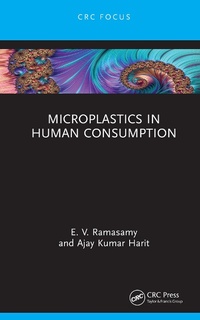
Microplastics in Human Consumption
1st Edition
Published on 23. February 2023
150 pages
978-1-000-80214-6 (ISBN)
Description

This book highlights plastic pollution, especially microplastics, and the consequences on the environment and on the human diet through food chain/web transmission and contamination through processing and packaging of various human food items including water and beverages. This book provides a detailed outlook on the microplastics, their origin, distribution, categories, presence in human food items and their impact on the ecosystem, organisms and so forth. It covers updated information on microplastic contamination in the biotic and abiotic products of the sea/ocean, the contamination of microplastics in drinking water/bottled water, honey, sugar and so forth.
Features:
Discusses the presence of microplastics in matrices prone to human consumption
Includes general information on microplastics, their origin, types, shapes, size and nomenclature
Reviews microplastics in different types of human consumable items
Illustrates fundamental methods and techniques used in microplastics research
Explores overall impacts of microplastics in the organisms contaminated with the same
This book is aimed at researchers, graduate students and faculty members interested in plastic pollution, microplastics, environmental science, food consumption and analysis.
Features:
Discusses the presence of microplastics in matrices prone to human consumption
Includes general information on microplastics, their origin, types, shapes, size and nomenclature
Reviews microplastics in different types of human consumable items
Illustrates fundamental methods and techniques used in microplastics research
Explores overall impacts of microplastics in the organisms contaminated with the same
This book is aimed at researchers, graduate students and faculty members interested in plastic pollution, microplastics, environmental science, food consumption and analysis.
More details
Edition
1. Auflage
Language
English
Place of publication
London
United Kingdom
Publishing group
Taylor & Francis Ltd
Target group
Professional and scholarly
Product notice
Reflowable
Illustrations
15 Tables, black and white; 7 Line drawings, black and white; 4 Halftones, black and white; 11 Illustrations, black and white
ISBN-13
978-1-000-80214-6 (9781000802146)
Copyright in bibliographic data and cover images is held by Nielsen Book Services Limited or by the publishers or by their respective licensors: all rights reserved.
Schweitzer Classification
Other editions
Additional editions
E. V. Ramasamy | Ajay Kumar Harit
Microplastics in Human Consumption
Book
11/2024
1st Edition
CRC Press
€32.00
Shipment within 10-20 days
E. V. Ramasamy | Ajay Kumar Harit
Microplastics in Human Consumption
Book
02/2023
1st Edition
CRC Press
€71.80
Shipment within 10-20 days
Persons
Dr E.V. Ramasamy is a Professor at School of Environmental Sciences, Mahatma Gandhi University, Kottayam, Kerala, India. He is also the Dean, Faculty of Environmental and Atmospheric Sciences, former Director of School of Environmental Sciences. In his 30 years of professional career, he has guided 16 PhD scholars, 30 MPhil scholars and 120 research publications including three books to his credit. He is also serving as member of several committees of Government of Kerala such as : State Waste Management Policy Committee and the Technical committee of Suchitwa Mission, Local Self Government Department (LSGD); Member, Kerala State Council for Science, Technology & Environment (KSCSTE) - Programme Advisory Committee for Environment and Ecology programme Govt. of Kerala. He has also participated in Indian Arctic Expedition (Summer batch 2019) and Indian Scientific Expedition to Southern Ocean (Antarctic water) ISESO 2020, in both these expeditions he has done research on Microplastics in Polar environment. He has been awarded with DUO-India 2020 Professor Fellowship Award by ASEM-DUO Fellowship Program (Seoul, Korea).
He works on Municipal Solid Waste (MSW) management, wastewater treatment, Microbial Fuel Cells (MFCs), water pollutants like heavy metals, landfill leachates and microplastics. His work on Earthworms and soil carbon dynamics has been published in Scientific Reports of Nature publishing group. His paper on Microplastics in the sediments of Vembanad Lake was the First report from India, the recent publication on Microplastics in the Kongsfjord , Arctic was the outcome of his Polar research published in 2021.
Dr Ajay Kumar Harit has served as Research Associate at School of Environmental Sciences, Mahatma Gandhi University, Kottayam, Kerala, His doctorate is from Pondicherry University (A Central University), Puducherry. He did his post-doctoral work at Indo-French Cell for Water Sciences, Civil Engineering Department, Indian Institute of Science (IISc) Bangalore during 2016-17. He was awarded with DST-SERB-National Post-Doctoral fellowship (N-PDF) in 2017, he has joined Mahatma Gandhi University, Kottayam, Kerala as N-PDF in 2017 and completed the Associateship successfully. His doctoral and post-doctoral research work was on exploring the attributes of termites (one of the ecosystem engineers) and their influence in soil and forest ecosystem focusing on soil and nutrient dynamics.
During his stay at Mahatma Gandhi University, he developed his interest in Microplastics research with a focus on monitoring Microplastics contamination in water bodies and human consumable items. He has published research articles on microplastic pollution in the surface sediment of Kongsfjorden, Svalbard Arctic in Marine Pollution Bulletin (Elsevier) as co-author. A book chapter co-authored by Dr Harit has been published by Cuvillier Verlag, Gottingen, Germany. He also presented his research findings in National and International conferences in the field of Microplastics. He has 18 articles (of these 16 in SCI Indexed journal) and two book chapters published to his credit as the outcome of his Doctoral and Post-Doctoral research.
He works on Municipal Solid Waste (MSW) management, wastewater treatment, Microbial Fuel Cells (MFCs), water pollutants like heavy metals, landfill leachates and microplastics. His work on Earthworms and soil carbon dynamics has been published in Scientific Reports of Nature publishing group. His paper on Microplastics in the sediments of Vembanad Lake was the First report from India, the recent publication on Microplastics in the Kongsfjord , Arctic was the outcome of his Polar research published in 2021.
Dr Ajay Kumar Harit has served as Research Associate at School of Environmental Sciences, Mahatma Gandhi University, Kottayam, Kerala, His doctorate is from Pondicherry University (A Central University), Puducherry. He did his post-doctoral work at Indo-French Cell for Water Sciences, Civil Engineering Department, Indian Institute of Science (IISc) Bangalore during 2016-17. He was awarded with DST-SERB-National Post-Doctoral fellowship (N-PDF) in 2017, he has joined Mahatma Gandhi University, Kottayam, Kerala as N-PDF in 2017 and completed the Associateship successfully. His doctoral and post-doctoral research work was on exploring the attributes of termites (one of the ecosystem engineers) and their influence in soil and forest ecosystem focusing on soil and nutrient dynamics.
During his stay at Mahatma Gandhi University, he developed his interest in Microplastics research with a focus on monitoring Microplastics contamination in water bodies and human consumable items. He has published research articles on microplastic pollution in the surface sediment of Kongsfjorden, Svalbard Arctic in Marine Pollution Bulletin (Elsevier) as co-author. A book chapter co-authored by Dr Harit has been published by Cuvillier Verlag, Gottingen, Germany. He also presented his research findings in National and International conferences in the field of Microplastics. He has 18 articles (of these 16 in SCI Indexed journal) and two book chapters published to his credit as the outcome of his Doctoral and Post-Doctoral research.
Content
1. Plastics and Microplastics in the Environment
2. Microplastic in human food items
3. Microplastics in potable water and beverages
4. Methods in Microplastics extraction and identification
5. Impact of microplastics on Human health
6. Emerging trends in Microplastic pollution management: Legislation, Policies and Mitigation strategy
2. Microplastic in human food items
3. Microplastics in potable water and beverages
4. Methods in Microplastics extraction and identification
5. Impact of microplastics on Human health
6. Emerging trends in Microplastic pollution management: Legislation, Policies and Mitigation strategy
