

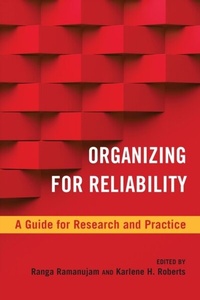
Organizing for Reliability
A Guide for Research and Practice
Published on 27. February 2018
344 pages
978-1-5036-0453-7 (ISBN)
Available for download
Description

Increasingly, scholars view reliability-the ability to plan for and withstand disaster-as a social construction. However, there is a tendency to evoke this concept only in the face of catastrophes, such as the British Petroleum oil spill or the Space Shuttle Challenger explosion. This book frames reliability as a fundamental issue in the study of organizations-one that can also improve day-to-day operations.
Bringing together a diverse cast of contributors, it considers how we can account for the ability of some organizations to maintain high reliability and what we can learn from them. The chapters distinguish reliability from related lines of inquiry; take stock of relevant research from different disciplinary perspectives; highlight implications for practice; and identify directions, questions, and priorities for future research. The first of its kind in over twenty years, this volume delivers a dynamic base of shared knowledge and an integrative research agenda at a time when organizational reliability has never been so important.
Bringing together a diverse cast of contributors, it considers how we can account for the ability of some organizations to maintain high reliability and what we can learn from them. The chapters distinguish reliability from related lines of inquiry; take stock of relevant research from different disciplinary perspectives; highlight implications for practice; and identify directions, questions, and priorities for future research. The first of its kind in over twenty years, this volume delivers a dynamic base of shared knowledge and an integrative research agenda at a time when organizational reliability has never been so important.
Reviews / Votes
"Contributing fresh insight on reliability, this book has the potential to rejuvenate interest and stimulate substantial new research in the field."-Sara J. Singer, Harvard T.H. Chan School of Public Health and Harvard Medical School "Integrating organizational perspectives from what are quite fragmented fields-human error, safety and disasters, resilience, and more-this book extends the research on high reliability and reliability management in organizations."-Kenneth Pettersen, University of Stavanger Organizing for Reliability is a mosaic of provocative fragments that are filled with insights."-Karl E. Weick, Administrative Science QuarterlyMore details
Series
Edition
New edition
Language
English
Place of publication
Palo Alto
United States
Publishing group
Stanford University Press
Target group
Professional and scholarly
Edition type
New edition
Illustrations
9 figures, 3 tables
ISBN-13
978-1-5036-0453-7 (9781503604537)
Copyright in bibliographic data and cover images is held by Nielsen Book Services Limited or by the publishers or by their respective licensors: all rights reserved.
Schweitzer Classification
Other editions
Additional editions
Book
02/2018
Stanford Business Books,US
€91.50
Shipment within 15-20 days
Persons
Ranga Ramanujam is Professor at Vanderbilt University's Owen Graduate School of Management. He serves on the editorial board of Stanford's High Reliability and Crisis Management series.Karlene H. Roberts is Professor Emeritus at The Haas School of Business, University of California, Berkeley, where she is also Chair of the Center for Catastrophic Risk Management. She is co-editor of Stanford's High Reliability and Crisis Management series.
Content
1. Advancing Organizational Reliability
-Karlene H. Roberts
2. The Multiple Meanings and Models of Reliability in Organizational Research
-Rangaraj Ramanujam
3. Three Lenses for Understanding Reliable, Safe, and Effective Organizations: Strategic Design, Political, and Cultural Approaches
-John S. Carroll
4. Mindful Organizing
-Kathleen M. Sutcliffe
5. Reliability through Resilience in Organizational Teams
-Seth A. Kaplan and Mary J. Waller
6. How High Reliability Mitigates Organizational Goal Conflicts
-Peter M. Madsen and Vinit Desai
7. Organizational Learning as Reliability Enhancement
-Peter M. Madsen
8. Metaphors of Communication in High Reliability Organizations
-John L. S. Jahn, Karen K. Myers, and Linda L. Putnam
9. Extending Reliability Analysis across Organizations, Time, and Scope
-Paul R. Schulman and Emery Roe
10. Organizing for Reliability in Health Care
-Peter F. Martelli
11. Organizational Reliability in Practice: Searching for Resilience in Communities at Risk
-Louise K. Comfort
12. Applying Reliability Principles: Lessons Learned
-W. Earl Carnes
Epilogue
-Karlene H. Roberts and Rangaraj Ramanujam
-Karlene H. Roberts
2. The Multiple Meanings and Models of Reliability in Organizational Research
-Rangaraj Ramanujam
3. Three Lenses for Understanding Reliable, Safe, and Effective Organizations: Strategic Design, Political, and Cultural Approaches
-John S. Carroll
4. Mindful Organizing
-Kathleen M. Sutcliffe
5. Reliability through Resilience in Organizational Teams
-Seth A. Kaplan and Mary J. Waller
6. How High Reliability Mitigates Organizational Goal Conflicts
-Peter M. Madsen and Vinit Desai
7. Organizational Learning as Reliability Enhancement
-Peter M. Madsen
8. Metaphors of Communication in High Reliability Organizations
-John L. S. Jahn, Karen K. Myers, and Linda L. Putnam
9. Extending Reliability Analysis across Organizations, Time, and Scope
-Paul R. Schulman and Emery Roe
10. Organizing for Reliability in Health Care
-Peter F. Martelli
11. Organizational Reliability in Practice: Searching for Resilience in Communities at Risk
-Louise K. Comfort
12. Applying Reliability Principles: Lessons Learned
-W. Earl Carnes
Epilogue
-Karlene H. Roberts and Rangaraj Ramanujam

