

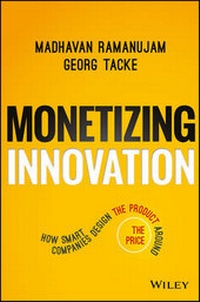
Monetizing Innovation
Description

Reviews / Votes
"Madhavan Ramanujam is to monetization strategy what Bob Marley is to reggae music. You must read this book." --Bill Gurley, Board member of Uber and General Partner at BenchmarkMore details
Other editions
Additional editions
Persons
Content
Chapter 1
How Innovators Leave Billions on the Table
A Tale of Two Cars
Let's begin with a story about two new cars launched by two well-known, established car companies. One launch went very, very well; the other went very, very wrong.
The first car in our story was launched by Porsche, a relatively small player in the multi-trillion dollar global automotive industry,1 renowned for its 911 sports car that will take you down the road at nearly 200 mph.
In the early 1990s, Porsche was speeding off a financial cliff-if not at 200 mph, then pretty rapidly. Annual sales were a third of what they had been in the 1980s. The company's manufacturing processes were inefficient and defective. The new CEO, Wendelin Wiedeking, at 41 years old the youngest of a new generation of German auto manufacturing executives, decided to institute Japanese-style manufacturing techniques and quality improvements. Costs fell and sales rose, and the company was able to avoid disaster.
The new CEO had bought Porsche some time. He knew the company needed a fundamental change-something different, something new. It needed, as most companies eventually do, to innovate-or risk losing everything. It needed a new car.
In the second half of the 1990s, the company began planning an automobile that was far outside the sports car niche it had focused on successfully for 50 years. Porsche decided to make a sport-utility vehicle-an SUV-a family car associated not with racing's checkered flags but with soccer moms and soccer dads slumped behind the wheel mournfully recalling their lost youth.
Porsche called its new car the Cayenne.
A Porsche SUV? It didn't make sense. The Porsche brand was about speed and power, daring and engineering, not about loading up the family car with groceries and taking Emily, Mike, and their little friends to their Saturday games. What did Porsche know about SUVs? It had never built one before.
But Porsche had done its homework. Specifically, it had designed and built the product-the Cayenne-around the price.
When most people hear the word "price," they think of a number. That's a price point. When we use the term price, we are trying to get at something more fundamental. We want to understand the perceived value that the innovation holds for the customer. How much is the customer willing to pay for that value? What would the demand be? Seen in this light, price is both an indication of what customers value and a measure of how much they are willing to pay for that value.
Porsche understood all this when it set about creating the Cayenne. Porsche's top executives knew they had a bold, perhaps even revolutionary, concept. They also knew the car would be a tremendous risk. They instructed their product team to rigorously determine what the customer wanted in a Porsche SUV and, importantly, how much they were willing to pay. The message was clear: If the customer was not willing to pay a price that would ensure success, Porsche would walk away from the Cayenne.
Long before the first concept car rolled out of the Engineering Group center in Weissach, the product team conducted an extensive set of surveys with potential customers, gauging the appetite for a Porsche SUV and evaluating prices to find an acceptable range. They were pleased to find that customers were enthusiastic. Analysis showed that customers were willing to pay more for a Porsche SUV than they would for comparable vehicles from other manufacturers. The potential for a hit was there.
This meant that Porsche could invest in building its SUV.
But what exactly should it build? Porsche wasn't about to risk creating a car with a bloated design. Every single feature stood trial before the customer.
Target customers wanted and were willing to pay for a high-and in this vehicle category, unknown-level of sportiness. They expressed an interest in a powerful engine and a handling performance close to a sports car (despite the size of an SUV). Porsche's famous manual six-speed racing transmission was not on the wish list. Out it went. But the voice of the customer convinced the Porsche engineers to include large cup holders, something Porsche was not used to. At every turn, the product team removed features the customers did not value-even if the engineers loved them-and replaced those with features customers were actually willing to pay for.
Porsche's masterstroke was thinking about monetization long before product development for the SUV was in full speed, then designing a car with the value and features customers wanted the most, around a price that made sense. The result was total corporate alignment: Porsche knew it had a winner, and had the confidence to invest accordingly.
Over time the Cayenne enabled Porsche to generate the highest profits per car in the industry-the whole automotive industry. Ten years after it hit the market in 2003, Porsche was selling about 100,000 Cayennes annually, almost five times as many as it did in the launch year. Today, the Cayenne accounts for about half the company's total profit, with the venerable 911 generating a third.2 What's more, the Cayenne enabled Porsche to pay down a suffocating level of debt and increase its cash reserves.
By any and all measures, the Cayenne was a roaring success.
Why did Porsche succeed? It wasn't the company's engineering prowess, although the Cayenne drives quite nicely. And it wasn't a technological breakthrough that enabled Porsche to manufacture SUVs more efficiently or make consumer hearts beat faster. Porsche succeeded by designing the product around the price. This is what smart companies do.
Now, we turn to the second car in our tale. This car comes from Fiat Chrysler, a company that has six times the revenue of Porsche. In 2009, the massive automaker began working to bring something new into the world: a reimagining of the classic 1970s Dodge Dart.
The new Dodge Dart was a crucial entry in a crucial market segment for Fiat Chrysler: compact cars. Fiat Chrysler needed the Dart badly to make the company competitive in the category, a segment in which it had struggled for years. Compacts account for one in every six vehicles sold in America. Every major automaker must succeed in the compact market, explained Fiat Chrysler CEO Sergio Marchionne in a March 2012 interview on 60 Minutes. Any carmaker unable to succeed in the category was "doomed," he said.3
Marchionne didn't mince words within the company about the importance of the Dart. He told employees just what was riding on the car. "Our future hangs on how well we do here," he told workers in a 2012 visit to the car's Belvidere, Illinois, plant. He backed up his words with money, committing hundreds of millions of dollars to turn a very successful Fiat model (the Alfa Romeo Giulietta) into a Dodge Dart.
"Of all the cars I can get wrong," Marchionne said, "it ain't this one."
Both cars were equally critical to their companies' futures. However, Fiat Chrysler's approach to developing the Dart was radically different from Porsche's Cayenne. Rather than starting with a hard look at the customer, Fiat Chrysler took a hard look at the product.
As it documented in a 90-second TV commercial to market the car,4 Fiat Chrysler's product development process was to design it, build it, rethink it, design it, build it, rethink it-until the engineering team, in its exclusive opinion, felt the car was ready to go. In fact, the advertisement announced proudly that the company was "kicking the finance guys" out of the development process. Money was not going to be an issue. The company would build prototype after prototype to get it right. The executive team "suits" would only interfere with designing the Dart. This car would be built to perfection, the commercial suggested.
"Perfection" as defined by Fiat Chrysler, not the customer.
Then a price was slapped on, and Dodge took it to customers to try to sell it.
Market performance was a disaster. In 2012, the year it launched, the Dart sold about 25,000 units5-a quarter of the total predicted by market analysts and a number that caused Dow Jones's MarketWatch to call the Dart the year's second biggest new product flop. The number one spot was given to Apple's buggy iPhone mapping software. That's right: The Dart was "Apple Maps bad."
Since then, the Dart has failed to lure most compact car buyers away from the two segment leaders, Toyota's Corolla and Honda's Civic, or even from Chevrolet's Cruze and Ford's Focus. By the end of 2014, sales were so disappointing that the company had to issue temporary layoffs at its Belvidere plant. Ironically, these were the same workers who two years earlier had heard Marchionne say that Dart was the one car the company couldn't afford to get wrong. In the first nine months of 2015, Dart sales were only a seventh of the combined sales of the two compact segment leaders.6
Fiat Chrysler couldn't afford to get the Dart wrong, but it did.
The reason Porsche succeeded with the Cayenne and the reason Fiat Chrysler bombed with the Dart are the same reasons product innovations have succeeded or failed at so many companies in so many industries...
