

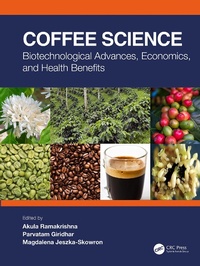
Coffee Science
Biotechnological Advances, Economics, and Health Benefits
1st Edition
Published on 25. August 2022
326 pages
978-1-000-61385-8 (ISBN)
Description

Coffee Science: Biotechnological Advances, Economics and Health Benefits highlights the important advances in coffee research and an all-inclusive collection of information on the current status of global coffee production and market, sustainable benefits, novel methods and recent developments in coffee metabolites analysis, advancements in coffee processing technology and improvement of coffee quality by fermentation, solid-liquid extraction methods, and post-harvesting processes to improve the beverage quality and produce coffees with different sensory profiles. The book compiles insights into the biotechnological advances to improve coffee quality. It also describes specialty coffees, which are gaining consumer acceptance and enjoying a good global market.
This book collates work on the influence of various coffee metabolites such as methyl xanthine, polyphenols, phenolic compounds, indoleamines, biogenic amines, and coffee diterpenes in human health effects such as cardiovascular diseases, cancer, type 2 diabetes mellitus, Alzheimer's disease, and Parkinson's disease.
This book is a useful resource for scientists, academicians, and professionals all over the world who are engaged in coffee cultivation, research, business and coffee consumers' health.
Key Features
Current status on coffee production and the global market
Novel methods and recent developments in the determination of coffee metabolites
Advancements in coffee bean processing technology and improvement of coffee quality
Biotechnological advances to improve coffee quality: The role of molecular markers, tissue culture, transgenic technology, and micro RNAs
Effects of coffee consumption on human health
Knowledge contributions from acknowledged experts from across the world
This book collates work on the influence of various coffee metabolites such as methyl xanthine, polyphenols, phenolic compounds, indoleamines, biogenic amines, and coffee diterpenes in human health effects such as cardiovascular diseases, cancer, type 2 diabetes mellitus, Alzheimer's disease, and Parkinson's disease.
This book is a useful resource for scientists, academicians, and professionals all over the world who are engaged in coffee cultivation, research, business and coffee consumers' health.
Key Features
Current status on coffee production and the global market
Novel methods and recent developments in the determination of coffee metabolites
Advancements in coffee bean processing technology and improvement of coffee quality
Biotechnological advances to improve coffee quality: The role of molecular markers, tissue culture, transgenic technology, and micro RNAs
Effects of coffee consumption on human health
Knowledge contributions from acknowledged experts from across the world
More details
Edition
1. Auflage
Language
English
Place of publication
London
United Kingdom
Publishing group
Taylor & Francis Ltd
Target group
College/higher education
Professional and scholarly
Product notice
Reflowable
Illustrations
51 Tables, black and white; 7 Line drawings, color; 41 Line drawings, black and white; 14 Halftones, color; 8 Halftones, black and white; 20 Illustrations, color; 50 Illustrations, black and white
ISBN-13
978-1-000-61385-8 (9781000613858)
Copyright in bibliographic data and cover images is held by Nielsen Book Services Limited or by the publishers or by their respective licensors: all rights reserved.
Schweitzer Classification
Other editions
Additional editions
Akula Ramakrishna | Parvatam Giridhar | Magdalena Jeszka-Skowron
Coffee Science
Biotechnological Advances, Economics, and Health Benefits
Book
08/2022
1st Edition
CRC Press
€191.89
Shipment within 15-20 days
Persons
Akula Ramakrishna is currently a Scientist at Bayer Crop Science, Bangalore, India. Dr. Ramakrishna holds a master's degree from Sri Krishna Devaraya University, Anantapur, Andhra Pradesh, India. He obtained his Ph.D. in biochemistry from University of Mysore, CSIR-CFTRI, Mysuru. He is a Senior Research Fellow of CSIR, New Delhi. He is involved in various research fields such as Plant Biotechnology, Biochemistry, Plant secondary metabolites, Food Science and Technology and vegetable quality analytics, double haploid production in vegetables, tomato rapid cycling. He has published several research papers in the leading international journals, reviews and book chapters. He has edited 4 books in CRC Press, USA and also co-author for the book "Indian medicinal plants: Uses and propagation Aspects (2020), 2 books in Springer. He is also serving as editorial board member, and reviewer for reputed international journals. Presented over 20 research papers in symposia in India and abroad, as well as few invited lectures in India. He attended the Fifth International Symposium on Plant Neurobiology held in 2009 in Florence, Italy. He also attended the Technical Community of Monsanto (TCM) held in 2016, in St. Louis, Missouri. He is a member of the Indian science congress association and society for biotechnologists (India). He is a fellow of the Society for Applied Biotechnology, India (2012), and recipient of Global Vegetable Research Excellence Award (2017), Global technology recognition, Rapid Recognition Award, and Special recognition from the Monsanto company and Veg R&D champion (2020) from Bayer crop science.
Parvatam Giridhar is currently Senior Principal Scientist at CSIR-Central Food Technological Research Institute, Mysuru, Karnataka India. Dr. Giridhar holds a Master's degree from Kakatiya University, Warangal, Telangana, India. He obtained his Ph.D. from Kakatiya University, Warangal. He was a DAAD Fellow (1995-1996) at University of Bayreuth, Bayreuth, Germany and BOYSCAST Fellow of DST, Government of India (2005-2006) at IRD, Montpellier, France. Dr.Giridhar's research areas of interest are Plant tissue culture, secondary metabolites, molecular biology, Bioactive metabolites, and Food Science and Technology. Since 2000, engaged with R&D on coffee metabolites, tissue culture and genomics. He has published several research papers in the leading international journals, reviews and book chapters altogether 190 with 5059citations, h-index 42, and i10-index 107. He is an Associate Editor, Editorial board member, and Reviewer for reputed International and National journals. He has presented over 50 research papers in symposia in India and abroad. He attended the 21st, 23rd , 24th and 26th International Conferences on Coffee (ASIC- Association Scientifique International du Cafe) held in 2006 (Montpellier, France), 2010 (Bali, Indonesia), 2012 (San Jose, Costa Rica) and 2016 (Kunming, China). Also attended scientific conferences at Belgium, Malaysia, and Nepal. He is an elected member of the Plant Tissue Culture Association of India, and National Academy of Sciences, Allahabad, India. He is a fellow of the National Academy of Biological Sciences, India, Indian Botanical Society, Andhra Pradesh Akademi of Sciences, A.P., India, Academy of Plant Sciences, India and Society for Applied Biotechnology, India. Dr. Giridhar holds 09 patents and a recipient of 12 important awards from various scientific associations and societies of India.
Prof. Magdalena Jeszka-Skowron is currently working as an academic teacher and scientist at Faculty of Chemical Technology, Poznan University of Technology, Poland. She holds a master's degree from Poznan University of Economics at the Faculty Commodity Sciences, Poland. She obtained her Ph.D. in food technology and nutrition from Poznan University of Life Sciences, Poland. She is involved at various research fields: Food Chemistry and Science, Plant secondary metabolites analysis, Food Quality, and Water and Environment Sciences.
Her experience in coffee research is connected with analytical methods especially chromatographic, spectrophotometric and isotachophoresis analyses for the determination of bioactive compounds in coffee. She has published 30 research papers in the leading international journals including seven publications with the cooperation of Polish and foreigner experts of coffee analysis. She has published a book, review and also book chapters. Dr. Jeszka-Skowron has presented over 50 research papers in symposia as well in Poland and abroad and she was a reviewer over 50 papers. In 2015 she has been attended on Symposium Cocotea - Coffee, cocoa and tea, in Aveiro, Portugal.
In 2015 she has received a scholarship Engineer of the Future for the execution of a project titled: Quality of coffee - chemical and toxicological analysis of coffee beans depending on their origin". In 2020 she has received a grant Miniatura from National Centre of Science, Poland for the execution of a project titled: The influence of fermentation process of coffee beans on caffeoylquinic acids and antioxidant activity of coffee extracts (Coffea arabica and Coffea robusta). She is also a lecturer and one of her lecture is Instrumental analysis of Food products for Bachelor Students. Dr. Jeszka-Skowron is teaching chemistry in laboratories also in food analysis field.
Parvatam Giridhar is currently Senior Principal Scientist at CSIR-Central Food Technological Research Institute, Mysuru, Karnataka India. Dr. Giridhar holds a Master's degree from Kakatiya University, Warangal, Telangana, India. He obtained his Ph.D. from Kakatiya University, Warangal. He was a DAAD Fellow (1995-1996) at University of Bayreuth, Bayreuth, Germany and BOYSCAST Fellow of DST, Government of India (2005-2006) at IRD, Montpellier, France. Dr.Giridhar's research areas of interest are Plant tissue culture, secondary metabolites, molecular biology, Bioactive metabolites, and Food Science and Technology. Since 2000, engaged with R&D on coffee metabolites, tissue culture and genomics. He has published several research papers in the leading international journals, reviews and book chapters altogether 190 with 5059citations, h-index 42, and i10-index 107. He is an Associate Editor, Editorial board member, and Reviewer for reputed International and National journals. He has presented over 50 research papers in symposia in India and abroad. He attended the 21st, 23rd , 24th and 26th International Conferences on Coffee (ASIC- Association Scientifique International du Cafe) held in 2006 (Montpellier, France), 2010 (Bali, Indonesia), 2012 (San Jose, Costa Rica) and 2016 (Kunming, China). Also attended scientific conferences at Belgium, Malaysia, and Nepal. He is an elected member of the Plant Tissue Culture Association of India, and National Academy of Sciences, Allahabad, India. He is a fellow of the National Academy of Biological Sciences, India, Indian Botanical Society, Andhra Pradesh Akademi of Sciences, A.P., India, Academy of Plant Sciences, India and Society for Applied Biotechnology, India. Dr. Giridhar holds 09 patents and a recipient of 12 important awards from various scientific associations and societies of India.
Prof. Magdalena Jeszka-Skowron is currently working as an academic teacher and scientist at Faculty of Chemical Technology, Poznan University of Technology, Poland. She holds a master's degree from Poznan University of Economics at the Faculty Commodity Sciences, Poland. She obtained her Ph.D. in food technology and nutrition from Poznan University of Life Sciences, Poland. She is involved at various research fields: Food Chemistry and Science, Plant secondary metabolites analysis, Food Quality, and Water and Environment Sciences.
Her experience in coffee research is connected with analytical methods especially chromatographic, spectrophotometric and isotachophoresis analyses for the determination of bioactive compounds in coffee. She has published 30 research papers in the leading international journals including seven publications with the cooperation of Polish and foreigner experts of coffee analysis. She has published a book, review and also book chapters. Dr. Jeszka-Skowron has presented over 50 research papers in symposia as well in Poland and abroad and she was a reviewer over 50 papers. In 2015 she has been attended on Symposium Cocotea - Coffee, cocoa and tea, in Aveiro, Portugal.
In 2015 she has received a scholarship Engineer of the Future for the execution of a project titled: Quality of coffee - chemical and toxicological analysis of coffee beans depending on their origin". In 2020 she has received a grant Miniatura from National Centre of Science, Poland for the execution of a project titled: The influence of fermentation process of coffee beans on caffeoylquinic acids and antioxidant activity of coffee extracts (Coffea arabica and Coffea robusta). She is also a lecturer and one of her lecture is Instrumental analysis of Food products for Bachelor Students. Dr. Jeszka-Skowron is teaching chemistry in laboratories also in food analysis field.
Content
1 Current status of coffee production and global marketing: recent update
Anna Maria Jeszka
2 Scientific and technological knowledge: a review of sustainable benefits on the coffee sector
David Israel Contreras-Medina , Maria Emilia Camargo, and Elia Socorro Diaz-Nieto
3 Contemporary topics in coffee research: a glance
Parvatam Giridhar,, Akula Ramakrishna, and Magdalena Jeszka-Skowron
4 The bioactive compounds and substances with toxic potential in coffee products: the properties and the methods of analysis
Magdalena Jeszka-Skowron and Beata Czarczynska-Goslinska
5 Elemental analysis of coffee products
Ewa Stanisz
6 Coffee fermentation: new approaches to enhance quality
Rosane Freitas Schwan, Nadia Nara Batista, Silvia Juliana Martinez, Ana Paula Pereira Bressani, and Disney Ribeiro Dias
7 Coffee polyphenols: biochemical, processing, and health insights
Wenny Bekti Sunarharum, Tunjung Mahatmanto, Dego Yusa Ali, Yuniar Ponco Prananto, and Paulus Imanuel Nugroho
8 Effect of solid-liquid extraction in the art of preparing fine coffee drinks (Coffea arabica L. var. Castillo) on the antioxidant activity in 28 preparation methods
Angela M. Ormaza-Zapata, Felix O. Diaz-Arango, and Benjamin A. Rojano
9 Phenolic compounds in coffee seeds and by-products
Juliana de Paula and Adriana Farah
10 Influence of coffee bean processing on the phenolic acid and flavonoid content in coffee brews (Coffea arabica and Coffea robusta)
Magdalena Jeszka-Skowron, Robert Frankowski, and Agnieszka Zgola-Grzeskowiak
11 The metabolic fate and mechanisms of action of coffee polyphenols
Tunjung Mahatmanto and Wenny Bekti Sunarharum
12 The effects of contact time, brewing method, and bean roast on the chemistry of cold brew coffee
Niny Z. Rao, Frank H. Wilkinson, and Brian G. Yust
13 Latest developments on coffee discrimination by species, quality, and geographic origin
Adriana S. Franca and Leandro S. Oliveira
14 New frontiers in coffee processing for health and enhanced flavor molecules
Varun Eranna and Pushpa Srinivas Murthy
15 Emerging technologies for the management of coffee processing wastewater
Ijanu Emmanuel Madu, Mohamad Anuar Kamaruddin, Mohd Suffi an Mohd Yusof, Noorzalila Muhammad Niza, Abdubaki Mohamed Hussen Shadi, and Faris Aiman Norash
16 Sequencing-based molecular markers for wild and cultivated coffee diversity exploration and crop improvement
Tram Vi, Pierre Marraccini, Alexandre de Kochko, Philippe Cubry, Ngan Giang Khong, and Valerie Poncet
17 Insights into the coffee microRNAs: present and future perspectives
Johns Saji and Shibin Mohanan
18 Current progress in tissue culture and transgenic research in coffee (Coffea spp.)
Manoj Kumar Mishra
19 Coffee methylxanthines and human health effects
Monika Przeor and Monika Beszterda
20 Current understandings of health benefits of coffee on cardiovascular and metabolic syndromes
Prakash Narayana Reddy, Harish Babu Kolla, Hanumohan Reddy Konatham, Parvatam Giridhar, and Vijaya R. Dirisala
21 Coffee diterpenes: significance and biological functions
Vaddadi Sridevi, Anusree Poyyakara Veetil, and Parvatam Giridhar
22 Indoleamines and biogenic amines profiles in Coffea species and human health effects
Akula Ramakrishna, Soumya Mukherjee, Sridevi Vaddadi, and Parvatam Giridhar
23 Bioactive components in coffee and their health aspects
Palakkil Mavilavalappil Sandeep and Iychettira Machaiah Mandappa
Anna Maria Jeszka
2 Scientific and technological knowledge: a review of sustainable benefits on the coffee sector
David Israel Contreras-Medina , Maria Emilia Camargo, and Elia Socorro Diaz-Nieto
3 Contemporary topics in coffee research: a glance
Parvatam Giridhar,, Akula Ramakrishna, and Magdalena Jeszka-Skowron
4 The bioactive compounds and substances with toxic potential in coffee products: the properties and the methods of analysis
Magdalena Jeszka-Skowron and Beata Czarczynska-Goslinska
5 Elemental analysis of coffee products
Ewa Stanisz
6 Coffee fermentation: new approaches to enhance quality
Rosane Freitas Schwan, Nadia Nara Batista, Silvia Juliana Martinez, Ana Paula Pereira Bressani, and Disney Ribeiro Dias
7 Coffee polyphenols: biochemical, processing, and health insights
Wenny Bekti Sunarharum, Tunjung Mahatmanto, Dego Yusa Ali, Yuniar Ponco Prananto, and Paulus Imanuel Nugroho
8 Effect of solid-liquid extraction in the art of preparing fine coffee drinks (Coffea arabica L. var. Castillo) on the antioxidant activity in 28 preparation methods
Angela M. Ormaza-Zapata, Felix O. Diaz-Arango, and Benjamin A. Rojano
9 Phenolic compounds in coffee seeds and by-products
Juliana de Paula and Adriana Farah
10 Influence of coffee bean processing on the phenolic acid and flavonoid content in coffee brews (Coffea arabica and Coffea robusta)
Magdalena Jeszka-Skowron, Robert Frankowski, and Agnieszka Zgola-Grzeskowiak
11 The metabolic fate and mechanisms of action of coffee polyphenols
Tunjung Mahatmanto and Wenny Bekti Sunarharum
12 The effects of contact time, brewing method, and bean roast on the chemistry of cold brew coffee
Niny Z. Rao, Frank H. Wilkinson, and Brian G. Yust
13 Latest developments on coffee discrimination by species, quality, and geographic origin
Adriana S. Franca and Leandro S. Oliveira
14 New frontiers in coffee processing for health and enhanced flavor molecules
Varun Eranna and Pushpa Srinivas Murthy
15 Emerging technologies for the management of coffee processing wastewater
Ijanu Emmanuel Madu, Mohamad Anuar Kamaruddin, Mohd Suffi an Mohd Yusof, Noorzalila Muhammad Niza, Abdubaki Mohamed Hussen Shadi, and Faris Aiman Norash
16 Sequencing-based molecular markers for wild and cultivated coffee diversity exploration and crop improvement
Tram Vi, Pierre Marraccini, Alexandre de Kochko, Philippe Cubry, Ngan Giang Khong, and Valerie Poncet
17 Insights into the coffee microRNAs: present and future perspectives
Johns Saji and Shibin Mohanan
18 Current progress in tissue culture and transgenic research in coffee (Coffea spp.)
Manoj Kumar Mishra
19 Coffee methylxanthines and human health effects
Monika Przeor and Monika Beszterda
20 Current understandings of health benefits of coffee on cardiovascular and metabolic syndromes
Prakash Narayana Reddy, Harish Babu Kolla, Hanumohan Reddy Konatham, Parvatam Giridhar, and Vijaya R. Dirisala
21 Coffee diterpenes: significance and biological functions
Vaddadi Sridevi, Anusree Poyyakara Veetil, and Parvatam Giridhar
22 Indoleamines and biogenic amines profiles in Coffea species and human health effects
Akula Ramakrishna, Soumya Mukherjee, Sridevi Vaddadi, and Parvatam Giridhar
23 Bioactive components in coffee and their health aspects
Palakkil Mavilavalappil Sandeep and Iychettira Machaiah Mandappa
