

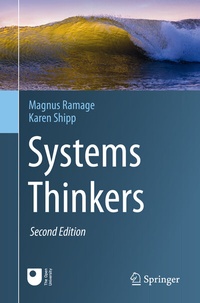
Systems Thinkers
Description

In our profoundly complex and interconnected world, there is a pressing need for systems thinking, to consider environmental, societal and organisational issues as interconnected wholes rather than separating them into parts and looking at each in isolation. This book presents a biographical history of systems thinking, by examining the life and work of thirty of its major thinkers.
Systems Thinkers discusses each thinker's key contributions, the way this contribution was expressed in practice and the relationship between their life and ideas. This discussion is supported by an extract from the thinker's own writing, to give a flavour of their work and to give readers a sense of which thinkers are most relevant to their own interests.
Systems thinking is highly interdisciplinary, so the thinkers selected come from a wide range of areas, including biology, management, physiology, anthropology, chemistry, public policy, sociology and environmental studies. Some are core innovators in systems ideas; some have been primarily practitioners who also advanced and popularised systems ideas; others are well-known figures who drew heavily upon systems thinking although it was not their primary discipline. The book provides an appetising 'taster' of the writings of each of the thirty thinkers, to encourage the reader to explore the published works of the thinkers themselves.
This second edition has been updated to reflect continuing scholarship in the academic community about the thirty thinkers, and in some cases new writing by them, bringing fresh insights about these inspiring and deeply relevant figures who challenged accepted ways of thinking and seeing, and continue to do so..
Karen Shipp is an educator and facilitator who created interactive and transformative learning experiences at The Open University from 1987 to 2011, the last ten of these as a lecturer in the Systems Group.
More details
Other editions
Additional editions
Persons
Magnus Ramage is a senior lecturer in Information Systems at The Open University, where he has worked since 2000, teaching systems thinking and sociotechnical IT systems. As well as researching the history of systems thinking, he conducts research on critical approaches to the concept of information and on the organisational and social impact of collaborative technologies. He holds a PhD in information systems from the University of Lancaster.
Karen Shipp is an educator and facilitator who created interactive and transformative learning experiences at The Open University from 1987 to 2011, the last ten of these as a lecturer in the Systems Group.
