

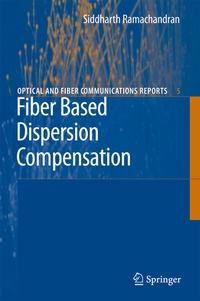
Fiber Based Dispersion Compensation
Description

A pulse of light spreads in time as it propagates in a fiber due to the physical phenomenon called dispersion. While dispersion can be deleterious in optical communications systems, it can also be exploited to manage the temporal and spectral shapes of pulses and their interactions with other pulses. Much of dispersion control is realized in optical communications systems with discrete devices - the so-called dispersion compensators, and almost all commercially deployed dispersion compensators today are based on specially designed fibers. This book addresses various aspects of this device technology, such as the physics of optical dispersive effects, the design philosophy and properties of devices deployed in optical networks today, futuristic devices utilizing novel fibers, and their systems level impact. Written by leaders in the field drawn from both academia and industry, this book serves as a comprehensive introduction to the topic of dispersion management of light for graduate students and applications engineers. Since each chapter provides a detailed description of the state-of-the-art in each technological platform, this book also serves as a practical reference for industry experts tasked with designing next generation optical networks.
More details
Other editions
Additional editions
Person
Dr Siddharth Ramachandran obtained his Bachelor of Technology degree from the Indian Institute of Technology, Kanpur, in 1991, MS from the University of Wisconsin, Madison, in 1993, and a Ph.D. in Electrical Engineering from the University of Illinois, Urbana, in 1998. Since Nov. 1998, he has worked at Bell Laboratories, Lucent Technologies and subsequently OFS Laboratories, OFS-Fitel, first as a Member of Technical Staff, and since March 2003, as a Distinguished Member of Technical Staff. Dr. Ramachandran's research focuses on fiber and fiber-grating devices in specialty, dispersion-tailored fibers. He was the technical-lead as well as team leader for Lucent Technologies efforts in defining next-generation dispersion-compensation solutions for future 40 Gb/s optical communications systems. He has authored over 90 refereed journal and conference publications, 2 book-chapters, 15 patent applications. Dr. Ramachandran has served on several conference committees, and was the program chair for the IEEE-LEOS Summer Topical meetings in 2006.
Dr. Ramachandran is a member of IEEE-LEOS.
