

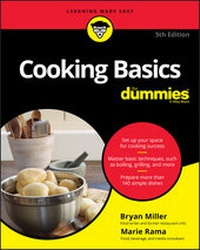
Cooking Basics For Dummies
Description

Are you looking to dig yourself out of microwave dinners and learn the ropes of home cooking? Cooking Basics For Dummies, 5th Edition takes the intimidation out of cooking and helps you start cultivating your culinary prowess in no time. From learning fundamental cooking techniques like dicing, chopping, and saut?ing to creating delicious, easy-to-follow recipes, you'll discover how to cook up crowd-pleasing meals the whole family will enjoy--all without breaking a sweat!
Even if you've never cracked an egg, this friendly, practical guide gives you all the ingredients to become a superior home cook. In plain English, it explains step-by-step how to master popular cooking techniques, such as dicing vegetables, hard boiling an egg, making quick and delicious sauces, planning menus, stocking your pantry, and so much more.
* Packed with more than 150 easy-to-follow recipes for every meal of the day, from mouth-watering mains to sumptuous sides to delectable desserts
* Helps you master grilling, slow cooking, baking, roasting, pressure cooking, and more
* Includes tips on adapting meals to meet the latest dietary trends, such as low-sugar, low-sodium, low-fat, plant-based, and vegetarian diets
* Covers shopping at farmer's markets and buying organic foods
Cooking Basics For Dummies, 5th edition is for every beginner cook or polished chef looking for a refresher on breathing new life into home-cooked meals.
P.S. If you think this book seems familiar, you're probably right. The Dummies team updated the cover and design to give the book a fresh feel, but the content is the same as the previous release of Cooking Basics For Dummies (9781118922316). The book you see here shouldn't be considered a new or updated product. But if you're in the mood to learn something new, check out some of our other books. We're always writing about new topics!
More details
Other editions
Additional editions
Persons
Bryan Miller is a food and wine writer and a former restaurant critic for The New York Times. He has written and cowritten a number of books.
Marie Rama is a food writer, recipe developer, and coauthor of Grilling For Dummies.
Content
Introduction 1
Part 1: Getting Started with Cooking 5
Chapter 1: Cooking with Confidence 7
Chapter 2: Investing in the Essential Tools 21
Chapter 3: The Bare Necessities: Stocking Your Pantry and Fridge 39
Part 2: Know Your Techniques 61
Chapter 4: The Cutting Edge: Working with Knives 63
Chapter 5: Boiling, Poaching, and Steaming 81
Chapter 6: Simply Sautéing 95
Chapter 7: Braising and Stewing: Slow and Seductive 111
Chapter 8: Roasting Poultry, Meats, and Veggies 125
Chapter 9: Coals and Coils: Grilling and Broiling 155
Chapter 10: Baking Basics 175
Part 3: Expand Your Repertoire 195
Chapter 11: Conquering Breakfast 197
Chapter 12: Super Soups and Savory Salads 217
Chapter 13: From Sides to Mains: Great Grains and Pastas 247
Chapter 14: Making Sensational Sauces: Fear No More 269
Chapter 15: Delectable Desserts 285
Part 4: Now You're Cooking! Real Menus for Real Life 303
Chapter 16: Taking It Easy with One-Pot Meals 305
Chapter 17: Making More (and Better) for Less 319
Chapter 18: Going Global with Asian and Mediterranean Dishes 331
Chapter 19: Quick Picks: Cooking with Fewer Ingredients 353
Chapter 20: Summertime Soirees 365
Chapter 21: Feeding Holiday Hordes: Festive Winter Menus 379
Part 5: The Part of Tens 399
Chapter 22: Ten Ways to Think Like a Chef 401
Chapter 23: Ten Common Cooking Myths 405
Appendix A: Glossary of 100 (Plus)
Common Cooking Terms 409
Appendix B: Common Substitutions, Abbreviations, and Equivalents 417
Index 425
Chapter 1
Cooking with Confidence
IN THIS CHAPTER
Setting up a space for cooking
Making your kitchen safe and user-friendly
Trying your hand at a simple recipe
RECIPE IN THIS CHAPTER
Cooking is fun and interesting and can be relaxing, exciting, and even therapeutic. Cooking is a life skill, but it can also be a hobby and a passion. When you cook at home, you can eat for less money than you'd spend ordering take-out or dining in a restaurant every night, and you control the ingredients, flavors, and health profile of your food so you know exactly what you're eating.
Cooking gives you options, allowing you to adapt your meals to suit your own nutritional and taste preferences. When you cook, you can always get exactly the food you want. Plus, cooking the food you eat makes you more aware of your food, your health, and your environment.
Whether you have a cramped apartment kitchen with counter space the size of a cereal box or a sprawling country kitchen with a commercial stove and a work island, this chapter helps you set up an efficient and comfortable environment. Knowing how to use what you have efficiently is even more important than square footage. You'd be surprised to see how small some restaurant kitchens are; they work, however, because everything is in its place and is easily accessible.
In this chapter, we give you a broad overview of what you need to know to be an effective cook. We talk about how to set up your cooking space and introduce you to the major appliances of a kitchen. Then we discuss kitchen safety and help you get started with a nice, easy, practical recipe.
Creating a Cook-Friendly Kitchen
You don't need a fabulous kitchen to prepare fabulous food, but a well-designed workspace sure makes cooking easier and more pleasurable. Chances are, you aren't in the process of remodeling your kitchen, and you have to make do with the basic kitchen design you have. However, if you are at liberty to shift some things around or you're designing your cooking space, consider the concept of access. If you want to spend the day running, join a health club. If you want to enjoy an efficient and pleasurable cooking experience, consider where your main appliances are located and where you store the equipment and ingredients you use the most. Do you have to walk 10 feet from the stove to get the salt? That's not efficient. Although nothing is wrong with a large, eat-in kitchen, the design of the cooking area in particular should be practical.
You should be able to move from your working counter space to the stove/oven, refrigerator, and sink in a smooth, unobstructed fashion. This working space actually has a name: the kitchen triangle (see Figure 1-1). It applies whether you have a long narrow kitchen, a U-shaped kitchen, or an L-shaped kitchen. Consider the positioning of these three major appliances and jettison any obstacles - if a table, plant, or small child is blocking the way, move it. Even if you can't redesign your kitchen space or move your refrigerator to another wall, you can arrange what you need in a way that works for you. Here's how to do that.
Illustration by Elizabeth Kurtzman
FIGURE 1-1: One example of an efficient kitchen triangle.
Declutter your countertops
You can't chop vegetables, slice meat, or whip up a cake batter if you can't even fit a cutting board or a mixing bowl on your counter, so take a good look at your countertops. What's on them? Coffeemakers, blenders, food processors, racks of spice jars or canisters of flour and sugar, stacks of bills, permission slips, and grade school art projects? Is your countertop doubling as a magazine rack, plant holder, or wine rack? Consider this: Your kitchen counters aren't meant to be storage units. They are meant to be food preparation areas. A clean, clear counter space can inspire the creation of a great meal. A cluttered one is more likely to inspire a call to the pizza delivery guy. If your kitchen counter is cluttered with paraphernalia beyond usefulness, that's a problem you can fix.
The ultimate test for whether something should be allowed valuable countertop real estate is how often you use it. If you use an appliance or food ingredient (like coffee or flour) almost every day, then go ahead and give it hallowed ground. Otherwise, stow it. Be ruthless. Put away the mixer, the food processor, the bread machine, and the rice cooker. Away with the herb and spice rack, the bottles of nut oil and fancy vinegar. Find a better spot for the mail and the bills. As you rid your counters of this clutter, you also get rid of your excuses for not having the space to cook dinner.
In addition to keeping your countertops clutter free, take steps to care for them. Use cutting boards for cutting and trivets for hot pots and pans, and wipe up spills quickly to prevent stains. The nicer your counters look, the more you'll enjoy being in the kitchen. (Flip to Chapter 22 for more information about countertop care.)
Let there be lighting
Efficient kitchens should be well lit so you can see what you're doing. Poor lighting increases mistakes, especially over the workspaces and stove. Lights under the stovetop hood can really help when stirring sauces or browning meat, and a nice bright oven light makes it much easier to assess the state of doneness of your casserole or cookies. You haven't replaced those burned-out bulbs in years? Time to do it! Get out your screwdriver and remove the panel over the lights. Unscrew the bulbs and take them with you to the store so you're sure to get the right replacement.
Another option is to have special lighting for the cooking area, either inset into overhead cabinets or in the ceiling. If your kitchen is poorly lit over the cooking area, the least expensive solution is a wall-mounted supplementary light - or a hard hat with a built-in flashlight.
Organize your pantry
The pantry is the place where you store your basic cooking staples, as well as other dry goods. (Dry goods are foods that aren't refrigerated or frozen, including staples like flour and sugar, and packaged foods like crackers, cookies, pasta, and rice.) If you're lucky enough to have an entire room or closet dedicated to a pantry, keep it well organized so you can see and easily reach the staples you use most, like flour, sugar, and cooking oil. Even if you have only a cabinet or two for your pantry, organization is the key to efficiency. (For tips on what to keep in your pantry, turn to Chapter 3.)
The first thing to consider in organizing your pantry is the kind of closet or cabinet you decide to use and whether the food you store inside of it is easily accessible.
We've seen many ingenious kitchen cabinets on the market, such as those that have extra storage shelves on swing-out doors; Lazy Susan-type cabinets that rotate for full access to round shelves; and cabinets with shelves, drawers, and baskets that roll out on tracks so you can easily reach even those things you store at the back. If your cabinets don't have these convenient features, you can improvise by mounting racks on the inside of the doors or installing those handy roll-out shelves yourself. Look for such kits in hardware or kitchen stores.
A good cabinet or closet system enables you to see exactly what's in your pantry, thus helping to inspire your culinary creativity and allowing you to grab what you need without knocking over vinegar bottles and stacks of spice jars. Store dried beans, pasta, different kinds of rice, flour, sugar, tea, and coffee in large glass or clear plastic jars with lids, or in containers with clear labels - it's practical and looks professional, too.
If you use something all the time, consider taking it out of the pantry and storing it closer to your stove or workstation, in a "satellite" pantry like a cabinet or shelf. You may want to do this with your cooking oils and sprays, your spice rack, or (if you like to bake) your baking supplies, such as baking soda, baking powder, and vanilla.
Kitchen islands are efficient food preparation stations, and they can also house considerable storage space. Moreover, they can double as a kitchen table or a place to serve party food. If you don't have an island (and you have the space), consider buying a butcher block-style table to act as one - with shelving underneath to store your stuff for easy access.
Introducing Major Appliances: Friends, Not Foes
Major appliances are your allies in good cooking if you work with them, not against them. Until you make friends with your stove, oven, refrigerator, and small appliances (which we discuss in Chapter 2), you'll never really feel at home in the kitchen. To know your appliances is to love them, and knowing each appliance's relative strengths and weaknesses can help you make the most of what they can do for you.
Most major appliance companies have websites and toll-free customer service numbers with appliance experts on hand to answer questions about using and caring for any major appliance.
Stovetop and oven
Whether you have an old gas stove that looks like it belonged to your grandma or a fancy space-age-looking...
