

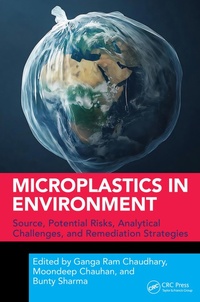
Microplastics in Environment
Source, Potential Risks, Analytical Challenges, and Remediation Strategies
1st Edition
Published on 15. November 2024
282 pages
978-1-040-18523-0 (ISBN)
Description

In recent years, the pervasive presence of microplastics in the environment has emerged as a pressing global concern. As we grapple with the complexities of this issue, it becomes increasingly evident that a comprehensive understanding of microplastics' sources, risks, analytical challenges, and remediation strategies is essential for effective mitigation and safeguarding of our ecosystems and human health.
Microplastics in Environment comprehensively explores the growing concern surrounding microplastic pollution. From their emergence as a significant environmental pollutant to their potential risks and various remediation strategies, this book delves into every aspect of microplastics' impact on ecosystems and human health. With chapters authored by experts in the field, readers gain insights into the sources, classification, properties, and dynamics of microplastics in different environmental compartments, including marine environments, soils, and indoor settings. Analytical challenges related to the identification, quantification, and characterization of microplastics are thoroughly discussed, along with emerging computational approaches to unravel the microplastic mystery. The book highlights recent trends in using bioindicators to monitor microplastic pollution and its adverse impacts on animal health. Additionally, the book explores trends, challenges, and opportunities in plastic recycling and future directions for addressing microplastics.
Microplastics in Environment compiles current knowledge and identifies gaps, serving as a valuable resource for researchers, policymakers, and practitioners working towards a cleaner, healthier planet. It aims to support those dedicated to safeguarding our planet for future generations.
FEATURES
Focuses on microplastic pollution in the environment and highlights the emergent need to reduce and eliminate microplastic pollution.
Includes special chapters on microplastic classifications, estimation tools, and the role of computational modeling in microplastic.
Discusses microplastic occurrence in marine, soil, air, and prevention strategies in different environmental settings.
Furthermore, it explores different remediation strategies, current trends, challenges, and opportunities in plastic recycling.
Microplastics in Environment comprehensively explores the growing concern surrounding microplastic pollution. From their emergence as a significant environmental pollutant to their potential risks and various remediation strategies, this book delves into every aspect of microplastics' impact on ecosystems and human health. With chapters authored by experts in the field, readers gain insights into the sources, classification, properties, and dynamics of microplastics in different environmental compartments, including marine environments, soils, and indoor settings. Analytical challenges related to the identification, quantification, and characterization of microplastics are thoroughly discussed, along with emerging computational approaches to unravel the microplastic mystery. The book highlights recent trends in using bioindicators to monitor microplastic pollution and its adverse impacts on animal health. Additionally, the book explores trends, challenges, and opportunities in plastic recycling and future directions for addressing microplastics.
Microplastics in Environment compiles current knowledge and identifies gaps, serving as a valuable resource for researchers, policymakers, and practitioners working towards a cleaner, healthier planet. It aims to support those dedicated to safeguarding our planet for future generations.
FEATURES
Focuses on microplastic pollution in the environment and highlights the emergent need to reduce and eliminate microplastic pollution.
Includes special chapters on microplastic classifications, estimation tools, and the role of computational modeling in microplastic.
Discusses microplastic occurrence in marine, soil, air, and prevention strategies in different environmental settings.
Furthermore, it explores different remediation strategies, current trends, challenges, and opportunities in plastic recycling.
More details
Edition
1. Auflage
Language
English
Place of publication
London
United Kingdom
Publishing group
Taylor & Francis Ltd
Target group
College/higher education
Professional and scholarly
Illustrations
10 Tables, black and white; 43 Line drawings, color; 1 Line drawings, black and white; 5 Halftones, color; 48 Illustrations, color; 1 Illustrations, black and white
ISBN-13
978-1-040-18523-0 (9781040185230)
Copyright in bibliographic data and cover images is held by Nielsen Book Services Limited or by the publishers or by their respective licensors: all rights reserved.
Schweitzer Classification
Other editions
Additional editions

Microplastics in Environment
Source, Potential Risks, Analytical Challenges, and Remediation Strategies
Book
12/2024
CRC Press
Unfortunately, price unknown
Available (delivery time upon request)
Ganga Ram Chaudhary | Moondeep Chauhan | Bunty Sharma
Microplastics in Environment
Source, Potential Risks, Analytical Challenges, and Remediation Strategies
Book
11/2024
1st Edition
CRC Press
€186.60
Available immediately
Persons
Professor Ganga Ram Chaudhary (analytical chemist) has more than 20 years of experience in the fabrication of functionalized nanomaterials/membranes/biopolymers via green methods and exploring their potential applications for the elimination of contaminants from wastewater, as catalyst and as electrochemical sensors and as an alternate to plastic materials. He has published over 204 publications (Patents: 5; Publications: 175; Book/Book Chapter: 24) in the reputed journals and publication houses. Presently, he is heading the Sophisticated Analytical Instrumentation Facility (SAIF) and Central Instrumentation Laboratory (CIL) which equips him with the deeper understanding, knowledge, and skills required to address the analytical challenges/solution associated with the detection of microplastic. He is also engaged in consultancy projects in Himachal Pradesh and Panjab industrial regions regarding the evaluation of processing parameters to upgrade the CETP (common effluent treatment plant) and achieve the goal of zero liquid discharge, mitigation of pollution and sustainable development for the treatment of wastewater from pharmaceutical, electroplating, textile and personal care products.
Dr. Moondeep Chauhan (Environmental Scientist) received his Doctoral degree in Environmental Studies from Panjab University in 2020. From 2020 to 2022, he worked as a Post-doctoral BIRAC innovation fellow at E-YUVA center, Panjab University. Thereafter, he worked as a research scientist in the Sophisticated Analytical Instrumentation Facility/Central Instrumentation Lab (SAIF/CIL), Panjab University. Currently, he is working as an assistant professor cum scientist in the central instrumentation facility, and Department of Environment Science at Amity University, Punjab. His current research interests include the development of nano-catalysts and electrochemical sensors for applications in the field of energy and environment. He is actively engaged in the synthesis of functionalized nanomaterials/membranes via green methods and exploring their potential applications for the elimination of contaminants from wastewater and has published over 25 research articles, including 6 book chapters and 2 patents (1 granted). Also, he is engaged in consultancy projects for the treatment of wastewater from pharmaceutical, electroplating, textile and personal care products.
Dr. Bunty Sharma received his Doctoral degree in Chemistry from Panjab University, India and during Ph.D. worked at the School of Pharmacy, University of Nottingham, UK (commonwealth scholarship). He has published 13 research articles in reputed peer-reviewed journals, 6 book chapters, and filed 3 Indian patents including 2 granted patents. He has vast experience in handling various analytical techniques that are used for the characterization of micro or nanoparticles. Currently, he is working as a research specialist in Molekule Group Inc. Florida, USA. Before this, he worked as a research officer in the School of Biochemistry and Cell Biology, at University College Cork, Ireland. Besides this, he is working in a team to provide consultancy to the Industries for Effluent treatment plant of Panjab, Himachal Pradesh region of India.
Dr. Moondeep Chauhan (Environmental Scientist) received his Doctoral degree in Environmental Studies from Panjab University in 2020. From 2020 to 2022, he worked as a Post-doctoral BIRAC innovation fellow at E-YUVA center, Panjab University. Thereafter, he worked as a research scientist in the Sophisticated Analytical Instrumentation Facility/Central Instrumentation Lab (SAIF/CIL), Panjab University. Currently, he is working as an assistant professor cum scientist in the central instrumentation facility, and Department of Environment Science at Amity University, Punjab. His current research interests include the development of nano-catalysts and electrochemical sensors for applications in the field of energy and environment. He is actively engaged in the synthesis of functionalized nanomaterials/membranes via green methods and exploring their potential applications for the elimination of contaminants from wastewater and has published over 25 research articles, including 6 book chapters and 2 patents (1 granted). Also, he is engaged in consultancy projects for the treatment of wastewater from pharmaceutical, electroplating, textile and personal care products.
Dr. Bunty Sharma received his Doctoral degree in Chemistry from Panjab University, India and during Ph.D. worked at the School of Pharmacy, University of Nottingham, UK (commonwealth scholarship). He has published 13 research articles in reputed peer-reviewed journals, 6 book chapters, and filed 3 Indian patents including 2 granted patents. He has vast experience in handling various analytical techniques that are used for the characterization of micro or nanoparticles. Currently, he is working as a research specialist in Molekule Group Inc. Florida, USA. Before this, he worked as a research officer in the School of Biochemistry and Cell Biology, at University College Cork, Ireland. Besides this, he is working in a team to provide consultancy to the Industries for Effluent treatment plant of Panjab, Himachal Pradesh region of India.
Content
Microplastics Pollution: An Overview of the Global Crisis. The Emergence, Chemical Nature, Classification, and Properties of Microplastics. Identifying and Characterizing Microplastics. Unraveling the Microplastic Mystery: Computational Insights, Real-World Cases, and the Road Ahead. Monitoring Microplastics and Nanoplastics in a Marine Realm. Microplastic in Soils: Sources, Fate, Toxicity, and Remediation Technologies. Airborne Microplastics: Sources, Characteristics, Dynamics, and Health Implications. Household Microplastic Pollutants: A Potential Contributor to Indoor Microplastics Pollution. Adverse Impact of Microplastics on Animal Health. Novel Remediation Pathways for Mitigating Microplastic Pollution. Emerging Frontiers in Environmental Biotechnology: Bridging Gaps to Confront the Microplastic Menace. Biodecomposition of Microplastics: A Sustainable Approach for Microplastic Waste Management. Plastic Recycling: Current Trends, Challenges, and Opportunities. Microplastics in the Environment: Current Consensus and Future Trends. Closing the Loop on Microplastics: Sources, Risks, Analysis, and Path Forward
