

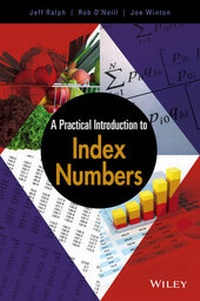
A Practical Introduction to Index Numbers
Description

More details
Other editions
Additional editions
Persons
Dr Jeff Ralph, Head of Index Number Methodology, Office for National Statistics, Cardiff, UK
Mr Joe Winton, Statistical Training Unit, Office for National Statistics, Cardiff, UK
Dr Robert O'Neill, Lecturer in Economics, University of Huddersfield, UK
Content
Preface xi
Acknowledgements xv
1 Introduction 1
1.1 What is an index number? 1
1.2 Example - the Consumer Prices Index 2
1.3 Example - FTSE 100 5
1.4 Example - Multidimensional Poverty Index 6
1.5 Example - Gender Inequality Index 6
1.6 Representing the world with index numbers 7
1.7 Chapter summary 8
References 8
2 Index numbers and change 9
2.1 Calculating an index series from a data series 9
2.2 Calculating percentage change 11
2.3 Comparing data series with index numbers 13
2.4 Converting from an index series to a data series 14
2.5 Chapter summary 16
Exercise A 17
3 Measuring inflation 19
3.1 What is inflation? 19
3.2 What are inflation measures used for and why are they important? 20
3.2.1 Determination of monetary policy by a central bank 21
3.2.2 Changing of provisions for private pensions 21
3.2.3 Changes in amounts paid over long-term contracts 21
3.2.4 Changes in rail fares and other goods 22
3.2.5 Evaluating investment decisions 22
3.2.6 Inputs to economic research and analysis 23
3.2.7 Index-linked debt 23
3.2.8 Tax allowances 23
3.2.9 Targets for stability of the economy in an international context 23
3.3 Chapter summary 24
References 24
Exercise B 25
4 Introducing price and quantity 27
4.1 Measuring price change 27
4.2 Simple, un-weighted indices for price change 30
4.2.1 Simple price indices 30
4.2.2 Simple quantity indices 33
4.3 Price, quantity and value 34
4.4 Example - Retail Sales Index 35
4.5 Chapter summary 36
Exercise C 37
5 Laspeyres and Paasche indices 39
5.1 The Laspeyres price index 40
5.2 The Paasche price index 41
5.3 Laspeyres and Paasche quantity indices 43
5.4 Laspeyres and Paasche: mind your Ps and Qs 45
5.4.1 Laspeyres price index as a weighted sum of price relatives 45
5.4.2 Laspeyres quantity index as a weighted sum of quantity relatives 46
5.4.3 Paasche price index as a weighted harmonic mean of price relatives 46
5.4.4 Paasche quantity index as a weighted harmonic mean of quantity relatives 46
5.5 Laspeyres, Paasche and the Index Number Problem 48
5.6 Laspeyres or Paasche? 49
5.7 A more practical alternative to a Laspeyres price index? 51
5.8 Chapter summary 51
References 52
Exercise D 53
6 Domains and aggregation 55
6.1 Defining domains 55
6.2 Indices for domains 57
6.3 Aggregating domains 58
6.4 More complex aggregation structures 62
6.5 A note on aggregation structures in practice 62
6.6 Non-consistency in aggregation 63
6.7 Chapter summary 63
Exercise E 64
7 Linking and chain-linking 67
7.1 Linking 68
7.2 Re-basing 71
7.3 Chain-linking 74
7.4 Chapter summary 75
Exercise F 76
8 Constructing the consumer prices index 79
8.1 Specifying the index 79
8.2 The basket 80
8.3 Locations and outlets 81
8.4 Price collection 81
8.5 Weighting 81
8.6 Aggregation structure 82
8.7 Elementary aggregates 83
8.8 Linking 84
8.9 Owner occupier housing 85
8.10 Publication 85
8.11 Special procedures 86
8.12 Chapter summary 86
References 86
Exercise G 88
9 Re-referencing a series 89
9.1 Effective comparisons with index numbers 89
9.2 Changing the index reference period 92
9.3 Why re-reference? 94
9.4 Re-basing 95
9.5 Chapter summary 96
References 96
Exercise H 97
10 Deflation 99
10.1 Value at constant price 101
10.2 Volume measures in the national accounts 102
10.3 Chapter summary 103
Exercise I 104
11 Price and quantity index numbers in practice 105
11.1 A big picture view of price indices 105
11.2 The harmonised index of consumer prices 106
11.3 UK measures of consumer price inflation 107
11.4 PPI and SPPI 108
11.5 PPPs and international comparison 109
11.6 Quantity indices 109
11.7 Gross domestic product 110
11.8 Index of Production 111
11.9 Index of services 112
11.10 Retail sales index 113
11.11 Chapter summary 114
11.12 Data links 115
References 115
12 Further index formulae 119
12.1 Recap on price index formulae 119
12.2 Classifying price and quantity index formulae 120
12.3 Asymmetrically weighted price indices 120
12.4 Symmetric weighted price indices 123
12.5 Un-weighted price indices 124
12.6 Different formulae, different index numbers 126
12.7 Chapter summary 127
References 127
Exercise J 129
13 The choice of index formula 131
13.1 The index number problem 131
13.2 The axiomatic approach 133
13.3 The economic approach 134
13.4 The sampling approach 135
13.5 The stochastic approach to index numbers 136
13.6 Which approach is used in practice? 137
13.7 Chapter summary 138
References 138
Exercise K 140
14 Issues in index numbers 141
14.1 Cost-of-living versus cost-of-goods 141
14.2 Consumer behaviour and substitution 143
14.3 New and disappearing goods 144
14.4 Quality change 145
14.4.1 Option 1: do nothing - pure price change 146
14.4.2 Option 2: automatic linking - pure quality change 146
14.4.3 Option 3: linking 147
14.4.4 Option 4: imputation 147
14.4.5 Option 5: hedonics 147
14.5 Difficult to measure items 148
14.6 Chapter summary 149
References 149
15 Research topics in index numbers 151
15.1 The uses of scanner data 151
15.1.1 Improvements at the lowest level of aggregation 152
15.1.2 Understanding consumer behaviour 152
15.1.3 Alternative measurement schemes 153
15.1.4 Frequency of indices 153
15.2 Variations on indices 154
15.2.1 Regional indices 154
15.2.2 Variation by socio-economic group or income quantile 154
15.3 Difficult items 155
15.3.1 Clothing 155
15.3.2 New and disappearing goods 156
15.3.3 Hedonics 157
15.4 Chaining 157
15.5 Some research questions 158
References 158
A Mathematics for index numbers 161
A.1 Notation 161
A.1.1 Summation notation 161
A.1.2 An alternative representation 163
A.1.3 Geometric indices 164
A.1.4 Harmonic indices 164
A.2 Key results 165
A.2.1 The value ratio decomposition 165
A.2.2 Converting between the two forms of price and quantity indices 166
A.2.3 Other examples of the price-relative/weights 167
A.2.4 The value ratio as a product of Fisher indices 167
A.3 Index Formula Styles 168
B Choice of index formula 169
B.1 The axiomatic approach to index numbers 169
B.1.1 An introduction to the axiomatic approach 169
B.1.2 Some axioms 170
B.1.3 Choosing an index based on the axiomatic approach 173
B.1.4 Conclusions 174
B.2 The economic approach to index numbers 174
B.2.1 The economic approach to index numbers 174
B.2.2 A result on expenditure indices 177
B.2.3 Example 1: Cobb-Douglas and the Jevons index 179
B.2.4 Example 2: CES and the Lloyd-Moulton index 181
B.2.5 Issues with the economic approach 183
References 184
C Glossary of terms and formulas 185
C.1 Commonly used terms 185
C.2 Commonly used symbols 189
C.3 Unweighted indices (price versions only) 190
C.4 Weighted indices (price versions only) 191
D Solutions to exercises 193
E Further reading 211
E.1 Manuals 211
E.2 Books 211
E.3 Papers 212
Index 213
Preface
The inspiration for writing an introduction to index numbers arose from our work in delivering index number training. We provide introductory and advanced training courses for the Government Statistical Service, for the Official Statistics module of the Operational Research, Applied Statistics and Risk MSc course at Cardiff University and for students sitting the index number components of the Royal Statistical Society (RSS) Ordinary and Higher Certificates. A number of students have asked us to recommend an introductory text to supplement the training, and we have struggled to find a suitable modern book to recommend. While other statistical topics are well supported by introductory books, this is not the case for index numbers.
There are, of course, a number of very good books on index numbers; however, they are directed towards more advanced study. We wanted to write a short, practical book that would introduce the subject and be suitable for students and others who would like a general introduction to the subject. We have therefore based the content partly on the syllabuses for the two RSS Certificates and partly on the content of the workshops we have developed at the Office for National Statistics.
Index numbers is a topic whose concepts are applied very widely. In the economic sphere, many of the most prominent of our economic indicators are presented as index numbers, including the Consumer Prices Index, Gross Domestic Product and the Retail Sales Index. Readers of most newspapers will find regular mentions of these indices and many others too. However, it is not just in the economic sphere that index number concepts appear. Increasingly, they are finding application in the social sphere through composite measures such as those aiming to quantify complex concepts such as poverty and prosperity.
Despite finding widespread application, few statistics or economics books contain even a mention of index numbers, let alone any detailed description; a curious student might well wonder which academic subject they fall under. The answer is that the topic tends to fall between economics and statistics. Where it does appear, it is usually studied as part of a specialist topic, like measurement economics.
At a basic level, the subject may appear simple to the beginning student, or casual academic observer; however, in our experience this is not the case. There are many subtle and complex aspects that have gradually developed over many years and are still the subject of much discussion and academic research.1 Indeed, the practical implementation of a price index like the Consumer Prices Index is a massive undertaking that requires a considerable amount of effort and expertise on the part of National Statistics Institutes around the world. It is the intention of this book to highlight some of these aspects, hopefully resulting in an enhanced understanding of index numbers as commonly used in Official Statistics.
In common with other topics in statistics and economics, some observers may consider index numbers a dry subject, distant from the general population and perhaps not very interesting. While we can understand why this view might be held, we see the subject very differently. It is a complex and absorbing subject that provides a good return on investment in study. It should also be pointed out that through index number measures such as the Consumer Prices Index, all of our lives are affected in one way or another by the application of the subject.
This is not a book that will examine and explain all of the complex aspects of major index number outputs. However, there are facets of the Consumer Prices Index that are instructive for the student to consider, and we have included some of them in this book. We hope they will also prove interesting and will give the student a better understanding of this key indicator when watching the news, listening to the radio or reading a newspaper.
One of the significant advantages of developing and delivering training courses over a number of years is the opportunity to continuously improve the teaching material based on feedback from students. Two particular aspects of the training have proved popular with students. Firstly, including exercises that require students to calculate index numbers from a modest amount of data, and secondly, mixing material on the theoretical aspects of the subject with sections on the practical aspects of price statistics. We have continued this approach in this book.
Organisation of the book
This book has 15 chapters and includes 11 sets of exercises. Chapter 1 provides a general introduction to the concepts of an index and an index number; it identifies a range of applications from both the economic and social spheres. Chapter 2 introduces the reader to the procedure for converting a simple data series into a series of index numbers and back again. It shows how to calculate percentage change from an index series and identifies some benefits of working with data in index number form. The first exercise gives the reader the opportunity to develop the basic skills with some simple data.
One of the major applications of index numbers is the measurement of inflation; it is arguably the most important output any National Statistics Institute produces and it is the subject of Chapter 3. We explain briefly what is meant by inflation and why it is important. Chapters 4 and 5 set out the basic material to enable the student to understand how inflation is calculated in practice. Chapter 4 introduces price, quantity and value, and the application of simple unweighted price indices. An exercise follows in which the reader is invited to calculate price index numbers for goods on sale in a shop. Chapter 5 describes value change for a basket of goods between two time periods and introduces the iconic price (and quantity) indices of Étienne Laspeyres and Hermann Paasche. It explains the difference between the two indices and shows how value change can be decomposed into measures of pure price change and pure quantity change; it also introduces the index number problem. An exercise follows.
Chapters 6 and 7 explore two aspects of the subject that are important for the practical application of index numbers - domains and aggregation, and linking and chain-linking. How the Consumer Prices Index is constructed is the subject of Chapter 8; it uses the knowledge gained from Chapters 2 to 7. Two more practical topics are covered in Chapters 9 and 10 - re-referencing and rebasing, and deflation; both chapters are followed by exercises. A brief description of the major price and quantity indices produced by National Statistics Institutes is given in Chapter 11.
Chapter 12 returns to the theoretical development of the subject, considering further index formulae including the Fisher, Walsh and Törnqvist indices; an exercise includes both algebra and calculation based questions. Chapter 13 gives an overview of the various approaches that have been made to identify the 'best' formula to use. More advanced topics that are much discussed and studied in the index number research field are the subject of Chapter 14. They include: consumer substitution behaviour, new goods and disappearing goods, and hard to measure goods like housing. These are all challenging topics that producers of price indices need to address and we seek only to introduce them in this chapter. Current research topics, such as the role of big data in price indices are explored in Chapter 15.
Six appendices provide supporting material:
-
A: Mathematics for index numbers
Index numbers is a mathematical topic - though the level of mathematical knowledge needed is relatively modest at the introductory level that this book covers. However, we do not want readers to be inhibited by the mathematical requirements, so we have explained the mathematical notation and knowledge required in each chapter as it arises. Appendix A provides further support by providing a fuller explanation of the key mathematical concepts and index number results. -
B: Choice of index formula
This appendix provides a more detailed look at two of the approaches to index numbers that were introduced in Chapter 13 - the axiomatic and economic. This appendix is more advanced than any of the other material in the book. - C: Glossary of terms and formulae
- D: Solutions to most of the exercises
- E: Further reading
Additional material available online
The companion website, www.wiley.com/go/ralph/index_numbers, hosts additional content for this book. This includes presentations, example data and R code to run index number calculations. There is also some additional help for students who attempt the exercises.
Suggested routes through the book
While it is hoped that many readers will work through all chapters in the book, there are options for students taking the Royal Statistical Society exams2 who want to focus on the specific material they need. The following chapters are particularly relevant:
- Ordinary certificate: 1-5 and some parts of 7 and 12
- Higher certificate: 1-13 and Appendix A.
For a reader who would like to learn about the concept of index numbers, their use and some of the challenging aspects, but without wanting to develop skills in calculation, the following is a suggested subset of the book: Chapters...
