

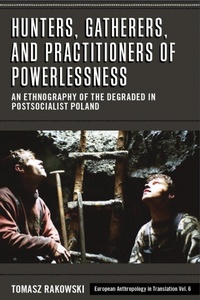
Hunters, Gatherers, and Practitioners of Powerlessness
Description

The socio-economic transformations of the 1990s have forced many people in Poland into impoverishment. Hunters, Gatherers, and Practitioners of Powerlessness gives a dramatic account of life after this degradation, tracking the experiences of unemployed miners, scrap collectors, and poverty-stricken village residents. Contrary to the images of passivity, resignation, and helplessness that have become powerful tropes in Polish journalism and academic writing, Tomasz Rakowski traces the ways in which people actively reconfigure their lives. As it turns out, the initial sense of degradation and helplessness often gives way to images of resourcefulness that reveal unusual hunting-and-gathering skills.
More details
Other editions
Additional editions
Person
Tomasz Rakowski is Associate Professor at the Institute of Ethnology and Cultural Anthropology, University of Warsaw. He is also a medical doctor, specialist in Accident & Emergency medicine. He conducts fieldwork in Poland and Mongolia.
Content
Foreword
Jan Kubik
Acknowledgments
Preface
Introduction: The Anthropologist as a Poverty Inspector
- An Anthropological Shift in Perspective
- The 'Culture of Poverty': Getting Beyond the Concept
- Social Trauma and Dependency: Shift in Perspective
- Hermeneutics and Anthropology
- Towards a Method
- Maurice Merleau-Ponty - the 'Patron Saint' of the Present Ethnography
- Method: (Lack of) Ethnographic Knowledge
- Pre-textual Ethnography
- The Most Bitter Side of the Polish Transformation: Fields of Research
- The "New Poverty"
- Post-socialism: History and Experience
- The Studied Phenomena
- The Field Research
Chapter 1. The Szydlowiec and Przysucha Environs (The S¿wie¿tokrzyskie and Radom Foothills)
- A World Full of Adversities
- Unemployment and the Farming Recession
- Community of the Unemployed: Immobility, Odd Jobs and 'Tragic Scarring'
- Motionless Orchards, Motionless Fields: Failure
- Dependency and Irreversibility: A Reproof at the World
- Second-string Ecology
- The New Face of the Jobless Village
- Gatherers of Wild Herbs and Undergrowth, Gatherers of Fir Wood
- The 'New Ecology': The Convertibility of the Environment
- Collection, Conversion, Transition
- The 'Culture of Survival'
Chapter 2. Walbrzych - Boguszów-Gorce
- From Destruction to 'Empty' Communication: The Liquidation of the Coal Basin
- The City and the Mine
- The Highly Ambivalent Story of the Walbrzych Basin
- Experience and Liquidation: Destruction - The City - The Body
- How to Speak of Liquidation? (Auto)aggression - Dialogue - Social Muteness
- Externalized Shame: Empty Communication and Internal Spectacles
- Facing Reality after the Mines (1)
- Complaints - Accusations - Triumphs
- A World Affected from the Outside
- Bootleg Mines, Diggers, Skills: The Body's Active Knowledge
- Rhythm, Jokes, Anecdotes: 'Scoffing at the World'
- Law and Lawlessness: Interior Spectacles
- The Grey Market: Deal-making and Resourcefulness
- The 'Internal Circulation' and the Fragmentationof Transactions
- Home-Oikos: The Internal Circulation
- Freedom in the Mines
- 'Do It Yourself' Equipment
- Working and Efficiency in Manual Labor: Resources and Deposits
- Demolition - Collecting - Objects
- Things
- Memory
- Facing Reality after the Mines (2)
Chapter 3. The Belchatów Brown Coal Mine -- The Shadowlands of the Exposed Mine
- The Mine/ Power Station. The Perfect Balance, an Abrupt Modernization
- Causative Alienation and Control over the Environment
- At the Margins of the Great Industry - Marginalization and Exclusion
- The Mine: Orbis Exterior
- Violence, Guilt, and the Building Sacrifice
- The Consequences of 'Excess': Metaphors of Exploitation
- The Mine: Orbis Interior
- The Players, Their Families, and Their Means of Sustenance
- Self-sufficiency, Subsistence: Gathering and Processing Goods
- Hunting and Gathering
- Waclaw Okon¿ski - The Stalker, Orbis Interior
- Goods and Trophies: The Hunting/Gathering Existence on the Edge of the Mine
- Records
- Cabinets of Curiosities, Collectors' Museums
- The Work of Memory: Reconstructions, Objects, Collections
- 'The Science of the Concrete': Inscriptions, Journals, Enumeration
- Hunters and Gatherers - Practitioners of Powerlessness
Conclusion
- The 'Reality Testing'
- Outcome
- Beyond Anthropology
Bibliography
Materials
