

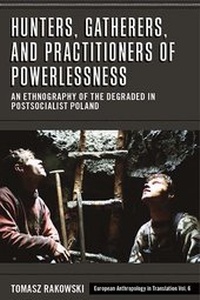
Hunters, Gatherers, and Practitioners of Powerlessness
An Ethnography of the Degraded in Postsocialist Poland
1st Edition
Published on 1. October 2016
332 pages
978-1-78533-241-8 (ISBN)
Description

The socio-economic transformations of the 1990s have forced many people in Poland into impoverishment. Hunters, Gatherers, and Practitioners of Powerlessness gives a dramatic account of life after this degradation, tracking the experiences of unemployed miners, scrap collectors, and poverty-stricken village residents. Contrary to the images of passivity, resignation, and helplessness that have become powerful tropes in Polish journalism and academic writing, Tomasz Rakowski traces the ways in which people actively reconfigure their lives. As it turns out, the initial sense of degradation and helplessness often gives way to images of resourcefulness that reveal unusual hunting-and-gathering skills.
Reviews / Votes
"[T]his book is a treasure that will be mined by anyone interested in the human costs of Poland's market economy, in comparative studies of postsocialist societies, and in experiences of marginalization, de-industrialization, and de-modernization around the world... As an example of anthropology at home, this book raises many important issues of theory and method." * Journal of the Royal Anthropological Institute (JRAI)"The virtue of Rakowski's book lies in his exact observation and the way the author pays attention to the way change is experienced - bodily, metaphorically, in everyday practices and yearning - and he links them to symbolic meaning and patterns of thought and behaviour, both synchronically and diachronically." * Anthropological Journal of European Cultures
"In Hunters, Gatherers, and Practitioners of Powerlessness, Rakowski has produced a haunting and beautiful book. The ethnographic writing is extraordinary. It is an unusual skill, to be able to write about degradation but also to convey the dignity of individual lives. Anyone interested in postsocialism, poverty, or economic anthropology more generally should read this book." * Journal of Anthropological Research
"Tomasz Rakowski presents a theoretically reflective and empirically rich ethnographic study of 'the degraded' in three geographical locales in Poland which were ravaged by change... [His] study does these people justice and represents a significant intellectual achievement." * Slavonic and East European Review
"With a very unique voice and perspective, the ethnographer examines the phenomenology and ontology of postsocialist Poland, where people have been driven to an almost pre-modern (the author even says pre-Neolithic) mode of existence, reformulating their experience of the environment and their relationship to objects created and abandoned by the retreating industrial system." * Anthropology Review Database
"This is an important book that is both theoretically insightful and ethnographically rich. It provides a look into the "other side" of the postcommunist, neoliberal transformation in Poland, focusing on those who experienced social degradation-they lost social status as the country has gained position in the global economy." * Marysia Galbraith, University of Alabama
"Rakowski is consistent in following his outlined path, trying to return the culture of poverty its human, inner face. Hermeneutical evidence, backed by extraordinary field work experience and thick description, give desired results. Polish ethnological tradition combined with inspirations drawn from world-class anthropologists, the achievements of Polish researchers of poverty and the classics of sociology and philosophy, result in a work of unquestionable research and intellectual value. A real breakthrough in studies on marginalised people, victims of progress." * Michal Buchowski, Adam Mickiewicz University in Poznan, European University Viadrina
"In his book Rakowski studies the most tragic dimension of the postcommunist condition, by immersing himself in the lives of those who experienced the total, if temporary, collapse of the economic and social foundations of their existence. He produces three nuanced ethnographies of social and economic resilience in the face of not just an economic collapse but also a cultural catastrophe. [...]Rakowski, an heir to the tradition of Bronislaw Malinowski and Florian Znaniecki, takes it to a new level, enriching it not only with the results of his own trail-blazing ethnographic work, but also with novel interpretive threads, taken for example from Marleau-Ponty's phenomenology. It is hard to find a better ethnographic example of the work that is 'ontological' in its spirit." From the foreword, Jan Kubik, University College London, School of Slavonic and East European Studies
More details
Series
Language
English
Place of publication
Oxford
United Kingdom
Target group
Professional and scholarly
Illustrations
Bibliography; Index; 20 Illustrations
ISBN-13
978-1-78533-241-8 (9781785332418)
DOI
10.3167/9781785332401
Copyright in bibliographic data and cover images is held by Nielsen Book Services Limited or by the publishers or by their respective licensors: all rights reserved.
Schweitzer Classification
Other editions
Additional editions
Tomasz Rakowski
Hunters, Gatherers, and Practitioners of Powerlessness
An Ethnography of the Degraded in Postsocialist Poland
Book
08/2019
1st Edition
Berghahn Books
€42.20
Shipment within 3-4 weeks
Tomasz Rakowski
Hunters, Gatherers, and Practitioners of Powerlessness
An Ethnography of the Degraded in Postsocialist Poland
Book
10/2016
1st Edition
Berghahn Books
€147.60
Shipment within 3-4 weeks
Person
Tomasz Rakowski is Associate Professor at the Institute of Ethnology and Cultural Anthropology, University of Warsaw. He is also a medical doctor, specialist in Accident & Emergency medicine. He conducts fieldwork in Poland and Mongolia.
Content
Foreword
Jan Kubik
Acknowledgments
Preface
Introduction: The Anthropologist as a Poverty Inspector
An Anthropological Shift in Perspective
The 'Culture of Poverty': Getting Beyond the Concept
Social Trauma and Dependency: Shift in Perspective
Hermeneutics and Anthropology
Towards a Method
Maurice Merleau-Ponty - the 'Patron Saint' of the Present Ethnography
Method: (Lack of) Ethnographic Knowledge
Pre-textual Ethnography
The Most Bitter Side of the Polish Transformation: Fields of Research
The "New Poverty"
Post-socialism: History and Experience
The Studied Phenomena
The Field Research
Chapter 1. The Szydlowiec and Przysucha Environs (The S?wie?tokrzyskie and Radom Foothills)
A World Full of Adversities
Unemployment and the Farming Recession
Community of the Unemployed: Immobility, Odd Jobs and 'Tragic Scarring'
Motionless Orchards, Motionless Fields: Failure
Dependency and Irreversibility: A Reproof at the World
Second-string Ecology
The New Face of the Jobless Village
Gatherers of Wild Herbs and Undergrowth, Gatherers of Fir Wood
The 'New Ecology': The Convertibility of the Environment
Collection, Conversion, Transition
The 'Culture of Survival'
Chapter 2. Walbrzych - Boguszow-Gorce
From Destruction to 'Empty' Communication: The Liquidation of the Coal Basin
The City and the Mine
The Highly Ambivalent Story of the Walbrzych Basin
Experience and Liquidation: Destruction - The City - The Body
How to Speak of Liquidation? (Auto)aggression - Dialogue - Social Muteness
Externalized Shame: Empty Communication and Internal Spectacles
Facing Reality after the Mines (1)
Complaints - Accusations - Triumphs
A World Affected from the Outside
Bootleg Mines, Diggers, Skills: The Body's Active Knowledge
Rhythm, Jokes, Anecdotes: 'Scoffing at the World'
Law and Lawlessness: Interior Spectacles
The Grey Market: Deal-making and Resourcefulness
The 'Internal Circulation' and the Fragmentationof Transactions
Home-Oikos: The Internal Circulation
Freedom in the Mines
'Do It Yourself' Equipment
Working and Efficiency in Manual Labor: Resources and Deposits
Demolition - Collecting - Objects
Things
Memory
Facing Reality after the Mines (2)
Chapter 3. The Belchatow Brown Coal Mine -- The Shadowlands of the Exposed Mine
The Mine/ Power Station. The Perfect Balance, an Abrupt Modernization
Causative Alienation and Control over the Environment
At the Margins of the Great Industry - Marginalization and Exclusion
The Mine: Orbis Exterior
Violence, Guilt, and the Building Sacrifice
The Consequences of 'Excess': Metaphors of Exploitation
The Mine: Orbis Interior
The Players, Their Families, and Their Means of Sustenance
Self-sufficiency, Subsistence: Gathering and Processing Goods
Hunting and Gathering
Waclaw Okon?ski - The Stalker, Orbis Interior
Goods and Trophies: The Hunting/Gathering Existence on the Edge of the Mine
Records
Cabinets of Curiosities, Collectors' Museums
The Work of Memory: Reconstructions, Objects, Collections
'The Science of the Concrete': Inscriptions, Journals, Enumeration
Hunters and Gatherers - Practitioners of Powerlessness
Conclusion
The 'Reality Testing'
Outcome
Beyond Anthropology
Bibliography
Materials
Jan Kubik
Acknowledgments
Preface
Introduction: The Anthropologist as a Poverty Inspector
An Anthropological Shift in Perspective
The 'Culture of Poverty': Getting Beyond the Concept
Social Trauma and Dependency: Shift in Perspective
Hermeneutics and Anthropology
Towards a Method
Maurice Merleau-Ponty - the 'Patron Saint' of the Present Ethnography
Method: (Lack of) Ethnographic Knowledge
Pre-textual Ethnography
The Most Bitter Side of the Polish Transformation: Fields of Research
The "New Poverty"
Post-socialism: History and Experience
The Studied Phenomena
The Field Research
Chapter 1. The Szydlowiec and Przysucha Environs (The S?wie?tokrzyskie and Radom Foothills)
A World Full of Adversities
Unemployment and the Farming Recession
Community of the Unemployed: Immobility, Odd Jobs and 'Tragic Scarring'
Motionless Orchards, Motionless Fields: Failure
Dependency and Irreversibility: A Reproof at the World
Second-string Ecology
The New Face of the Jobless Village
Gatherers of Wild Herbs and Undergrowth, Gatherers of Fir Wood
The 'New Ecology': The Convertibility of the Environment
Collection, Conversion, Transition
The 'Culture of Survival'
Chapter 2. Walbrzych - Boguszow-Gorce
From Destruction to 'Empty' Communication: The Liquidation of the Coal Basin
The City and the Mine
The Highly Ambivalent Story of the Walbrzych Basin
Experience and Liquidation: Destruction - The City - The Body
How to Speak of Liquidation? (Auto)aggression - Dialogue - Social Muteness
Externalized Shame: Empty Communication and Internal Spectacles
Facing Reality after the Mines (1)
Complaints - Accusations - Triumphs
A World Affected from the Outside
Bootleg Mines, Diggers, Skills: The Body's Active Knowledge
Rhythm, Jokes, Anecdotes: 'Scoffing at the World'
Law and Lawlessness: Interior Spectacles
The Grey Market: Deal-making and Resourcefulness
The 'Internal Circulation' and the Fragmentationof Transactions
Home-Oikos: The Internal Circulation
Freedom in the Mines
'Do It Yourself' Equipment
Working and Efficiency in Manual Labor: Resources and Deposits
Demolition - Collecting - Objects
Things
Memory
Facing Reality after the Mines (2)
Chapter 3. The Belchatow Brown Coal Mine -- The Shadowlands of the Exposed Mine
The Mine/ Power Station. The Perfect Balance, an Abrupt Modernization
Causative Alienation and Control over the Environment
At the Margins of the Great Industry - Marginalization and Exclusion
The Mine: Orbis Exterior
Violence, Guilt, and the Building Sacrifice
The Consequences of 'Excess': Metaphors of Exploitation
The Mine: Orbis Interior
The Players, Their Families, and Their Means of Sustenance
Self-sufficiency, Subsistence: Gathering and Processing Goods
Hunting and Gathering
Waclaw Okon?ski - The Stalker, Orbis Interior
Goods and Trophies: The Hunting/Gathering Existence on the Edge of the Mine
Records
Cabinets of Curiosities, Collectors' Museums
The Work of Memory: Reconstructions, Objects, Collections
'The Science of the Concrete': Inscriptions, Journals, Enumeration
Hunters and Gatherers - Practitioners of Powerlessness
Conclusion
The 'Reality Testing'
Outcome
Beyond Anthropology
Bibliography
Materials
