

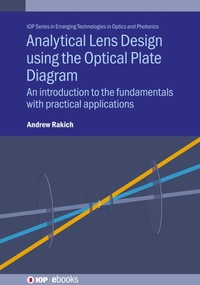
Analytical Lens Design using the Optical Plate Diagram
Description

In this book, Rakich provides a fresh look at the Optical Plate Diagram of C. R. Burch, with design examples, descriptions of well-known (and some less well-known) design types, along with some interesting historical background.
The Optical Plate Diagram is a useful tool for conceptualizing the behavior of optical systems. Although Seidel aberration theory provides guidance as to the large-scale behavior of optical systems, the required algebra is sometimes a barrier to the visualization of solutions. By contrast, the diagram describes aberrations with reference to a simple mechanical analog that is in many cases conceptually simpler than Seidel theory.
This book is highly recommended for optical designers seeking to broaden their conceptual understanding of optical systems and aberration theory.
Key features: * Provides a highly intuitive pathway to understanding optical system aberrations. * Claims, then demonstrates by example, the way the Optical Plate Diagram can lead to powerful new design insights. * Structured to render material in each chapter in increasing order of technical difficulty, enhancing accessibility and readability to people from a wide range of backgrounds and experiences. * Assistance to people new to the field, a fresh perspective to people experienced in the field, and a useful overview to people working in related fields.
More details
Other editions
Additional editions
Person
Dr. Andrew Rakich is an optical designer who throughout his career has seen the value in combining a theoretical understanding of optical aberrations with practical applications. Dr. Rakich has worked on many of the world's major land-based telescope projects and now continues to do so as a consultant from his home country of New Zealand.
Content
- The origins of plate diagram theory
- The plate diagram for a single surface
- Multi-element telescope systems
- Finite-conjugate systems
- System surveys
- Conclusions
- Appendices
