

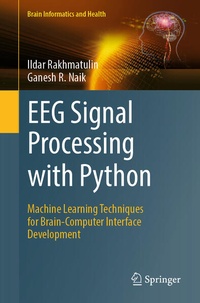
EEG Signal Processing with Python
Description

Unlock the power of brain-computer interfaces (BCIs) with this practical guide to signal processing and machine learning. Learn to decode neural data using Python, from fundamental techniques to cutting-edge algorithms. Master essential libraries, implement real-time processing, and design your own BCI systems. Perfect for students, researchers, and innovators ready to build the future of neurotechnology.
From basic signal processing to advanced machine learning techniques, you will learn how to extract meaningful insights from complex neuroscience data. Step-by-step tutorials guide you through real-world applications, empowering you to:
- Master essential Python libraries for neuroscience data analysis
- Implement signal filtering, feature extraction, and neural decoding algorithms
- Design and evaluate BCI systems using state-of-the-art machine learning approaches
Whether you are a student, researcher, or entrepreneur, this book provides the tools and knowledge to turn brain signals into actionable insights. With its focus on practical implementation and real-time processing, it's an invaluable resource for anyone looking to harness the potential of BCIs. Don't just read about neurotechnology - learn to build it. Take your first step towards creating the next generation of brain-computer interfaces today.
More details
Other editions
Additional editions
Persons
Dr. Ildar Rakhmatulin is a scientist and the creator of several popular open-source brain-computer interfaces (BCI) projects on GitHub. He is the founder of PiEEG, a low-cost BCI solution. His experience includes working as a BCI developer at Imperial College London, a machine learning researcher at Heriot-Watt University, and a researcher in the neurotechnology group at the University of Edinburgh, UK. Additionally, he is the author of neuroscience courses on Udemy.
Dr. Ganesh R. Naik is a distinguished biomedical engineer and signal processing expert, recognized within the top 2% of global researchers in his field by Stanford University. Holding a PhD from RMIT University, he has built a robust career marked by significant contributions to academia and research. Currently a senior academic at Torrens University Australia, his extensive publication record includes approximately 150 peer-reviewed papers and 14 edited books. Dr. Naik's expertise is further evidenced by his leadership roles in data analysis for large-scale research projects, particularly in sleep technology, and his development of novel algorithms for wearable devices. He has held prestigious postdoctoral positions at leading Australian institutions and has received numerous accolades, including the Baden-Württemberg Scholarship and the BridgeTech industry fellowship. His influence extends to the editorial realm, where he serves as an associate editor for prominent journals such as IEEE ACCESS and Frontiers in Neurorobotics, solidifying his position as a leading figure in biomedical engineering.
Content
"Chapter 1. Introduction to EEG".- "Chapter 2. EEG and Signal Preprocessing".- "Chapter 3. EEG and Visualization".- "Chapter 4. Band-pass filter implementation".- "Chapter 5. Smoothing filters".- "Chapter 6. Frequency analysis".- "Chapter 7. Introduction to Artefacts".- "Chapter 8. Remove artifacts from EEG".- "Chapter 9. Evaluation of artifact removal".- "Chapter 10. Real-time signal processing in EEG".- "Chapter 11. Application without Machine Learning".- "Chapter 12. Introduction to Machine Learning for EEG".- "Chapter 13. Usage of Machine Learning and EEG".- "Chapter 14. Case Studies and Applications".
