

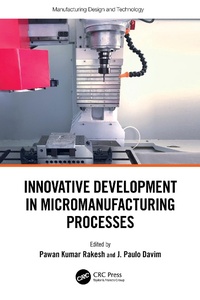
Innovative Development in Micromanufacturing Processes
1st Edition
Published on 23. November 2023
462 pages
978-1-000-99429-2 (ISBN)
Description

Innovative Development in Micromanufacturing Processes details cutting edge technologies in micromanufacturing processes, an industry which has undergone a technological transformation in the past decade. Enabling engineers to create high performance, low cost, and long-lasting products, this book is an essential companion to all those working in micro and nano engineering.
As products continue to get smaller and smaller, the field of micromanufacturing has gained an international audience. This book looks at both approaches of micromanufacturing: top-down and bottom-up. The top-down approach includes subtractive micromanufacturing processes such as microturning, micromilling, microdrilling, laser beam micromachining, and magnetic abrasive finishing. The bottom-up approach involves additive manufacturing processes such as micro-forming, micro deep drawing, microforging, microextrusion, and microwelding. Additionally, microjoining and microhybrid manufacturing processes are discussed in detail. The book also aids engineers and students in solving common manufacturing issues such as choice of materials and testing.
The book will be of interest to those working in micro and nano engineering and machining, as well as students in manufacturing engineering, materials science, and more.
As products continue to get smaller and smaller, the field of micromanufacturing has gained an international audience. This book looks at both approaches of micromanufacturing: top-down and bottom-up. The top-down approach includes subtractive micromanufacturing processes such as microturning, micromilling, microdrilling, laser beam micromachining, and magnetic abrasive finishing. The bottom-up approach involves additive manufacturing processes such as micro-forming, micro deep drawing, microforging, microextrusion, and microwelding. Additionally, microjoining and microhybrid manufacturing processes are discussed in detail. The book also aids engineers and students in solving common manufacturing issues such as choice of materials and testing.
The book will be of interest to those working in micro and nano engineering and machining, as well as students in manufacturing engineering, materials science, and more.
More details
Series
Edition
1. Auflage
Language
English
Place of publication
London
United Kingdom
Publishing group
Taylor & Francis Ltd
Target group
College/higher education
Product notice
Reflowable
Illustrations
27 Tables, black and white; 108 Line drawings, black and white; 72 Halftones, black and white; 180 Illustrations, black and white
ISBN-13
978-1-000-99429-2 (9781000994292)
Copyright in bibliographic data and cover images is held by Nielsen Book Services Limited or by the publishers or by their respective licensors: all rights reserved.
Schweitzer Classification
Other editions
Additional editions
Pawan Kumar Rakesh | J. Paulo Davim
Innovative Development in Micromanufacturing Processes
Book
approx. 12/2025
1st Edition
CRC Press
€79.60
Not yet published
Pawan Kumar Rakesh | J. Paulo Davim
Innovative Development in Micromanufacturing Processes
Book
11/2023
1st Edition
CRC Press
€169.70
Shipment within 10-20 days
Persons
Dr. Pawan Kumar Rakesh is serving as an Assistant Professor, Department of Mechanical Engineering, National Institute of Technology Uttarakhand, (NIT Uttarakhand) Srinagar Garhwal, India. He has also served as Head of Department, Mechanical Engineering (2013-2016), and Associate Dean (Faculty Welfare) from 2016 to 2020. Working in a growing organization, he has got substantial exposure to several lab developments, academic structure and student welfare. He is also the Coordinator of the Design Innovation Center, NIT Uttarakhand. He has authored 52 articles published in reputed International/National journals and conferences. He has also organized two International conferences and fifteen workshops in the Institute. He has edited four books, namely, "Processing of Green Composites", Advances in Engineering Design, Joining Processes for Dissimilar and Advanced Materials, and Cellulose Composites. He has contributed twelve book chapters in a different books. He has supervised three PhD and six M.Tech students.
J. Paulo Davim is a Full Professor in the Department of Mechanical Engineering, University of Aveiro, Portugal. He has more than 30 years of teaching and research experience in manufacturing, materials, and mechanical engineering. He also has an interest in management, engineering education and higher education for sustainability. He has worked as an evaluator of projects for the ERC-European Research Council and other international research agencies as well as an examiner of PhD thesis for many universities in different countries. In addition, he has edited/co-edited more than 150 books and authored/co-authored more than 15 books, 100 book chapters, and 500 articles for journals and conferences. He is the Series Editor of 'Woodhead Publishing Reviews: Mechanical Engineering Series'.
J. Paulo Davim is a Full Professor in the Department of Mechanical Engineering, University of Aveiro, Portugal. He has more than 30 years of teaching and research experience in manufacturing, materials, and mechanical engineering. He also has an interest in management, engineering education and higher education for sustainability. He has worked as an evaluator of projects for the ERC-European Research Council and other international research agencies as well as an examiner of PhD thesis for many universities in different countries. In addition, he has edited/co-edited more than 150 books and authored/co-authored more than 15 books, 100 book chapters, and 500 articles for journals and conferences. He is the Series Editor of 'Woodhead Publishing Reviews: Mechanical Engineering Series'.
Content
Chapter 1: Micromanufacturing of Miniature Non-Circular Gears by WSEM Process
Chapter 2: Research status on micro-grinding technology
Chapter 3: Numerical investigation and simulation of micro-EDM process
Chapter 4: Micro-Electrochemical Machining
Chapter 5: Pulsed fiber laser processing of A4 stainless steel
Chapter 6: Machining Strategies for Micromachining of Glass Using Electrochemical Discharge Machining: A Review
Chapter 7: Application and mechanism of the cavitation effect in the preparation of magnetorheological polishing fluid
Chapter 8: Surface Coating
Chapter 9: Direct Ink Writing
Chapter 10: Ultrasonic Moulding
Chapter 11: Spark plasma sintering of layered structures and powder mixtures of reactive metals
Chapter 12: Laser micro-spot welding of magnesium alloys for bone tissue engineering scaffolds
Chapter 13: Mixing Enhancement in Low Amplitude Wavy Channel Micromixers (LAWC-M) with Different Obstacles
Chapter 14: Prediction of machined slot areas using artificial neural network and adaptive neural fuzzy interference system by WEDM on for different slant angles.
Chapter 15: Nanocomposite surface modification
Chapter 16: Nanotechnology: nanocomposites processing
Chapter 17: Opportunities and Challenges in Miniaturized Product Manufacturing Processes
Chapter 18: COMSOL Multiphysics: A simulation tool to analyze the processing of biodegradable biomaterials used in arthroplasty
Chapter 19: Elastically Embedded Abrasives for micro finishing: Theory and State-of-the-art
Chapter 2: Research status on micro-grinding technology
Chapter 3: Numerical investigation and simulation of micro-EDM process
Chapter 4: Micro-Electrochemical Machining
Chapter 5: Pulsed fiber laser processing of A4 stainless steel
Chapter 6: Machining Strategies for Micromachining of Glass Using Electrochemical Discharge Machining: A Review
Chapter 7: Application and mechanism of the cavitation effect in the preparation of magnetorheological polishing fluid
Chapter 8: Surface Coating
Chapter 9: Direct Ink Writing
Chapter 10: Ultrasonic Moulding
Chapter 11: Spark plasma sintering of layered structures and powder mixtures of reactive metals
Chapter 12: Laser micro-spot welding of magnesium alloys for bone tissue engineering scaffolds
Chapter 13: Mixing Enhancement in Low Amplitude Wavy Channel Micromixers (LAWC-M) with Different Obstacles
Chapter 14: Prediction of machined slot areas using artificial neural network and adaptive neural fuzzy interference system by WEDM on for different slant angles.
Chapter 15: Nanocomposite surface modification
Chapter 16: Nanotechnology: nanocomposites processing
Chapter 17: Opportunities and Challenges in Miniaturized Product Manufacturing Processes
Chapter 18: COMSOL Multiphysics: A simulation tool to analyze the processing of biodegradable biomaterials used in arthroplasty
Chapter 19: Elastically Embedded Abrasives for micro finishing: Theory and State-of-the-art
