

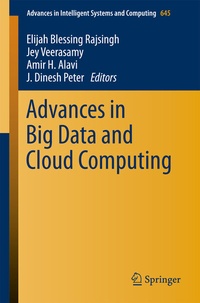
Advances in Big Data and Cloud Computing
Description

More details
Other editions
Additional editions
Persons
ELIJAH BLESSING RAJSINGH is currently the Registrar of Karunya University, Coimbatore, India. He received his PhD from Anna University, India in 2005. His research areas include network security, mobile computing, wireless and ad hoc networks, medical image processing, parallel and distributed computing, grid computing and pervasive computing. He has published a number of articles for respected journals. He is a member of the IEEE, CSI and ISTE, and has served as an advisory board member for various international conferences.
JEY VEERASAMY
is Director of the Center for Computer Science Education & Outreach and a member of the teaching faculty at the Department of Computer Science, University of Texas at Dallas, USA. Prior to joining the UT Dallas in August 2010, he worked in the US wireless telecom software industry (Nortel & Samsung) for 16 years, while also teaching online courses for several colleges. Having now returned to academia to focus onteaching, he travels to India regularly to offer technical lectures & workshops and share his US experience with Indian students.
Amir H. Alavi is an Assistant Professor with a joint appointment in the Civil and Environmental Engineering Department at the University of Missouri and the University of Missouri Extension Business Development Program. His multidisciplinary research integrates sensing, computation, control, networking and information systems into the civil infrastructure to create cyber-physical infrastructure systems. Dr. Alavi's research interests include smart cities, smart infrastructure, structural health monitoring, deployment of advanced sensors, energy harvesting and civil engineering system informatics. Dr. Alavi has authored four books and more than 150 publications in archival journals, book chapters and conference proceedings. He has received a number of award certificates for his journal articles. Recently, he has been selected among theScholar Google 300 Most Cited Authors in Civil Engineering, as well as Web of Science ESI's World Top 1% Scientific Minds. He has served as the editor/guest editor of several journals such as Case Studies in Construction Material, Automation in Construction, Geoscience Frontiers, ASCE-ASME Journal of Risk and Uncertainty in Engineering Systems, and Advances in Mechanical Engineering.
J. DINESH PETER
is currently working with the Department of Computer Sciences Technology at Karunya University, Coimbatore. He received his PhD in Computer Science from the National Institute of Technology Calicut. His research focus areas include Big Data, image processing and computer vision. He has authored several publications for reputed international journals. Further, he is a member of the IEEE and CSI, and has served as session chair and delivered plenary speeches for various international conferences and workshops.
