

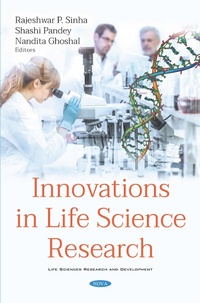
Innovations in Life Science Research
Published on 17. September 2019
420 pages
978-1-5361-5869-4 (ISBN)
Description

At any given moment, a number of innovations in life science research occurs. There has always been an ever-increasing demand for the interdisciplinary research in life science to solve the problems of mankind. It is a challenging task to bring the fruits of laboratory level research to the commercial level for the welfare of humans. This book is an attempt to keep abreast with the recent innovations made in various fields of life science research. The book encompasses topics ranging from prokaryotic microscopic organisms to eukaryotic higher plants, distributed in fifteen chapters for the benefit of graduate and postgraduate students as well as young researchers, scientists and professionals. The book deals with topics pertaining to natural sunscreens, secondary metabolites, genome editing, molecular markers, stress biology, crop improvement, herbal medicines, plant diseases, genetic engineering, biotechnology and aspects related to ecology. This book imparts the latest innovations and knowledge in the specific fields of life sciences. In addition, it also provides details of newer and state-of-the art technology/tools employed in achieving the potential of microbes and higher plants to make products that can be readily available for the welfare of humans. An insight for future perspectives has also been provided that makes this book highly useful and a must-read for students, researchers and professionals working in the field of microbiology, botany, biotechnology, agriculture, molecular biology, photobiology, ecology and other streams of life sciences.
More details
Other editions
Additional editions
Rajeshwar P. Sinha
Innovations in Life Science Research
Book
10/2019
Nova Science Publishers Inc
€303.55
Shipment within 15-20 days
Content
- Intro
- Contents
- Preface
- Chapter 1
- Natural Sunscreens: Sources and Mode of Action
- Abstract
- Introduction
- Biology of Natural Sunscreens
- Melanin
- Flavonoids and Phenylpropanoids
- Carotenoids
- Scytonemin and Mycosporine-Like Amino Acids
- Other Chemicals, Antioxidants as Sunscreen
- Mode of Action
- Future Perspectives
- Conclusion
- Acknowledgments
- References
- Chapter 2
- Biomedical and Pharmaceutical Potentials of Cyanobacterial Secondary Metabolites
- Abstract
- Introduction
- Anti-Inflammatory Metabolites
- Anti-HIV Compounds
- Lyngbyatoxin
- Spirulan and Ca-Spirulan
- Cyanovirin-N
- Scytovirin (SVN)
- Lectins
- Microvirin (MVN)
- Nostoflan
- Bauerines A-C
- Proteins, Lipids and Pigments
- Indolo [2, 3-a]-3-Methoxy-4-Cyanocarbazole and N-Methylindolo [2,3-a]-3-Methoxy-4 Cyanocarbazole
- Antifungal Compounds
- Scytophycin
- Hassallidin
- Nostofungicidine
- Amino-6-Hydroxy Stearic Acid
- Microviridins
- Nostopeptolides
- Cryptophycin-1
- Ambigols
- Hapalolindoles
- Ambiguine Isonitrils
- Majusculoic Acid
- Majusculamide C
- Lobocyclamides
- Fischerindole L
- Tjipanazoles
- Antimalarial Compounds
- Cyanotoxins
- Microcystins (MCs)
- Nodularin (NODLN)
- Saxitoxins (STXs)
- Anatoxins (ANTX)
- Cylindrospermopsin (CYN)
- Lipopolysaccharides (LPS)
- Kalkitoxin
- Besarhanamides A
- Aplysiatoxin
- Hoiamides
- Antillatoxin
- Palmyrolide A
- Cyanotoxins as Insecticidal and Larvicidal Compounds
- Cyanobacterial Toxins As Allelopathic Compounds
- UV-Screening Compounds
- Scytonemin
- Mycosporine-Like Amino Acids (MAAs)
- Siderophores: The Iron Chelators
- Phytohormones
- Antibacterial Activities of Cyanobacteria
- Comnostins
- Muscoride A
- Noscomin
- Carbamidocyclophanes
- Dodecahydrophenanthrene, 4-Methylchrysazin and 4-Hydroxy-7-Methylindan-1-One
- Hormothamnions
- Malyngolides
- Ambiguine 1 Isonitrile
- Ambiguine
- Norbiestane
- Phayokolide A
- Hapalindoles
- Hapalindole T
- Scytoscalarol
- Eucapsitrione
- Nostocarboline
- Antiprotozoal Compounds
- Almiramide B and C
- Calothixin A and B
- Ambigol C
- Bastimolide A
- Anti-Inflammatory Compounds
- ?-Linolenic Acid
- Conclusion
- Acknowledgments
- References
- Chapter 3
- Genomics and Proteomics of Photo protective Compounds Mycosporine-Like Amino Acids in Cyanobacteria
- Abstract
- Introduction
- Molecular Structures and Properties of UV-Absorbing Mycosporine-Like Amino Acids in Cyanobacteria
- Genetics and Proteomics of MAAs Biosynthesis in Cyanobacteria
- Occurrence and Distribution of MAAs in Cyanobacteria
- Techniques Used for Characterization of MAAs
- Acknowledgments
- References
- Chapter 4
- Targeted Genome Editing Tools in Plants
- Abstract
- Introduction
- Genome Editing
- Genome Editing by NHEJ
- Genome Editing by HR
- Gene Targeting in Plants
- Engineered Nucleases for Gene Targeting
- Homing Endonucleases
- Zinc Finger Nucleases (ZFNs)
- Transcription Activator-Like Effector Nucleases (TALENs)
- Clustered Regularly Interspaced Short Palindromic Repeats/ CRISPR-Associated Protein 9 (CRISPR/Cas9)
- Regulatory Aspects of Genome Edited Plants
- Conclusion
- References
- Chapter 5
- Molecular Markers: A Tool in Plant Breeding for Pyramiding Resistance Genes
- Abstract
- Introduction
- Types of Markers
- Morphological Markers
- Biochemical Markers
- DNA Markers (or Molecular Markers)
- Classification of Molecular Markers
- Low-Throughput Hybridization Based Markers/First Generation Markers
- Restriction Fragment Length Polymorphism (RFLP)
- Medium-Throughput PCR Based Markers/Second Generation Markers
- Randomly Amplified Polymorphic DNA (RAPD)
- Amplified Fragment Length Polymorphism (AFLP)
- Microsatellites or Simple Sequence Repeats (SSRs)
- Inter Simple Sequence Repeats (ISSR)
- Sequence Tagged Sites (STS)
- Sequence Characterized Amplified Regions (SCARs)
- Cleaved Amplified Polymorphic Sequences (CAPS)
- Expressed Sequence Tags (ESTs)
- High-Throughput Sequence-Based Markers/Third Generation Markers
- Single Nucleotide Polymorphism (SNPs)
- Diversity Arrays Technology (DArT)
- Genotyping-By-Sequencing (GBS)
- Marker-Assisted Selection
- Prerequisites for an Efficient Marker-Assisted Selection Programme
- Populations for Gene Tagging/QTL Mapping
- Marker Development
- Genetic/QTL Mapping
- QTL/Marker Validation
- Functional/Diagnostic Markers (Fms)
- Marker Assisted Gene Pyramiding
- MAS Gene Pyramiding Strategies
- Marker Assisted Backcrossing (MAB)
- Conclusion
- Acknowledgments
- References
- Chapter 6
- Significance of Ploidy in Genome Evolution, Speciation and Crop Improvement
- Abstract
- Introduction
- Polyploidy in Plants: An Overview
- Polyploidization in Plants: An Evolutionary Implication
- Mechanisms of Induction of Polyploidy
- Apospory: A Natural Event for the Induction of Polyploidy
- Alteration in Genetic Makeup and Ploidy
- Types of Polyploidy in Plants
- Autotetraploid versus Allotetraploids
- Ploidy and Speciation
- Key Role of Polyploidy in Plant Breeding
- Improvement of Cultivated Crop Plants via Polyploidization
- Ploidy Status and Metabolome Profile (Role in Metabolite Diversity)
- Future Prospects and Conclusion
- Acknowledgments
- References
- Chapter 7
- Recent Advances in Epigenetic Research in Plants
- Abstract
- Introduction
- Different Types of Epigenetic Modifications
- DNA Methylation
- Histone Modification
- Epi-Fingerprinting for Crop Improvement
- Epigenetic Silencing
- Epigenetics of Plant Pathogen Interaction and Abiotic Stress
- Conclusion
- Acknowledgments
- References
- Chapter 8
- Genetic Engineering: An Emerging Approach for Fostering Bioremediation, Current Status, Challenges and Outlook
- Abstract
- Introduction
- Genetic Engineering: Advancement in Bioremediation Strategy
- Basic Tools for Genetic Engineering
- Progress in Genetic Engineering
- Bacteria
- Fungi
- Plants
- New Insights into Performance Improvisation of Genetically Modified Organisms
- Modularization of Genetic Elements
- Programmed Cell Death
- Conclusion
- Acknowledgments
- References
- Chapter 9
- Enhancing Abiotic Stress Tolerance in Hyacinth Bean (Lablab purpureus. L)
- Abstract
- Introduction
- Taxonomy
- Botany and Floral Biology
- Nutritive and Medicinal Value
- The Challenge of Multiple Environmental Stresses on Agriculture
- Global Scenario
- Indian Scenario
- Major Abiotic Stresses Affecting Hyacinth Bean
- High Temperature (HT) Stress
- Drought Stress
- Salinity Stress
- ROS as Key Players in Plant Stress Signalling
- Enzymatic and Non-Enzymatic Defence System
- Enzymatic Antioxidants
- Non-Enzymatic Antioxidants
- Use of Exogenous Protectants in Mitigating Abiotic Stresses
- Salicylic Acid (SA)
- Abscisic Acid (ABA)
- Sodium Nitroprusside (SNP)
- Proline (PRO)
- Biotechnological Tools for Empowering Abiotic Stress Tolerance
- Advanced Genomic Tools Applicable to Hyacinth Bean Genomics
- Transcriptomics for Genome Annotation and Marker Development
- Proteomics Analysis
- Metabolic Fingerprinting in Legumes
- Epigenetic Changes in Response to Abiotic Stress
- Conclusion and Future Outlook
- Acknowledgments
- References
- Chapter 10
- Papaya Ringspot Disease and Its Management Strategies
- Abstract
- Introduction
- Disease Symptoms and Transmission of PRSV
- Structural and Genomic Organization of PRSV
- Molecular Detection of PRSV
- Management of PRSV Infection
- Rouging and Netting
- Use of Insecticides and Antiviral Agents
- Time of Plantation and Border Cropping
- Use of Fertilizer
- Resistance against PRSV
- Conventional Breeding Approach
- Cross-Protection
- Systemic Induced Resistance
- Transgenic Approach
- 1. CP-Mediated Virus Resistance
- 2. Replicase Gene (RP)-Mediated Virus Resistance
- Conclusion
- References
- Chapter 11
- Withania coagulans: An Overview on Therapeutic Potential and Use of Recent Biotechnological Approaches for Conservation and Enhancement of Secondary Metabolites
- Abstract
- Introduction
- Origin and Distribution
- Scientific Classification and Local Names
- Botanical features and Description
- Ethanomedicinal Applications
- The Bioactive Compounds:Withanolides
- Other Chemical Constituents
- Therapeutic Potential of Withania coagulans
- Hypoglycemic Activity
- Anti-Cancer
- Anti-Inflammatory
- Immunosuppressive Effect
- Anti-Fungal and Anti-Bacterial
- Anti-Lipidemic Activity
- CNS Related
- Cardiovascular Effects
- Anti-Oxidative Activity
- Hepatoprotective Activity
- Anti-Arthritic Activity
- Alzheimer's Disease
- Anti-Diuretic Potential
- Biotechnological Approaches for Withania coagulans Conservation and Secondary Metabolites Production
- Conclusion
- Acknowledgments
- References
- Chapter 12
- Paederia foetida: A Potent Medicinal Plant with Anti-Inflammatory and Anti-Oxidative Properties
- Abstract
- Introduction
- About the Plant
- Taxonomic Classification and Nomenclature
- Distribution
- Description
- Habitat Types and Plant Communities
- P. foetida as a Weed
- Genetics and Reproductive Biology of P. foetida
- Chemical Constitution of P. foetida
- Pharmacological Activities
- Anti-Inflammatory and Antioxidant Activity
- Hepatoprotective and Gastroprotective Activity
- Renoprotective Potential
- Antitussive, Antispasmodic and Antihelmintic Activity
- Chronic Inflammation, Arthritis, and P. foetida
- Conclusion and Future Prospective
- Acknowledgments
- References
- Chapter 13
- Carica papaya: Pharmacological, Nutritional and Its Therapeutic Uses
- Abstract
- Introduction
- Origin and Distribution
- Morphology
- Ecology and Cultivation of Carica papaya
- Cultivars and Different Varieties
- Papaya Nutritional Value
- Medicinal and Pharmacological Activities of Papaya
- Carica papaya as a Potent Dengue Virus Inhibitor- CPLe in Cure of Dengue and Increased Platelets Count
- Molecular Aspect of Dengue Cure by CPLe-
- Increase in Platelet Count
- Prevention of DV Replication
- Other Medicinal Properties of Carica papaya
- Carica papaya as Cardioprotector and Reduces the Blood Pressure
- Treatment in Ulcers and Wounds- Anti-Inflammatory Activity
- Anti-Microbial Activities
- Anti-Diabetic Activity
- Anti-Oxidant Activity
- Genetics and Genomics of Carica papaya
- Conclusion
- Acknowledgment
- References
- Chapter 14
- Land Use, Land Use Change and Sustainable Land Management
- Abstract
- Introduction
- Land and Land Use
- Land Use Change
- Land Use Change: Indian Scenario
- Consequences of Land Use Change
- Land Degradation
- Land Use Change and Carbon Dynamics
- Land Use Change and Soil Microbial Biomass Dynamics
- Soil Aggregates and Land Use Change
- Sustainable Land Management: A Strategy to Mitigate Impact of Land Use Change
- Land Rehabilitation
- Social Forestry
- Trees Outside Forests (TOF)
- Conclusion
- Acknowledgments
- References
- Chapter 15
- Multifunctional Tropical Dry Forest Systems of India: Current Need and Future Directions
- Abstract
- Introduction
- Distribution of Forest Area
- Characteristic Features of the Tropical Dry Forest
- Tropical Dry Forest System as a Carbon Sink and Source
- Tropical Dry Forests Increase Soil Fertility and Water Use Efficiency
- Threats to Tropical Dry Forests
- Role of Tropical Dry Forests in Enhancing Livelihood
- The Future of Tropical Dry Forests
- Conclusion
- Acknowledgments
- References
- About the Editors
- Index
- Blank Page
