

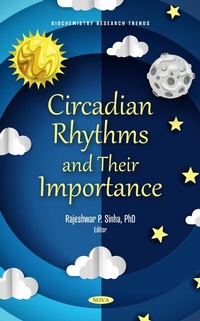
Circadian Rhythms and Their Importance
Published on 12. January 2022
365 pages
978-1-68507-585-9 (ISBN)
Description

Circadian rhythm is the mechanism for measuring time by organisms in units of around 24 hours. Almost every organism has the ability to predict daily events such as sunrise and sunset, which is essential for their optimal survival strategies. Circadian rhythms persist even in the absence of time cues and ensure that behavioral, physiological and metabolic processes align with changing environmental conditions. Most organisms, irrespective of whether they are prokaryotic or eukaryotic, have evolved certain mechanisms to sense their external environment in order to prepare a biological response. Often, these biological responses result in changes in physiology and biochemistry of organisms for the optimization of their survival. There is no unified mechanism among organisms by which sensory environment can be applied to control their lifespan. In humans, disruptions of the circadian rhythm may have an increased risk of age-related neurodegenerative diseases such as cancer, diabetes, etc. This book encompasses the most recent knowledge and modern trends in the field of circadian rhythms research. It is also expected to provide a must-read guide for beginners as well as advanced researchers in this field of study. Undergraduate, post-graduate and research scholars of several disciplines such as chemistry, botany, microbiology, biochemistry, biotechnology, bioinformatics, life sciences and bionanotechnology will benefit from this book.
More details
Other editions
Additional editions
Rajeshwar P. Sinha
Circadian Rhythms and Their Importance
Book
01/2022
Nova Science Publishers Inc
€303.55
Shipment within 15-20 days
Content
- Intro
- Contents
- Preface
- Chapter 1
- Circadian Rhythms: An Introduction
- Abstract
- Introduction
- Circadian Rhythms and Ecological Adaptations
- Circadian Rhythm As Metabolic Regulator in Plant
- Photic Regulation and Health
- Circadian Rhythm and Regulation of Spike Activity
- Circadian Rhythm and the Expression of Disorders
- Circadian Rhythm and Innate Immunity
- Circadian Rhythm and Physiological Activities
- Circadian Rhythm and Drosophila Lifespan
- Conclusion
- Acknowledgments
- References
- Chapter 2
- Molecular Mechanisms and Importance of Circadian Rhythms in Microorganisms
- Abstract
- Introduction
- Molecular Bases of Circadian Rhythms in Microorganisms
- Circadian Rhythm in Prokaryotes
- Cyanobacteria
- Mechanism of Circadian Rhythm in Cyanobacteria
- Input Mechanism in Cyanobacteria
- Output Mechanism in Cyanobacteria
- Mechanism of Circadian Rhythm in Archaebacteria
- Circadian Rhythm In Eukaryotes
- Circadian Rhythmic Mechanism in Fungi
- Mechanism of Circadian Rhythm in Neurospora
- Input and Output Mechanism in Neurospora
- Mechanism of Circadian Rhythm in Algal Members
- Circadian Mechanism in Chlorophyta
- Circadian Mechanism in Pyrrophyta
- Many Quasi-Independent Oscillators in Dinoflagellates
- Synthesis and Destruction of Protein in Dinoflagellates
- Circadian Rhythmic Mechanism in Protozoa
- Importance of Circadian Rhythm in Microorganisms
- Host and Microbes Cross-Talk Between Their Circadian Rhythms
- Microbes Regulates Circadian Physiology
- Circadian Clock Regulates the Immune System
- Diurnal Oscillation of Gut Microbiota Regulates the Central Nervous System Function
- Conclusion
- Acknowledgments
- References
- Chapter 3
- Cyanobacterial Endogenous Clock: Molecular Mechanisms and Ecological Adaptations
- Abstract
- Introduction
- Effects of Various Abiotic Stress on Circadian Clock
- Solar Radiation
- Temperature
- Oxidative Stress
- Pressure
- Operation and Cyclic Interplay of Circadian Proteins
- Structure and Function of Kai C Protein
- Structure and Function of Kai B Protein
- Structure and Function of Kai A Proteins
- Regulatory Mechanisms
- Sensory Input Pathway
- Regulatory Output Pathway
- Conclusion
- Acknowledgments
- References
- Chapter 4
- Plant Circadian Rhythm: A Biological Clock as Developmental and Metabolic Regulator
- Abstract
- Introduction
- Plant Circadian Clock: Historical Perspective
- The Organization of Plant Circadian Clock at the Molecular Level
- The Mechanism of Plant Circadian Clock
- Regulation of the Plant Circadian Clock
- Plant Circadian Clock and Chromatin Modifications
- Circadian Clock as Regulator of Cellular Processes
- Circadian Clock Regulators at Tissue/Organ Level Controlling Plant Developmental Processes
- Function of Plant Biological Clock under Stress Signals
- Role of Plant Circadian Clock under Abiotic Stresses
- Plant Biological Clock in Relation with Biological Stress Factors
- Circadian Clock in the Plant Development and Other Processes
- Role of Circadian Clock in Regulation of Secondary Metabolism
- Conclusion
- References
- Chapter 5
- Circadian Clock: Photic Regulation and Its Disruption on Health
- Abstract
- Introduction
- Molecular Feedback Mechanism in SCN
- Photic Inputs to Suprachiasmatic Nucleus
- Circadian Rhythm Disruption on Melatonin and Glucocorticoid Rhythm
- Influence of Circadian Rhythm Disruption on Mental Health
- Circadian Rhythm Disruption on Metabolism
- Conclusion
- Acknowledgments
- References
- Chapter 6
- Circadian Phase Shifting of Wheel Running and Modulation of Spike Activity in the Rat Suprachiasmatic Nucleus by Neuropeptide Y
- Abstract
- Introduction
- Methods
- Recording of Wheel Running Activity
- Recording of Spike Activity of the SCN Neurones In Vitro
- Electrophysiological Characterization of Afferent Inputs from the Arcuate Nucleus (ARCN) to the SCN
- Results
- Effects of NPY on the Circadian Rhythm of Wheel Running Activity
- Effects of NPY on Spike Activity of the SCN Neurons In Vitro
- Effects of NPY on Afferent Inputs from the ARCN to the SCN In Vitro
- Conclusion
- Acknowledgements
- References
- Chapter 7
- The Role of Circadian Rhythms Disturbances in the Pathophysiology and Clinical Expression of Affective Disorders
- Abstract
- Introduction
- Circadian Rhythm: An Overview
- Physiologic and Genetic Bases
- Main Types of Circadian Rhythms Disrupted in Psychiatric Disorders
- Sleep-Wake Cycle
- Hormonal Circadian Rhythms
- Alimentary Rhythms
- Activity Rhythms
- Social Rhythms
- Circadian Rhythm Disruptions in Affective Disorders
- Circadian Rhythm Disruptions in Depressive Disorders
- Circadian Rhythm Disruptions in Bipolar Disorders
- Conclusion
- References
- Chapter 8
- Insights into Circadian Modulation of Innate Immunity: The Role of Melatonin and Proenkephalin-Derived Opioid Peptides
- Abstract
- Introduction
- Overview of Circadian Rhythms: Environmental Factors Influence on Physiology
- Overview of the Innate Immune Response and the Transition to Adaptive Immunity
- Circadian Regulation of Innate Immunity: Biochemical Modulators Rhythmically Released that Affect Immune Cells
- Melatonin
- Proenkephalin-Derived Opioid Peptides
- Modulation of Spleen Macrophage Physiology and Immune Response by Melatonin and Enkephalins
- Spleen Macrophages
- Melatonin and Enkephalins Modulation of Macrophage Physiology and Immune Response
- Conclusion
- Acknowledgements
- References
- Chapter 9
- Features of Circadian Rhythms of Heart Rate Variability, Arterial Stiffness and Outpatient Monitoring of Blood Pressure in Diabetes Mellitus: Data, Mechanisms and
- Abstract
- Introduction
- Diabetes Mellitus and Circadian Rhythms of Heart Rate Variability
- Diabetes Mellitus and Circadian Rhythms of Arterial Stiffness
- Diabetes Mellitus and Circadian Rhythms of Blood Pressure
- Diabetic Cardiac Autonomic Neuropathy and Circadian Rhythm's Disorders
- Conclusion
- Acknowledgments
- References
- About the Editor
- Index
- Blank Page
