

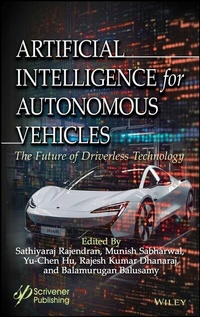
Artificial Intelligence for Autonomous Vehicles
Description

With the advent of advanced technologies in AI, driverless vehicles have elevated curiosity among various sectors of society. The automotive industry is in a technological boom with autonomous vehicle concepts. Autonomous driving is one of the crucial application areas of Artificial Intelligence (AI). Autonomous vehicles are armed with sensors, radars, and cameras. This made driverless technology possible in many parts of the world. In short, our traditional vehicle driving may swing to driverless technology. Many researchers are trying to come out with novel AI algorithms that are capable of handling driverless technology. The current existing algorithms are not able to support and elevate the concept of autonomous vehicles. This addresses the necessity of novel methods and tools focused to design and develop frameworks for autonomous vehicles.
There is a great demand for energy-efficient solutions for managing the data collected with the help of sensors. These operations are exclusively focused on non-traditional programming approaches and depend on machine learning techniques, which are part of AI. There are multiple issues that AI needs to resolve for us to achieve a reliable and safe driverless technology.
The purpose of this book is to find effective solutions to make autonomous vehicles a reality, presenting their challenges and endeavors. The major contribution of this book is to provide a bundle of AI solutions for driverless technology that can offer a safe, clean, and more convenient riskless mode of transportation.
More details
Other editions
Additional editions
Persons
Sathiyaraj Rajendran, PhD, is an assistant professor in the School of Engineering & Technology at the Chikka Muniyappa Reddy University, Bangalore. He completed his PhD at Anna University, Chennai. He has more than nine years of experience and has collaborated actively with researchers in several other disciplines of computer science, particularly traffic prediction systems and intelligent systems. Additionally, he has authored more than 25 publications and filed five patents.
Munish Sabharwal, PhD, is a professor and dean in the School of Computing Science & Engineering, Galgotias University, Greater Noida, India, as well as an adjunct professor in the department of Applied Mathematics and IT at Samarkand State University, Samarkand, Uzbekistan. He has contributed over 21 years in teaching, education management, research, and software development. Additionally, he has published more than 55 research papers in conferences and journals and three books.
Yu-Chen Hu, PhD, is a professor in the Department of Computer Science and Information Management, Providence University, Sha-Lu, Taiwan. He is a senior member of Institute of Electrical and Electronics Engineers. He is also a member of Computer Vision, Graphics, and Image Processing (CVGIP), the Chinese Cryptology and Information Security Association (CCISA), Computer Science and Information Management (CSIM), and the Phi Tau Phi Society of the Republic of China. His research interests include digital forensics, information hiding, image and signal processing, data compression, information security, and data engineering.
Rajesh Kumar Dhanaraj, PhD, is an associate professor in the School of Computing Science and Engineering at Galgotias University, Greater Noida, Uttar Pradesh, India. He has published over 35 articles in various journals and conference proceedings and contributed chapters to many books. In addition to his teaching role, he is also an Expert Advisory Panel Member of Texas Instruments Inc., USA.
Balamurugan Balusamy is a professor at Galgotias University, Greater Noida, Uttar Pradesh, India with over 14 years of experience. He has published close to 30 books on various technologies, as well as over 150 quality journal, conference, and book chapters combined, visiting over 15 countries for his technical discourse. He serves on the advisory committee for several startups and forums and does consultancy work for the industry on Industrial Internet of Things.
Content
Preface xi
1 Artificial Intelligence in Autonomous Vehicles-A Survey of Trends and Challenges 1
Umamaheswari Rajasekaran, A. Malini and Mahalakshmi Murugan
2 Age of Computational AI for Autonomous Vehicles 25
Akash Mohanty, U. Rahamathunnisa, K. Sudhakar and R. Sathiyaraj
3 State of the Art of Artificial Intelligence Approaches Toward Driverless Technology 55
Sriram G. K., A. Malini and Santhosh K.M.R.
4 A Survey on Architecture of Autonomous Vehicles 75
Ramyavarshini P., A. Malini and Mahalakshmi S.
5 Autonomous Car Driver Assistance System 105
R. Annamalai, S. Sudha Mercy, J. M. Mathana, N. Banupriya, Rajalakshmi S. and S. D. Lalitha
6 AI-Powered Drones for Healthcare Applications 131
M. Nalini
7 An Approach for Avoiding Collisions with Obstacles in Order to Enable Autonomous Cars to Travel Through Both Static and Moving Environments 151
T. Sivadharshan, K. Kalaivani, N. Golden Stepha, Rajitha Jasmine R., A. Jasmine Gilda and S. Godfrey
8 Drivers' Emotions' Recognition Using Facial Expression from Live Video Clips in Autonomous Vehicles 173
Tumaati Rameshtrh, Anusha Sanampudi, S. Srijayanthis, S. Vijayakumarsvk, Vijayabhaskar and S. Gomathigomathi
9 Models for the Driver Assistance System 193
B. Shanthini, K. Cornelius, M. Charumathy, Lekshmy P., P. Kavitha and T. Sethukarasi
10 Control of Autonomous Underwater Vehicles 209
M. P. Karthikeyan, S. Anitha Jebamani, P. Umaeswari, K. Chitti Babu, C. Geetha and Kirupavathi S.
11 Security and Privacy Issues of AI in Autonomous Vehicles 229
K. Ramalakshmi, Sankar Ganesh and L. KrishnaKumari
References 245
Index 247
