

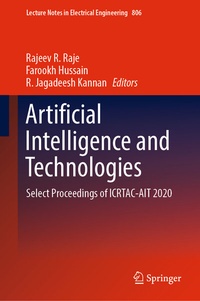
Artificial Intelligence and Technologies
Description

This book constitutes refereed proceedings of the 3rd International Conference on Recent Trends in Advanced Computing - Artificial Intelligence and Technologies. This book covers a wide range of topics-vision, analytics, robotics, networking, health care, current pandemic issues of COVID-19, and cutting-edge technologies connected to cybersecurity in digital manufacturing and Industry 4.0. The contents of this book will be useful to researchers from industry and academia. The volume includes novel contributions and the latest developments from researchers across industry and academia. The book will serve as a valuable reference resource for academics and researchers across the globe.
More details
Other editions
Additional editions
Persons
Rajeev R. Raje is a Professor in the Department of Computer and Information Science (CIS) and is an Associate Dean in the School of Science at Indiana University-Purdue University Indianapolis (IUPUI). Dr. Raje's research interests are in distributed and service-oriented software systems, programming languages, and software engineering. Dr. Raje has authored over 140 publications. Dr. Raje is a Senior Member of the ACM and IEEE, and he also co-directs the software engineering and distributed systems group in the CIS department.
Farookh Hussain is a Professor in the School of Computer Science, University of Technology, Sydney, Australia, and is currently serving as Head of Software Engineering. Dr. Hussain is an Associate Member of the Advanced Analytics Institute and a Core Member of the Australian Arti?cial Intelligence Institute. He has written various books and chapters and has published widely in journals too. Dr. Hussain has over 500 papers in various international journals and conferences. He has completed over 50 funded projects for the government and various private organizations.
R. Jagadeesh Kannan is Professor and Dean of the School of Computer Science and Engineering at Vellore Institute of Technology, India. He completed his Ph.D. in Handwritten Character Recognition using Hybrid Techniques from Anna University, Chennai, India. He got his M.E. degree in Computer Science and Engineering from National Engineering College, Tamil Nadu, and B.E. in Instrumentation and Control Engineering from Madurai Kamaraj University, Tamil Nadu, India. Prof. Kannan has over 18 years of teaching and industrial experience in reputed organizations. Prof. Kannan has got several publications inconference proceedings and journals of national and international repute. His research interests are neural networks, fuzzy logic, neuro-fuzzy systems, soft computing tools, pattern recognition, natural language processing, image processing, networking, printed, handwritten and cursive character recognition, and arti?cial intelligence.
