

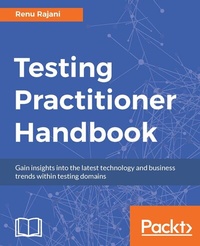
Testing Practitioner Handbook
Gain insights into the latest technology and business trends within testing domains.
Published on 8. July 2025
350 pages
978-1-78829-059-3 (ISBN)
Description

FTM
Key Features
This book covers the latest trends that every Testing and QA professional should keep up-to-date with given the advancements in digital technologies.
Master cutting-edge testing techniques for emerging areas such as IOT, Machine Learning, Cognitive.
Best practices for Testing and Quality Assurance within several industry domains.
Book DescriptionThe book is based on the author`s experience in leading and transforming large test engagements and architecting solutions for customer testing requirements/bids/problem areas. It targets the testing practitioner population and provides them with a single go-to place to find perspectives, practices, trends, tools, and solutions to test applications as they face the evolving digital world. This book is divided into five parts where each part explores different aspects of testing in the real world. The first module explains the various testing engagement models. You will then learn how to efficiently test code in different life cycles. The book discusses the different aspects of Quality Analysis consideration while testing social media, mobile, analytics, and the Cloud. In the last module, you will learn about futuristic technologies to test software. By the end of the book, you will understand the latest business and IT trends in digital transformation and learn the best practices to adopt for business assurance. What you will learn
Understand the TCOE model, managed services, the structure of testing in Agile/DevOps engagements, factory models, and crowdsourcing
Implement testing processes, practices, and automation tools in the Agile/DevOps life cycle
Adapt to current technologies in social media, mobile, analytics and the Cloud
Leverage cognitive intelligence/machine-learning, robotics, and the Internet of Things in testing
How key industries/domains (consumer products and retail, energy and utilities, healthcare, telecom, and automotive) adapt to digital transformation
Future directions for the QA industry, consulting careers, testing profession, and professionals
Who this book is forThis book is targeted at those working in the QA and Testing areas. The book does not cover testing basics, which QA professional are already familiar with-for example, writing a test plan or test case, and so on.
Key Features
This book covers the latest trends that every Testing and QA professional should keep up-to-date with given the advancements in digital technologies.
Master cutting-edge testing techniques for emerging areas such as IOT, Machine Learning, Cognitive.
Best practices for Testing and Quality Assurance within several industry domains.
Book DescriptionThe book is based on the author`s experience in leading and transforming large test engagements and architecting solutions for customer testing requirements/bids/problem areas. It targets the testing practitioner population and provides them with a single go-to place to find perspectives, practices, trends, tools, and solutions to test applications as they face the evolving digital world. This book is divided into five parts where each part explores different aspects of testing in the real world. The first module explains the various testing engagement models. You will then learn how to efficiently test code in different life cycles. The book discusses the different aspects of Quality Analysis consideration while testing social media, mobile, analytics, and the Cloud. In the last module, you will learn about futuristic technologies to test software. By the end of the book, you will understand the latest business and IT trends in digital transformation and learn the best practices to adopt for business assurance. What you will learn
Understand the TCOE model, managed services, the structure of testing in Agile/DevOps engagements, factory models, and crowdsourcing
Implement testing processes, practices, and automation tools in the Agile/DevOps life cycle
Adapt to current technologies in social media, mobile, analytics and the Cloud
Leverage cognitive intelligence/machine-learning, robotics, and the Internet of Things in testing
How key industries/domains (consumer products and retail, energy and utilities, healthcare, telecom, and automotive) adapt to digital transformation
Future directions for the QA industry, consulting careers, testing profession, and professionals
Who this book is forThis book is targeted at those working in the QA and Testing areas. The book does not cover testing basics, which QA professional are already familiar with-for example, writing a test plan or test case, and so on.
All prices
More details
Edition
Digital original
Language
English
Place of publication
Birmingham
United Kingdom
Target group
US School Grade: College Graduate Student
Edition type
Digital original
File size
11,64 MB
ISBN-13
978-1-78829-059-3 (9781788290593)
Copyright in bibliographic data and cover images is held by Nielsen Book Services Limited or by the publishers or by their respective licensors: all rights reserved.
Schweitzer Classification
Other editions
Additional editions
Renu Rajani
Testing Practitioner Handbook
Book
03/2017
Packt Publishing
€56.50
Shipment within 3-4 weeks
Person
Rajani Renu :
Renu Rajani is a seasoned IT services/consulting leader with 27 years of experience. She has worked with reputed tier-1 IT services companies. Renu's experience spans across delivery, transformation, providing technical solutions, outsourcing governance, and consulting. She has served Tier-1 organizations including IBM, Citi, Capgemini, KPMG Consulting in key leadership roles. Renu is an active blogger on digital quality assurance, technology, and managed services and has a follower base of over 15K on social media. She has been a key contributor to Capgemini/Sogeti/HPE World Quality Report during 2015-17. She has led the creation of go-to-market offerings in the area of digital, DevOps, and business assurance. Renu has been recipient of the Testing Thought Leadership award in 2008 by PureTesting and Testing Leader of the year award by Unicom in 2015. This book brings together some of her popular blogs on latest technologies and QA considerations in a book form. Renu authored her first book on software testing in 2003 with McGrawHill. Renu holds an MS from the Krannert Graduate School of Management, Purdue University USA, an MBA in Finance from DAVV Indore, and a B Tech in Computer Science from IET, Lucknow University. She is an IBM Sr PM certified with DPE/SM discipline, and holds the ITIL V3, CAIIB, and PMP Certifications.
Renu Rajani is a seasoned IT services/consulting leader with 27 years of experience. She has worked with reputed tier-1 IT services companies. Renu's experience spans across delivery, transformation, providing technical solutions, outsourcing governance, and consulting. She has served Tier-1 organizations including IBM, Citi, Capgemini, KPMG Consulting in key leadership roles. Renu is an active blogger on digital quality assurance, technology, and managed services and has a follower base of over 15K on social media. She has been a key contributor to Capgemini/Sogeti/HPE World Quality Report during 2015-17. She has led the creation of go-to-market offerings in the area of digital, DevOps, and business assurance. Renu has been recipient of the Testing Thought Leadership award in 2008 by PureTesting and Testing Leader of the year award by Unicom in 2015. This book brings together some of her popular blogs on latest technologies and QA considerations in a book form. Renu authored her first book on software testing in 2003 with McGrawHill. Renu holds an MS from the Krannert Graduate School of Management, Purdue University USA, an MBA in Finance from DAVV Indore, and a B Tech in Computer Science from IET, Lucknow University. She is an IBM Sr PM certified with DPE/SM discipline, and holds the ITIL V3, CAIIB, and PMP Certifications.
Content
Table of Contents
Testing Engagement Models
Automation & Testing in Agile/DevOps Lifecycles
Social Media, Mobility, Analytics and Cloud (SMAC)
Futuristic Technologies and QA Considerations
Domain Applications and Case Studies
Future Directions
Testing Engagement Models
Automation & Testing in Agile/DevOps Lifecycles
Social Media, Mobility, Analytics and Cloud (SMAC)
Futuristic Technologies and QA Considerations
Domain Applications and Case Studies
Future Directions

