

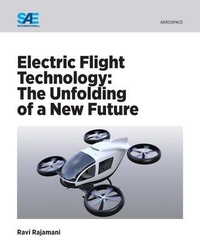
Electric Flight Technology
Description

The environmental impact of hydrocarbon-burning aircraft is one of the main motivations for the move to electric propulsion in aerospace. Also, cars, buses, and trucks are incorporating electric or hybrid-electric propulsion systems, reducing the pressure on hydrocarbons and lowering the costs of electrical components. The economies of scale necessitated by the automotive industry will help contain costs in the aviation sector as well.
The use of electric propulsion in airplanes is not a new phenomenon. However, it is only recently that it has taken off in a concrete manner with a viable commercial future.
Electric Flight Technology: Unfolding of a New Future reviews the history of this field, discusses the key underlying technologies, and describes how the future for these technologies will likely unfold, distinguishing between all-electric (AE) and hybrid-electric (HE) architectures.
Written by Dr. Ravi Rajamani, it covers the essential information needed to understand this new technology wave taking hold in the aerospace industry.
Electric Flight Technology: Unfolding of a New Future covers fundamental topics such as:
- The history of electric propulsion, including its evolution from using traditional electricity, to solar power to batteries as sources to sustain propulsion and flight.
- The various architectures being considered for electric aircraft, specifically small general aviation (GA) aircraft and larger business jets; single-aisle commercial aircraft; and larger twin-aisle commercial aircraft.
- The various systems and subsystems of an electric aircraft, along with how various subsystems in the vehicle can be integrated in a more optimal manner. In the future, the existing tube-and-wing configuration will not be the only available architecture; instead we will be more likely to find an architecture where the propulsion system is embedded within the airframe.
- The future trends in this arena and what we can expect to see in the next decade or so.
