

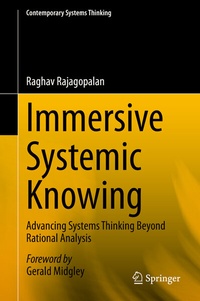
Immersive Systemic Knowing
Advancing Systems Thinking Beyond Rational Analysis
1st Edition
Published on 16. October 2020
XXIII, 231 pages
978-3-030-49135-2 (ISBN)
Description

This book advances systems thinking by introducing a new philosophy of systemic knowing. It argues that there are inescapable limits to rational understanding. Humankind has always depended on extended ways of knowing to complement the rational-analytic approach. The book establishes that the application of such methods is fundamental to systemic practice.
The author advocates embracing two modes of consciousness: intentionality, which Western philosophy has long recognized, and non-intentional awareness, which Eastern philosophy additionally highlights. The simultaneity of these two modes of consciousness, and the variety of knowings they spawn are harnessed for a more holistic, systemic knowing.
Four practices from fields related to systems thinking are examined: two contemporary action research methodologies from the US and the UK; the Sumedhian (Indian) approach to inquiry about processes within groups; and a technique of group psychotherapy originating in Eastern Europe. Each of these systematically harnesses knowing using both modes of consciousness. Therefore, the author insists, such approaches must be included in systemic practice, in purposeful and methodical juxtaposition to rational-analytic ways. The book provides examples and guidelines for deployment.
"All researchers and practitioners of systems thinking and action research must read this book...Raghav has craftfully blended Eastern and Western wisdom. He uses his immersion into Eastern ways of knowing practically, to elaborate the systems philosophy in rich detail. He has incorporated, from cooperative inquiry as action research, the idea of four ways of knowing: practical, propositional, presentational and experiential, to bolster the foundations of systems thinking"-SHANKAR SANKARAN, Professor, University of Technology Sydney, Australia; President International Society of Systems Sciences (ISSS) 2019-2020
"This is a book with the potential to stimulate the emergence of a new paradigm. Raghav shows that systems thinking can transcend rational analysis and incorporate other ways of knowing, such as arts-based methods. also, rather than be overly preoccupied with striving for change, there is value in simply abiding, which comes with a deep appreciation of the ecological relationships we are part of. It's not that rational analysis is wrong - it's that it is only part of a genuinely transformative practice". -GERALD MIDGLEY, Co-Director, Centre for Systems Studies, University of Hull; former President, ISSS (2013-14)
"Raghav Rajagopalan's writing on generating deep appreciation for the social and ecological interdependencies ties in closely with my own work. The philosophical ideas he develops contain the tracings and essential tones of Gregory Bateson's idea of "Mind" as a process of living complexities reaching well beyond the notion of the body. This book demonstrates outstanding erudition and deep compassion at the same time. It should delight the adventurous reader unafraid of big questions".-NORA BATESON, President of the International Bateson Institute
The author advocates embracing two modes of consciousness: intentionality, which Western philosophy has long recognized, and non-intentional awareness, which Eastern philosophy additionally highlights. The simultaneity of these two modes of consciousness, and the variety of knowings they spawn are harnessed for a more holistic, systemic knowing.
Four practices from fields related to systems thinking are examined: two contemporary action research methodologies from the US and the UK; the Sumedhian (Indian) approach to inquiry about processes within groups; and a technique of group psychotherapy originating in Eastern Europe. Each of these systematically harnesses knowing using both modes of consciousness. Therefore, the author insists, such approaches must be included in systemic practice, in purposeful and methodical juxtaposition to rational-analytic ways. The book provides examples and guidelines for deployment.
"All researchers and practitioners of systems thinking and action research must read this book...Raghav has craftfully blended Eastern and Western wisdom. He uses his immersion into Eastern ways of knowing practically, to elaborate the systems philosophy in rich detail. He has incorporated, from cooperative inquiry as action research, the idea of four ways of knowing: practical, propositional, presentational and experiential, to bolster the foundations of systems thinking"-SHANKAR SANKARAN, Professor, University of Technology Sydney, Australia; President International Society of Systems Sciences (ISSS) 2019-2020
"This is a book with the potential to stimulate the emergence of a new paradigm. Raghav shows that systems thinking can transcend rational analysis and incorporate other ways of knowing, such as arts-based methods. also, rather than be overly preoccupied with striving for change, there is value in simply abiding, which comes with a deep appreciation of the ecological relationships we are part of. It's not that rational analysis is wrong - it's that it is only part of a genuinely transformative practice". -GERALD MIDGLEY, Co-Director, Centre for Systems Studies, University of Hull; former President, ISSS (2013-14)
"Raghav Rajagopalan's writing on generating deep appreciation for the social and ecological interdependencies ties in closely with my own work. The philosophical ideas he develops contain the tracings and essential tones of Gregory Bateson's idea of "Mind" as a process of living complexities reaching well beyond the notion of the body. This book demonstrates outstanding erudition and deep compassion at the same time. It should delight the adventurous reader unafraid of big questions".-NORA BATESON, President of the International Bateson Institute
More details
Series
Language
English
Place of publication
Cham
Switzerland
Publishing group
Springer International Publishing
Target group
Professional and scholarly
Product notice
Reflowable
Illustrations
XXIII, 231 p. 16 illus., 10 illus. in color.
File size
2,80 MB
ISBN-13
978-3-030-49135-2 (9783030491352)
DOI
10.1007/978-3-030-49135-2
Schweitzer Classification
Other editions
Additional editions
Book
10/2020
Springer
€149.79
Shipment within 7-9 days
Person
Raghav Rajagopalan is an organisational and social development consultant from India, with experience in the diverse ways of knowing that the subcontinent has been famed for over centuries: practices such as yoga, meditation, various classical arts and handicrafts. Early in his career, his rural development practice required him to unlearn much of his formal professional training, and relearn significantly from diverse marginalized communities such as artisanal fisherfolk, tribal farmers and artisanal craftspersons, resulting in a discovery of the profound value of multiple ways of knowing. Raghav has a postgraduate specialization in Rural Management, followed by a doctorate in Systems Science, and is a Fellow of the Sumedhas Academy for Human Context, India. He was awarded the Margaret Mead Memorial Prize for an outstanding paper from his doctoral thesis at the 2014 International Society for the Systems Sciences Annual Conference in Washington DC.
Content
Chapter 1. Introduction.- Chapter 2. Systems Thinking.- Chapter 3. Three Basic Perspectives to Evaluate Systems Thinking.- Chapter 4. An Ontology for Systemic Knowing.- Chapter 5. Two Useful Models of Knowing.- Chapter 6. Innovative Knowing Methods and Wisdom Practices: What We Can Learn From Allied Disciplines and Further From Other Ages and Cultures.- Chapter 7. Immersive Systemic Knowing: A Theory for Knowing in Practice.- Chapter 8. Conclusion.
