

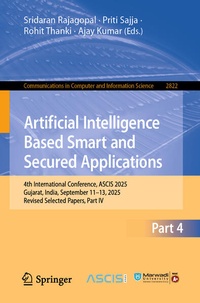
Artificial Intelligence Based Smart and Secured Applications
Description

This five-volume set CCIS 2819-2823 constitutes the refereed proceedings of the 4th International Conference on Advancements in Smart Computing and Information Security, ASCIS 2025, held in Rajkot, Gujarat, India, during September 11-13, 2025.
The 112 full papers and 25 short papers included in these volumes were carefully reviewed and selected from 579 submissions. They are organized into the following topical sections:
Part I, II, III: Artificial Intelligence & Machine Learning
Part IV: Cyber Security
Part V: Smart Computing
More details
Other editions
Additional editions
Content
Cyber Security.- Taxonomy of Tools and Techniques for Cyber Forensic Investigations.-Extending Decentralized Payment Gateways: Cross-Chain Interoperability and Advanced Analytics with StarkNet.- Optimized Self-Adaptive Intrusion Detection System (SPIDS) for Enhanced Network Security.- Optimizing Intrusion Detection with Bayesian Optimization in Reactive Intrusion Detection Systems (BO-RIDS) for Enhanced Security Performance.- A Comparative Analysis of Data Mining Approaches for Phishing Email and Website Detection.- Secure EEG Report with Time- Lock Access and Blockchain: A Survey.- Survey on Secure File Integrity & Ownership System Using Blockchain & NFTs.- Survey on Effectiveness of File Integrity Checker in Ensuring Medical Records.- Survey on Cyber Threat Detection Using Honeypot, Isolation Forest & Threat.- Adversarial-Resilient Federated Q-Learning for Scalable Intrusion Detection in WSNs.- Graph Transformer with Explainable AI for Improved Cybersecurity by Detecting and Mitigating IoT Cyber Threats.- Steganography Image Security Using Enhanced Hyperactive Cryptography Model.- Smart Digital Payments: A Comprehensive Literature Review and Research Analysis.- Preserving Mental Health Data Privacy Using Federated Learning and Homomorphic Encryption.- Detecting Network Attacks Using Decision Tree Classifier.- Cyber Deception and Fake Data Injection System Using AI.- Advanced Command and Control Framework for Covert Operations.- Cybersecurity Challenges in IoT-Based Healthcare Monitoring Systems.- AI-Augmented Social Health Analytics: Extracting Mental and Physical Well-being Insights from Social Media and Networks.- Enhancing Bitcoin Address Unlikability: Addressing Gaps in the Evicting-Filling Attack and Proposing a Holistic Defense Framework.- Power Analysis Vulnerability Assessment and Comparative Analysis with Simulator for Arduino Uno.- Database Vulnerabilities and Cyber Resilience in Critical Infrastructure: A Case Study of the 2025 UNFI Cyberattack.- Bridging the Cybersecurity Gap An Intuitive Web Security Scanner for Developers and Novice.- Anomaly Detection in Linux Kernels: A Framework for SSH Intrusion Prevention.- Linux Kernel Hardening Against SSH Attacks: An Audit Log-Driven Approach.- CyberBait: Strengthening Network Deception via Realistic SSH Honeypots.
