

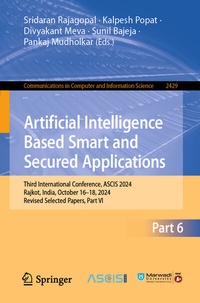
Artificial Intelligence Based Smart and Secured Applications
Description

The six-volume set, CCIS 2424 - 2429, constitutes the refereed proceedings of the Third International Conference on Advances in Smart Computing and Information Security, ASCIS 2024, held in Rajkot, Gujarat, India, in October 16-18, 2024.
The 138 full papers and 43 short papers presented in these six volumes were carefully reviewed and selected from 667 submissions.The papers presented in these six volumes are organized in the following topical sections:
Part I, II, III, IV: Artificial Intelligence & Machine Learning
Part V: Smart Computing; Network and Cloud Computing.
Part VI: Cyber Security; Computer Application for Sustainability.
More details
Other editions
Additional editions
Content
.- Cyber Security.
.- Automation of Endpoint Security using Machine Learning.
.- Comparative Analysis of Vulnerability and Threats related to Blogging Platforms.
.- Cybersecurity Threats to Autonomous Vehicles: A Deep Learning Approach.
.- Advanced Threat Intelligence Systems for Early Warning of Cyber Hacking.
.- Reconciliation - Backdoor Access finding strategies with Legacy applications.
.- Enhancing Cyber Hacking Breach Classification through Integrated Preprocessing and feature Extraction Technique.
.- An Ensemble Method for Insider Threat Detection based On User Activities Analysis Using Bi-LSTM and GA Optimization.
.- Systemization of Knowledge: Privacy Preservation for Decentralized Non-Financial Applications.
.- Identifying Application-Level Distributed Denial-Of-Service (DDoS) Attacks With Machine Learning (ML).
.- Cybersecurity Threats and Trust Dynamics in Digital Payment Systems: An Analysis of Domestic Fraud and User Perspectives.
.- Enhanced Web Browser Forensics: Innovative Methodology for Evidence Collection and Analysis.
.- DDOS attack detection and prevention using MIEC method in SDN environment.
.- A lossless image, video and audio encryption method based hybrid chaotic map and DNA encryption.
.- Enhancing Cloud Security for Structured Data: An AES-GCM Based Format-Preserving Encryption Approach.
.- Hacktivism or Cyber Warfare? Decoding the Motivations Behind Cyber Attacks Targeting Israel.
.- Designing a Secure E-Voting System with Ganache: Challenges and Solutions.
.- Computer Application for Sustainability.
.- Consumer Usage Intention Factors for Mobile Food- Delivery Applications Using Task Technology Fit Approach.
.- Optimizing Query Execution Time in Relational Databases Using Cost-Based and Index Merge Strategies: A Case Study on E-Commerce Data.
.- Securing Sign-Up and Sign-In in the Indian Market: Fraud Prevention in CIAM for CRM - A Comprehensive Review and Future Directions.
.- MERN Stack Website For Government Officials.
.- Brain Tumor Diagnosis using Deep Learning: A Systematic Review and Meta- Analysis of MRI Image-Based Studies.
.- A STUDY ON EMPLOYEE ENGAGEMENT FACTORS OF INFORMATION & COMMUNICATION TECHNOLOGY (ICT) WORKFORCE.
.- A Simulated Manufacturing Study on Rope Size and Number of Splits on the Productivity while Applying the Simplified Drum-Buffer-Rope Methodology.
.- Effect of Technology Acceptance among Employees in the Second Half of their Working Life.
.- A Study on the Effects of Social Media Platforms on Graduate Students' Academic Achievement.
.- Enhancement of Forest Fire Assessment by KDCPMNN Approach in Sikkim, India Using Remote Sensing Images.
.- Decentralized Payment Gateway: Bridging DeFi with Metamask.
.- Impact of Social Media Marketing in the Cosmetic Industry to Cross the Chasm in India.
.- Ubiquitous Computing of Low-Cost Pollutant Sensors for Monitoring Pollutant Gases in the Construction Sector.
.- Envisioning the AI-Driven Future: A Delphi Study on the Transformative Role of Artificial Intelligence in Higher Education.
.- IoT Integration for Smart Agriculture: Prioritizing Key Factors using WASPAS Approach.
.- Transforming EHR Systems Using the HyperLedger Fabric Blockchain Framework.
